
Stewardship of Life · Stewardship Faith-Spiritual Growth
You Are Not Your Own: Psalm 24 and 1 Corinthians 6 on Whose Life It Really Is
Qunetin Robinson

Before you can steward your time, your money or your gifts, you have to settle one question: whose life is it? Psalm 24 and 1 Corinthians 6 answer it plainly. The earth is the Lord's, you are not your own, and you were bought at a price. Start here.
Start Here: The Question Under Every Other Question
Most conversations about stewardship start too far downstream. We talk about budgets, calendars, habits and giving percentages. Those matter. But underneath them sits a question most of us never ask out loud: whose life is it?
If the answer is mine, then my time is mine to spend, my money is mine to keep, my body is mine to use, and God is a helpful adviser I consult when I choose. If the answer is His, then everything changes. I become a manager instead of an owner. My calendar, my bank account and my body become things I hold in trust and will one day give account for.
That is what this whole series is about. Stewardship is not a fundraising word. It is the shape of a life lived by someone who knows he is not the owner. On this site we look at that life in three places. The stewardship of life covers your body, your calling and your days as a whole. The stewardship of time covers your hours, your rest and your discipline. The stewardship of resources covers your money, your possessions and your work. Every post comes back to the same root, and this is it.
Two Texts, One Answer
Two passages, written a thousand years apart, give the same answer from two directions.
Psalm 24 answers from creation. David looks at the whole world and says it all belongs to God because God made it. Nothing on the map is unclaimed.
1 Corinthians 6 answers from redemption. Paul looks at a church full of people who thought their bodies were their own business, and he tells them they have been purchased. Christ paid for them.
So you belong to God twice. He made you, and He bought you back. The first truth makes you a creature. The second makes you a ransomed one. Together they form the foundation everything else in this series stands on.
Lesson One: The Earth Is the Lord's
David opens the psalm with a claim so large it is easy to read past. "The earth is the Lord's, and everything in it, the world, and all who live in it; for he founded it on the seas and established it on the waters." (Psalm 24:1-2, NIV).
Notice how far the claim reaches. Not just the earth, but everything in it. Not just the world, but all who live in it. That includes the land under your house and the person reading this sentence.
The reason David gives is simple: God founded it. In the ancient world the seas stood for chaos, the untamed waters no one could control. God set the world on top of them and established it. The One who built the house owns the house.
God says the same thing in His own voice in another psalm. "for every animal of the forest is mine, and the cattle on a thousand hills." (Psalm 50:10, NIV). And a little later: "If I were hungry I would not tell you, for the world is mine, and all that is in it." (Psalm 50:12, NIV). God is not short on anything. He does not need our offerings to fill a gap. When He asks us to manage what He owns, it is an honor, not a fundraising appeal.
Paul pushes the claim further, speaking of Christ: "For in him all things were created: things in heaven and on earth, visible and invisible, whether thrones or powers or rulers or authorities; all things have been created through him and for him." (Colossians 1:16, NIV). Not for us. For Him.
This is the first brick in the foundation. You have never owned anything. You have only held things that belong to Someone else. The sooner that settles in your heart, the lighter your grip on all of it becomes.
Lesson Two: Ownership Shapes Who May Come Near
Right after declaring that God owns everything, David asks a question. "Who may ascend the mountain of the Lord? Who may stand in his holy place?" (Psalm 24:3, NIV).
The order matters. Because the earth is the Lord's, the mountain is His too, and so is the right to decide who comes near. The owner sets the terms of entry. David answers, "The one who has clean hands and a pure heart, who does not trust in an idol or swear by a false god." (Psalm 24:4, NIV).
Clean hands speak of what we do. A pure heart speaks of what we want. And the warning against trusting an idol shows what ownership confusion looks like in practice. An idol is anything we treat as if it owns us, or anything we try to own in God's place. Money becomes an idol when we trust it to secure our future. Work becomes an idol when it decides our worth.
People who believe they own their lives tend to bargain with God, offering Him a portion and keeping the rest. The worshiper in Psalm 24 climbs the hill knowing that the hill, his hands and his heart all belong to the King.
And the owner is generous to those who come on His terms. "They will receive blessing from the Lord and vindication from God their Savior." (Psalm 24:5, NIV). The blessing is not earned by ownership. It is received by people who have given ownership up.
So stewardship is not only a financial idea. It is a worship idea. The way you handle what God owns shows whether you actually believe He owns it. Clean hands with your money, a pure heart toward your possessions and no idols in your calendar are what it looks like to climb the hill as a steward instead of a squatter.
Lesson Three: Free, but Not Your Own
Corinth was a city that prized freedom, and the church there had picked up a slogan. Paul quotes it back to them twice and answers it both times. "'I have the right to do anything,' you say—but not everything is beneficial. 'I have the right to do anything'—but I will not be mastered by anything." (1 Corinthians 6:12, NIV). The first answer asks whether a freedom helps you. The second asks whether it rules you.
That is the irony of trying to own your own life. The person who insists he is free to do anything usually ends up owned by something. Appetite, money, approval or a screen takes the throne he refused to give to God. Nobody is truly unowned. The only question is who or what holds the title.
The Corinthians had another saying about food and the stomach, as if what we do with our bodies were spiritually neutral. Paul rejects it. "The body, however, is not meant for sexual immorality but for the Lord, and the Lord for the body." (1 Corinthians 6:13, NIV). The body is not a disposable shell. It is meant for the Lord, and astonishingly, the Lord is for the body.
Then he gives the reason the body matters so much. "By his power God raised the Lord from the dead, and he will raise us also." (1 Corinthians 6:14, NIV). God is not done with your body. He intends to raise it. What He plans to resurrect, He expects you to steward now.
Paul goes further still. "Do you not know that your bodies are members of Christ himself?" (1 Corinthians 6:15, NIV). A believer's body is joined to Christ. What you do with it, Christ is brought into.
Christian freedom is real, but it is not the freedom of an owner. It is the freedom of a servant who has been released from every lesser master so that he can belong fully to the one good Master. That is why the steward is the freest person in the room.
Lesson Four: A Temple Has an Occupant
Now Paul asks the question that sits at the center of this post. "Do you not know that your bodies are temples of the Holy Spirit, who is in you, whom you have received from God? You are not your own;" (1 Corinthians 6:19, NIV).
A Corinthian reader would have known exactly what a temple was. The city was full of them. A temple was not an ordinary building. It existed for the god who lived there. Nobody walked into one and rearranged it to suit himself.
Paul says your body is that kind of building. The Holy Spirit lives in you. So the question is not only what you do with your body but whose house it is. You are not the landlord. You are the place where God has chosen to dwell.
This reshapes how we think about ordinary things. Sleep, food, exercise and rest are the upkeep of a house God lives in. Purity is not a list of rules imposed from outside. It is the refusal to bring into God's house what does not belong there. Even your schedule falls under this. A body that is run into the ground year after year by overwork is a temple being treated like a rental car.
Then come the four words that end every argument for self-ownership: you are not your own. Paul does not soften it. He does not say you are mostly your own, or your own on weekends. You are not your own.
For some people that sentence feels like a loss. In practice it is a relief. You do not have to be your own maker, provider, savior and judge. Someone else holds the title, and He lives with you.
Lesson Five: Bought at a Price
Paul finishes the thought with the reason we are not our own. "you were bought at a price. Therefore honor God with your bodies." (1 Corinthians 6:20, NIV).
Psalm 24 says God owns us because He made us. Paul adds a second, more personal claim. God owns us because He bought us. In Paul's day that language called to mind the marketplace, where a purchased servant belonged to the one who paid for him. Christ has paid for you.
Peter tells us what the price was. "For you know that it was not with perishable things such as silver or gold that you were redeemed from the empty way of life handed down to you from your ancestors, but with the precious blood of Christ, a lamb without blemish or defect." (1 Peter 1:18-19, NIV).
Notice what we were bought out of: an empty way of life. Then notice what we were bought with. Not silver or gold, which perish, but the precious blood of Christ. The price tells you the value. If He gave His Son for you, then your life is worth far more than you think, and it is His in a way no paycheck could ever buy back.
Paul draws one more conclusion in the next chapter. "You were bought at a price; do not become slaves of human beings." (1 Corinthians 7:23, NIV). Belonging to Christ frees you from belonging to anyone else. Your boss, your critics, your creditors and the opinions of others do not hold your title. Christ does.
The word therefore is where stewardship begins. Therefore honor God with your bodies. Because you were bought, you live differently. Not to pay back a debt, but because a ransomed person wants to honor the One who ransomed him. Every lesson in this series, on time, money, work, rest and family, is simply that therefore worked out in another part of life.
For Business Leaders: You Manage, He Owns
Every business owner signs papers that say he owns things: shares, equipment, property, accounts. But Psalm 24 sits above every deed. The earth is the Lord's, and that includes the company with your name on the door.
When a leader starts to see the business as God's and himself as the manager, decisions shift. Profit becomes something to steward, not just accumulate. Employees become people entrusted to your care, not just costs on a sheet. Even your own ability to build is a gift.
"But remember the Lord your God, for it is he who gives you the ability to produce wealth, and so confirms his covenant, which he swore to your ancestors, as it is today." (Deuteronomy 8:18, NIV).
Your Obedience Step
Write a one-sentence ownership statement for your business, beginning with the words "This company belongs to God, and I manage it for Him by..." Put it where you will see it during your next planning meeting, and let it shape one decision this month.
For Community Leaders: A People Who Belong
Leaders of churches, ministries and civic groups can quietly start to treat the people they serve as theirs. My church. My volunteers. My program. The heart behind that language can drift toward ownership.
Peter reminds us whose people they really are. They are God's special possession, and so are you. That truth guards leaders from using people and frees them to serve people.
"But you are a chosen people, a royal priesthood, a holy nation, God's special possession, that you may declare the praises of him who called you out of darkness into his wonderful light." (1 Peter 2:9, NIV).
Your Obedience Step
At your next team gathering, replace the word my with our or His when you speak about the people and work you lead. Then pray by name for three people you serve, thanking God that they belong to Him before they belong to your organization.
For Home Leaders: Whose Household Is It?
A home is where ownership confusion is easiest to hide. The house is ours, the schedule is ours, the money is ours, and the children feel like ours too. But children are entrusted, not owned, and a household runs best when everyone in it knows who the true Head is.
Joshua drew a line for his family in front of the whole nation.
"But as for me and my household, we will serve the Lord." (Joshua 24:15, NIV).
Your Obedience Step
Gather your household this week and read Psalm 24:1 together. Then walk through your home and name out loud a few things in it, a room, a car, a calendar, and say together, "This belongs to the Lord." Ask each person to choose one way to honor God with what is in their care.
For the Everyday Believer: The Life You Now Live
You may not run a company, lead a ministry or head a household. But you have a body, a set of days and whatever resources are in your hands. Every one of them was bought at a price.
Paul describes what it looks like when a person finally accepts that his life is not his own. It is not loss. It is a new life, lived by faith in the One who gave Himself for you.
"I have been crucified with Christ and I no longer live, but Christ lives in me. The life I now live in the body, I live by faith in the Son of God, who loved me and gave himself for me." (Galatians 2:20, NIV).
Your Obedience Step
Take an honest look at the three areas of stewardship: your life, your time and your resources. Ask which one you still treat as most fully your own. Write it down, and pray each morning this week, "This is not mine. You bought it. Show me how to honor you with it today."
Lift Up Your Heads
Psalm 24 does not end with a lecture about ownership. It ends with a procession. "Lift up your heads, you gates; be lifted up, you ancient doors, that the King of glory may come in." (Psalm 24:7, NIV).
The Owner is coming through the gates, and the psalm closes by naming Him. "Who is he, this King of glory? The Lord Almighty— he is the King of glory." (Psalm 24:10, NIV). The question is whether we will open the gates gladly. Many believers welcome God into Sunday mornings but keep the bank account, the calendar and the body behind a locked door.
Stewardship begins when you lift up the gates of every room. The earth is the Lord's. You are not your own. You were bought at a price. Those three sentences are the start of everything that follows in this series. Settle them, and you are ready to learn how to manage your days, your money and your gifts for the One who owns them.
Questions for Reflection
- If someone looked only at how I spend my time and money, whose life would they say it is?
- Which possession, relationship or achievement do I find hardest to call the Lord's?
- Where am I claiming freedom while actually being mastered by something?
- How would I care for my body differently if I truly believed it is a temple where God lives?
- What does the price Christ paid for me say about my worth and about my purpose?
Closing Prayer
Lord, the earth is yours and everything in it, and that includes me. You made me, and you bought me back with the precious blood of your Son. Forgive me for living as if my life were my own, for holding my time, my money and my body with a closed hand. Thank you that I am not my own, that I do not have to be my own provider, savior or judge. Give me clean hands and a pure heart. Break the hold of every lesser master in my life. Teach me to honor you with my body, to spend my days for you and to manage everything you have placed in my care as yours. I lift up the gates of my heart. Come in, King of glory, and take your place in every room. In Jesus' name, Amen.
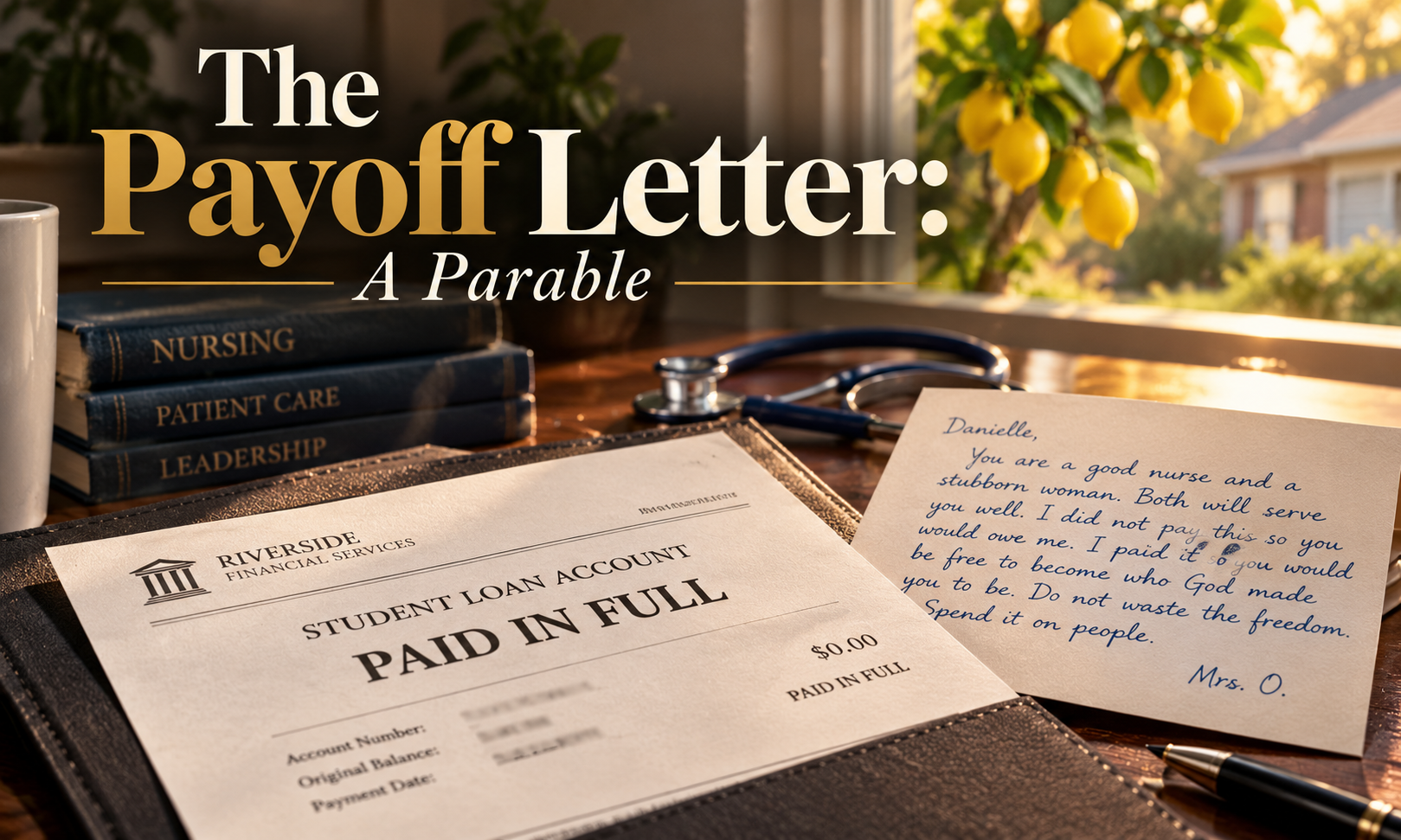
The Payoff Letter
Danielle Brooks was thirty-four, and she was proud of one thing above almost everything else: nobody had ever handed her anything.
She had worked two jobs through community college, finished a nursing degree at night and paid her own way ever since. She owned a small house on Fairview Avenue with a lemon tree in the back. When people at church talked about God providing, she nodded politely and privately thought about her overtime.
So when a letter arrived from a law office downtown, she assumed it was a mistake.
The lawyer was an older man named Mr. Pruitt. He slid a folder across the desk.
"Do you remember Mrs. Okafor?" he asked.
Danielle did. Mrs. Okafor had been the charge nurse on her first unit, a tall woman with reading glasses on a beaded chain who had made Danielle redo every chart until it was perfect. She had retired years ago. Danielle had heard in the spring that she had died.
"She asked me to give you this," Mr. Pruitt said. "She was very specific that you not receive it until after the funeral."
Inside the folder was a single sheet of paper. It was a payoff letter from Danielle's old student loan servicer, dated nine years earlier. The balance, every dollar of it, had been paid in full by a third party.
Danielle stared at it. "I paid those loans."
"You made payments for about eight months," Mr. Pruitt said gently. "Then the balance was cleared. The servicer would have sent you a notice. You may have thought it was your final payment."
She remembered the notice. She had taken herself out to dinner and told the waiter she had just paid off her student loans by herself.
She drove home and sat in her driveway for a long time. Nine years. Nine years of saying she had built everything on her own. The house on Fairview had been possible because there was no loan payment. The savings account she was so proud of had grown in the space Mrs. Okafor had cleared. Even her free evenings had been bought by someone else.
There was a second page in the folder she had not noticed. It was a short note in blue ink.
Danielle, you are a good nurse and a stubborn woman. Both will serve you well. I did not pay this so you would owe me. I paid it so you would be free to become who God made you to be. Do not waste the freedom. Spend it on people. Mrs. O.
That night she walked through her house slowly, as if she were a guest in it.
The kitchen table. The lemon tree. The car in the driveway. The calendar on the refrigerator, packed with overtime she had signed up for because she was afraid of ever needing anyone. She had thought it was all hers because she had paid for it. Now she knew that someone else had paid first.
She had expected to feel smaller. Instead she felt lighter. The house did not feel less like home. It felt more like a gift.
Over the next year a few things changed.
Danielle dropped two of her overtime shifts a month. On one of those evenings she started tutoring nursing students at the community college, the same building where she had taken night classes. On the other she went to bed early, because she had finally admitted she had been running her body like a machine she could replace.
She opened a small account at her bank and named it Mrs. O. Each month she put into it what her old loan payment would have been. When a student she tutored was about to drop out over a tuition bill, Danielle paid it quietly and asked the financial aid office not to tell the student who had paid.
On the anniversary of the meeting, she went back to Mr. Pruitt's office with a folder of her own.
"I'd like to set something up," she said. "When I'm gone, whatever is in this account goes to students. And I want a note to go with every check."
Mr. Pruitt smiled. "What should the note say?"
Danielle thought about the blue ink and the beaded chain and the charts she had redone a dozen times.
"It should say that somebody paid for them before they ever knew it," she said. "And that they are free now. So they should spend it on people."
Go Deeper
Ready to put this teaching into practice? You Are Not Your Own is a free guided workbook drawn from Psalm 24 and 1 Corinthians 6. Work through four movements at your own pace and finish with one page you build for yourself: Your Ownership Statement.
Before you can steward your time, your money or your gifts, you have to settle one question: whose life is it? Psalm 24 and 1 Corinthians 6 answer it plainly. The earth is the Lord's, you are not your own, and you were bought at a price. Start here.
Start Here: The Question Under Every Other Question
Most conversations about stewardship start too far downstream. We talk about budgets, calendars, habits and giving percentages. Those matter. But underneath them sits a question most of us never ask out loud: whose life is it?
If the answer is mine, then my time is mine to spend, my money is mine to keep, my body is mine to use, and God is a helpful adviser I consult when I choose. If the answer is His, then everything changes. I become a manager instead of an owner. My calendar, my bank account and my body become things I hold in trust and will one day give account for.
That is what this whole series is about. Stewardship is not a fundraising word. It is the shape of a life lived by someone who knows he is not the owner. On this site we look at that life in three places. The stewardship of life covers your body, your calling and your days as a whole. The stewardship of time covers your hours, your rest and your discipline. The stewardship of resources covers your money, your possessions and your work. Every post comes back to the same root, and this is it.
Two Texts, One Answer
Two passages, written a thousand years apart, give the same answer from two directions.
Psalm 24 answers from creation. David looks at the whole world and says it all belongs to God because God made it. Nothing on the map is unclaimed.
1 Corinthians 6 answers from redemption. Paul looks at a church full of people who thought their bodies were their own business, and he tells them they have been purchased. Christ paid for them.
So you belong to God twice. He made you, and He bought you back. The first truth makes you a creature. The second makes you a ransomed one. Together they form the foundation everything else in this series stands on.
Lesson One: The Earth Is the Lord's
David opens the psalm with a claim so large it is easy to read past. "The earth is the Lord's, and everything in it, the world, and all who live in it; for he founded it on the seas and established it on the waters." (Psalm 24:1-2, NIV).
Notice how far the claim reaches. Not just the earth, but everything in it. Not just the world, but all who live in it. That includes the land under your house and the person reading this sentence.
The reason David gives is simple: God founded it. In the ancient world the seas stood for chaos, the untamed waters no one could control. God set the world on top of them and established it. The One who built the house owns the house.
God says the same thing in His own voice in another psalm. "for every animal of the forest is mine, and the cattle on a thousand hills." (Psalm 50:10, NIV). And a little later: "If I were hungry I would not tell you, for the world is mine, and all that is in it." (Psalm 50:12, NIV). God is not short on anything. He does not need our offerings to fill a gap. When He asks us to manage what He owns, it is an honor, not a fundraising appeal.
Paul pushes the claim further, speaking of Christ: "For in him all things were created: things in heaven and on earth, visible and invisible, whether thrones or powers or rulers or authorities; all things have been created through him and for him." (Colossians 1:16, NIV). Not for us. For Him.
This is the first brick in the foundation. You have never owned anything. You have only held things that belong to Someone else. The sooner that settles in your heart, the lighter your grip on all of it becomes.
Lesson Two: Ownership Shapes Who May Come Near
Right after declaring that God owns everything, David asks a question. "Who may ascend the mountain of the Lord? Who may stand in his holy place?" (Psalm 24:3, NIV).
The order matters. Because the earth is the Lord's, the mountain is His too, and so is the right to decide who comes near. The owner sets the terms of entry. David answers, "The one who has clean hands and a pure heart, who does not trust in an idol or swear by a false god." (Psalm 24:4, NIV).
Clean hands speak of what we do. A pure heart speaks of what we want. And the warning against trusting an idol shows what ownership confusion looks like in practice. An idol is anything we treat as if it owns us, or anything we try to own in God's place. Money becomes an idol when we trust it to secure our future. Work becomes an idol when it decides our worth.
People who believe they own their lives tend to bargain with God, offering Him a portion and keeping the rest. The worshiper in Psalm 24 climbs the hill knowing that the hill, his hands and his heart all belong to the King.
And the owner is generous to those who come on His terms. "They will receive blessing from the Lord and vindication from God their Savior." (Psalm 24:5, NIV). The blessing is not earned by ownership. It is received by people who have given ownership up.
So stewardship is not only a financial idea. It is a worship idea. The way you handle what God owns shows whether you actually believe He owns it. Clean hands with your money, a pure heart toward your possessions and no idols in your calendar are what it looks like to climb the hill as a steward instead of a squatter.
Lesson Three: Free, but Not Your Own
Corinth was a city that prized freedom, and the church there had picked up a slogan. Paul quotes it back to them twice and answers it both times. "'I have the right to do anything,' you say—but not everything is beneficial. 'I have the right to do anything'—but I will not be mastered by anything." (1 Corinthians 6:12, NIV). The first answer asks whether a freedom helps you. The second asks whether it rules you.
That is the irony of trying to own your own life. The person who insists he is free to do anything usually ends up owned by something. Appetite, money, approval or a screen takes the throne he refused to give to God. Nobody is truly unowned. The only question is who or what holds the title.
The Corinthians had another saying about food and the stomach, as if what we do with our bodies were spiritually neutral. Paul rejects it. "The body, however, is not meant for sexual immorality but for the Lord, and the Lord for the body." (1 Corinthians 6:13, NIV). The body is not a disposable shell. It is meant for the Lord, and astonishingly, the Lord is for the body.
Then he gives the reason the body matters so much. "By his power God raised the Lord from the dead, and he will raise us also." (1 Corinthians 6:14, NIV). God is not done with your body. He intends to raise it. What He plans to resurrect, He expects you to steward now.
Paul goes further still. "Do you not know that your bodies are members of Christ himself?" (1 Corinthians 6:15, NIV). A believer's body is joined to Christ. What you do with it, Christ is brought into.
Christian freedom is real, but it is not the freedom of an owner. It is the freedom of a servant who has been released from every lesser master so that he can belong fully to the one good Master. That is why the steward is the freest person in the room.
Lesson Four: A Temple Has an Occupant
Now Paul asks the question that sits at the center of this post. "Do you not know that your bodies are temples of the Holy Spirit, who is in you, whom you have received from God? You are not your own;" (1 Corinthians 6:19, NIV).
A Corinthian reader would have known exactly what a temple was. The city was full of them. A temple was not an ordinary building. It existed for the god who lived there. Nobody walked into one and rearranged it to suit himself.
Paul says your body is that kind of building. The Holy Spirit lives in you. So the question is not only what you do with your body but whose house it is. You are not the landlord. You are the place where God has chosen to dwell.
This reshapes how we think about ordinary things. Sleep, food, exercise and rest are the upkeep of a house God lives in. Purity is not a list of rules imposed from outside. It is the refusal to bring into God's house what does not belong there. Even your schedule falls under this. A body that is run into the ground year after year by overwork is a temple being treated like a rental car.
Then come the four words that end every argument for self-ownership: you are not your own. Paul does not soften it. He does not say you are mostly your own, or your own on weekends. You are not your own.
For some people that sentence feels like a loss. In practice it is a relief. You do not have to be your own maker, provider, savior and judge. Someone else holds the title, and He lives with you.
Lesson Five: Bought at a Price
Paul finishes the thought with the reason we are not our own. "you were bought at a price. Therefore honor God with your bodies." (1 Corinthians 6:20, NIV).
Psalm 24 says God owns us because He made us. Paul adds a second, more personal claim. God owns us because He bought us. In Paul's day that language called to mind the marketplace, where a purchased servant belonged to the one who paid for him. Christ has paid for you.
Peter tells us what the price was. "For you know that it was not with perishable things such as silver or gold that you were redeemed from the empty way of life handed down to you from your ancestors, but with the precious blood of Christ, a lamb without blemish or defect." (1 Peter 1:18-19, NIV).
Notice what we were bought out of: an empty way of life. Then notice what we were bought with. Not silver or gold, which perish, but the precious blood of Christ. The price tells you the value. If He gave His Son for you, then your life is worth far more than you think, and it is His in a way no paycheck could ever buy back.
Paul draws one more conclusion in the next chapter. "You were bought at a price; do not become slaves of human beings." (1 Corinthians 7:23, NIV). Belonging to Christ frees you from belonging to anyone else. Your boss, your critics, your creditors and the opinions of others do not hold your title. Christ does.
The word therefore is where stewardship begins. Therefore honor God with your bodies. Because you were bought, you live differently. Not to pay back a debt, but because a ransomed person wants to honor the One who ransomed him. Every lesson in this series, on time, money, work, rest and family, is simply that therefore worked out in another part of life.
For Business Leaders: You Manage, He Owns
Every business owner signs papers that say he owns things: shares, equipment, property, accounts. But Psalm 24 sits above every deed. The earth is the Lord's, and that includes the company with your name on the door.
When a leader starts to see the business as God's and himself as the manager, decisions shift. Profit becomes something to steward, not just accumulate. Employees become people entrusted to your care, not just costs on a sheet. Even your own ability to build is a gift.
"But remember the Lord your God, for it is he who gives you the ability to produce wealth, and so confirms his covenant, which he swore to your ancestors, as it is today." (Deuteronomy 8:18, NIV).
Your Obedience Step
Write a one-sentence ownership statement for your business, beginning with the words "This company belongs to God, and I manage it for Him by..." Put it where you will see it during your next planning meeting, and let it shape one decision this month.
For Community Leaders: A People Who Belong
Leaders of churches, ministries and civic groups can quietly start to treat the people they serve as theirs. My church. My volunteers. My program. The heart behind that language can drift toward ownership.
Peter reminds us whose people they really are. They are God's special possession, and so are you. That truth guards leaders from using people and frees them to serve people.
"But you are a chosen people, a royal priesthood, a holy nation, God's special possession, that you may declare the praises of him who called you out of darkness into his wonderful light." (1 Peter 2:9, NIV).
Your Obedience Step
At your next team gathering, replace the word my with our or His when you speak about the people and work you lead. Then pray by name for three people you serve, thanking God that they belong to Him before they belong to your organization.
For Home Leaders: Whose Household Is It?
A home is where ownership confusion is easiest to hide. The house is ours, the schedule is ours, the money is ours, and the children feel like ours too. But children are entrusted, not owned, and a household runs best when everyone in it knows who the true Head is.
Joshua drew a line for his family in front of the whole nation.
"But as for me and my household, we will serve the Lord." (Joshua 24:15, NIV).
Your Obedience Step
Gather your household this week and read Psalm 24:1 together. Then walk through your home and name out loud a few things in it, a room, a car, a calendar, and say together, "This belongs to the Lord." Ask each person to choose one way to honor God with what is in their care.
For the Everyday Believer: The Life You Now Live
You may not run a company, lead a ministry or head a household. But you have a body, a set of days and whatever resources are in your hands. Every one of them was bought at a price.
Paul describes what it looks like when a person finally accepts that his life is not his own. It is not loss. It is a new life, lived by faith in the One who gave Himself for you.
"I have been crucified with Christ and I no longer live, but Christ lives in me. The life I now live in the body, I live by faith in the Son of God, who loved me and gave himself for me." (Galatians 2:20, NIV).
Your Obedience Step
Take an honest look at the three areas of stewardship: your life, your time and your resources. Ask which one you still treat as most fully your own. Write it down, and pray each morning this week, "This is not mine. You bought it. Show me how to honor you with it today."
Lift Up Your Heads
Psalm 24 does not end with a lecture about ownership. It ends with a procession. "Lift up your heads, you gates; be lifted up, you ancient doors, that the King of glory may come in." (Psalm 24:7, NIV).
The Owner is coming through the gates, and the psalm closes by naming Him. "Who is he, this King of glory? The Lord Almighty— he is the King of glory." (Psalm 24:10, NIV). The question is whether we will open the gates gladly. Many believers welcome God into Sunday mornings but keep the bank account, the calendar and the body behind a locked door.
Stewardship begins when you lift up the gates of every room. The earth is the Lord's. You are not your own. You were bought at a price. Those three sentences are the start of everything that follows in this series. Settle them, and you are ready to learn how to manage your days, your money and your gifts for the One who owns them.
Questions for Reflection
- If someone looked only at how I spend my time and money, whose life would they say it is?
- Which possession, relationship or achievement do I find hardest to call the Lord's?
- Where am I claiming freedom while actually being mastered by something?
- How would I care for my body differently if I truly believed it is a temple where God lives?
- What does the price Christ paid for me say about my worth and about my purpose?
Closing Prayer
Lord, the earth is yours and everything in it, and that includes me. You made me, and you bought me back with the precious blood of your Son. Forgive me for living as if my life were my own, for holding my time, my money and my body with a closed hand. Thank you that I am not my own, that I do not have to be my own provider, savior or judge. Give me clean hands and a pure heart. Break the hold of every lesser master in my life. Teach me to honor you with my body, to spend my days for you and to manage everything you have placed in my care as yours. I lift up the gates of my heart. Come in, King of glory, and take your place in every room. In Jesus' name, Amen.
The Payoff Letter
Danielle Brooks was thirty-four, and she was proud of one thing above almost everything else: nobody had ever handed her anything.
She had worked two jobs through community college, finished a nursing degree at night and paid her own way ever since. She owned a small house on Fairview Avenue with a lemon tree in the back. When people at church talked about God providing, she nodded politely and privately thought about her overtime.
So when a letter arrived from a law office downtown, she assumed it was a mistake.
The lawyer was an older man named Mr. Pruitt. He slid a folder across the desk.
"Do you remember Mrs. Okafor?" he asked.
Danielle did. Mrs. Okafor had been the charge nurse on her first unit, a tall woman with reading glasses on a beaded chain who had made Danielle redo every chart until it was perfect. She had retired years ago. Danielle had heard in the spring that she had died.
"She asked me to give you this," Mr. Pruitt said. "She was very specific that you not receive it until after the funeral."
Inside the folder was a single sheet of paper. It was a payoff letter from Danielle's old student loan servicer, dated nine years earlier. The balance, every dollar of it, had been paid in full by a third party.
Danielle stared at it. "I paid those loans."
"You made payments for about eight months," Mr. Pruitt said gently. "Then the balance was cleared. The servicer would have sent you a notice. You may have thought it was your final payment."
She remembered the notice. She had taken herself out to dinner and told the waiter she had just paid off her student loans by herself.
She drove home and sat in her driveway for a long time. Nine years. Nine years of saying she had built everything on her own. The house on Fairview had been possible because there was no loan payment. The savings account she was so proud of had grown in the space Mrs. Okafor had cleared. Even her free evenings had been bought by someone else.
There was a second page in the folder she had not noticed. It was a short note in blue ink.
Danielle, you are a good nurse and a stubborn woman. Both will serve you well. I did not pay this so you would owe me. I paid it so you would be free to become who God made you to be. Do not waste the freedom. Spend it on people. Mrs. O.
That night she walked through her house slowly, as if she were a guest in it.
The kitchen table. The lemon tree. The car in the driveway. The calendar on the refrigerator, packed with overtime she had signed up for because she was afraid of ever needing anyone. She had thought it was all hers because she had paid for it. Now she knew that someone else had paid first.
She had expected to feel smaller. Instead she felt lighter. The house did not feel less like home. It felt more like a gift.
Over the next year a few things changed.
Danielle dropped two of her overtime shifts a month. On one of those evenings she started tutoring nursing students at the community college, the same building where she had taken night classes. On the other she went to bed early, because she had finally admitted she had been running her body like a machine she could replace.
She opened a small account at her bank and named it Mrs. O. Each month she put into it what her old loan payment would have been. When a student she tutored was about to drop out over a tuition bill, Danielle paid it quietly and asked the financial aid office not to tell the student who had paid.
On the anniversary of the meeting, she went back to Mr. Pruitt's office with a folder of her own.
"I'd like to set something up," she said. "When I'm gone, whatever is in this account goes to students. And I want a note to go with every check."
Mr. Pruitt smiled. "What should the note say?"
Danielle thought about the blue ink and the beaded chain and the charts she had redone a dozen times.
"It should say that somebody paid for them before they ever knew it," she said. "And that they are free now. So they should spend it on people."
Go Deeper
Ready to put this teaching into practice? You Are Not Your Own is a free guided workbook drawn from Psalm 24 and 1 Corinthians 6. Work through four movements at your own pace and finish with one page you build for yourself: Your Ownership Statement.
Comments
Keep it kind and on topic. See something that doesn't belong? Tap Report under it and we'll review it.