
Stewardship of Resources
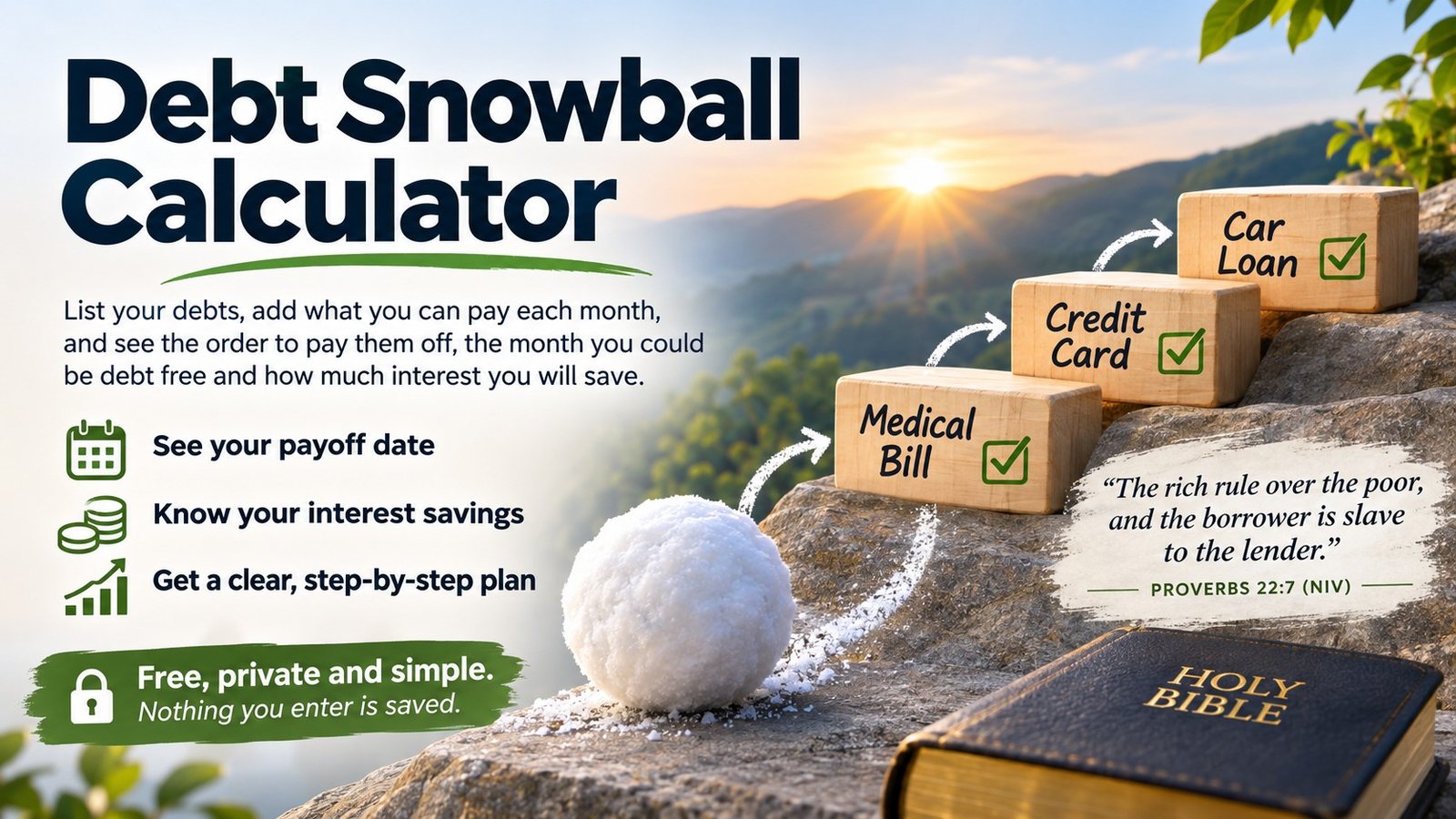
Debt Snowball Calculator
Free, private and simple. Nothing you enter is saved.
List your debts, add what you can pay each month, and see the order to pay them off, the month you could be debt free and how much interest you will save.
Your Debts
Enter each debt. Use the minimum payment from your latest statement. Interest rate is the yearly rate (APR).
Money above your minimums that you can put toward debt every month.
Your Plan
Debt free
Dec 2028
in 2 years, 1 month
Total interest
$1,208
on $13,200 owed
Monthly payment
$585
stays the same until you are free
Compared with paying only the minimums, this plan gets you out 2 years, 5 months sooner and saves $1,494 in interest.
The avalanche method would finish in 2 years, 1 month with $1,084 in interest ($124 less).
Payoff Order
| # | Debt | Balance | Rate | Paid off |
|---|---|---|---|---|
| 1 | Medical bill | $900 | 0% | Mar 2027 (month 4) |
| 2 | Credit card | $2,500 | 22.9% | Nov 2027 (month 12) |
| 3 | Car loan | $9,800 | 6.5% | Dec 2028 (month 25) |
Estimates assume fixed rates, no new charges and payments made on time each month. Nothing you enter is saved or sent anywhere.
How the Debt Snowball Works
The debt snowball pays off your debts from the smallest balance to the largest, no matter the interest rate.
- List every debt from the smallest balance to the largest.
- Pay the minimum on everything so every account stays current.
- Put every extra dollar on the smallest debt until it is gone.
- Roll that payment into the next debt. When one is paid off, add its whole payment to the next smallest. The payment grows like a snowball rolling downhill.
- Repeat until you are free. Your total monthly payment never goes down. It just keeps moving to the next target.
The strength of the snowball is momentum. Early wins keep you going, and for many people staying motivated matters more than squeezing out the last dollar of interest.
Snowball or Avalanche?
The debt avalanche pays the highest interest rate first instead of the smallest balance. It usually costs less in interest. The snowball usually gives you your first win sooner.
The calculator shows both. If the difference is small, choose the one you will actually stick with. If the avalanche saves a lot, it may be worth the slower start. The best plan is the one you keep.
What the Bible Says About Debt
"The rich rule over the poor, and the borrower is slave to the lender." (Proverbs 22:7, NIV)
Scripture does not call all borrowing sin, but it is honest about what debt does. It hands part of your future to someone else. Read more in Proverbs 22:7 Meaning.
"Let no debt remain outstanding, except the continuing debt to love one another, for whoever loves others has fulfilled the law." (Romans 13:8, NIV)
Getting out of debt is not only about numbers. It is about freedom: freedom to give, to rest and to say yes when God calls. Small, steady faithfulness is how it happens:
"Dishonest money dwindles away, but whoever gathers money little by little makes it grow." (Proverbs 13:11, NIV)
For the full picture, read the guide to biblical financial stewardship and these Bible verses about money.
Common Questions
What is the debt snowball method? The debt snowball is a way to pay off debt by paying the minimum on every debt and putting all extra money toward the smallest balance first. When that debt is gone, its payment rolls into the next smallest, so the payment grows as each debt is paid off.
Should I include my mortgage? Most people leave the mortgage out and use the snowball for everything else: credit cards, car loans, student loans, medical bills and personal loans. You can add it if you want to see the full picture.
Should I keep giving while I pay off debt? Many Christian financial teachers encourage giving something even while paying down debt, so generosity becomes a habit rather than a someday plan. The right amount depends on your situation.
Is my information saved? No. The calculator runs entirely in your browser. Nothing you type is stored or sent anywhere.
Go Deeper
- Know the Condition of Your Flocks: Proverbs 21, 22 and 27 on margin, debt and paying attention
- Don't Ask for Just a Few: 2 Kings 4 and the widow's oil on debt, help and provision
- Bible Verses About Contentment: the antidote to always wanting more
- All Stewardship of Resources articles
This calculator gives estimates for planning and shares biblical principles, not personal financial advice. For decisions about debt, investing or taxes, talk with a qualified advisor.
Weighing a hard money decision? The Steward Leader app gives you biblical counsel for your exact situation, with NIV Scripture and next steps. Start your free trial.