
Stewardship of Time and Discipline · Stewardship Faith-Spiritual Growth
Later On: Hebrews 12 on the Father's Discipline, Present Pain and the Harvest It Produces
Qunetin Robinson

No discipline seems pleasant at the time, but God does not waste the hard season. Here is what Hebrews 12 teaches about the Father's discipline, the pain we feel now and the harvest of righteousness and peace that comes later on.
The Season That Will Not Lift
The people who first heard the letter to the Hebrews were tired. Years earlier they had stood firm under insult and loss. Some had been thrown in prison, and others had watched their property taken (Hebrews 10:32-34). They had held on. But the pressure did not lift, and some were starting to wonder whether following Jesus was worth the cost.
The writer does not promise the hardship will end next month. He does something better. He gives it a name, discipline, and he tells them who is behind it.
The Question Under the Hardship
Most of us have a season we would not have chosen. A business that will not turn. A child who will not come home. A body that does not heal, or a long stretch where prayer feels like talking to the ceiling. In those seasons the loudest question is usually why.
Hebrews 12 does not answer every why. It answers a deeper question: what is God doing with me while this is happening? Its answer is that a Father is at work, and that He is growing something in you that you cannot see yet. The pain is real and it is now. The fruit is real, and it is later on. A steward of time learns to live faithfully in the space between the two.
Lesson One: Discipline Is Family Language
The writer starts by reminding his readers of words they should have known by heart. "And have you completely forgotten this word of encouragement that addresses you as a father addresses his son? It says, 'My son, do not make light of the Lord's discipline, and do not lose heart when he rebukes you, because the Lord disciplines the one he loves, and he chastens everyone he accepts as his son.'" (Hebrews 12:5-6, NIV).
He is quoting Proverbs 3:11-12, and he calls it a word of encouragement. Most of us do not hear discipline as good news. But in this passage discipline is family language. It is what a father does for a child he loves and intends to raise.
Then comes the line that turns the whole question around. "Endure hardship as discipline; God is treating you as his children. For what children are not disciplined by their father?" (Hebrews 12:7, NIV).
Hardship had made these believers wonder whether God had forgotten them. The writer says the opposite is true. The very fact that God is training you is evidence that you belong to Him. A man does not correct the children playing in his neighbor's yard. He corrects his own.
The writer presses the point even harder. "If you are not disciplined—and everyone undergoes discipline—then you are not legitimate, not true sons and daughters at all." (Hebrews 12:8, NIV). The absence of discipline would be the frightening thing, because it would mean God had let you go your own way.
This does not mean God delights in our pain. It means no hardship falls outside His fatherly care. You are not an orphan in this season. You are a son or a daughter being raised.
Lesson Two: Two Ways to Waste a Hard Season
Look again at the two warnings in that old proverb. Do not make light of the Lord's discipline. Do not lose heart when He rebukes you. These are two opposite ditches on either side of the same road, and most of us know which one we tend to fall into.
Making light of it is the shrug. We treat the hard season as bad luck, a rough patch to wait out. We grit our teeth and refuse to ask what God might be saying. The season ends, and we are unchanged. All the pain, and none of the training.
Losing heart is the collapse. The hardship swallows us. We decide God is against us, or that nothing good can come from this. We stop praying and stop showing up. Here too the season is wasted, not because we ignored it but because we despaired in it.
The writer has already named both dangers. A few verses earlier he urges the readers to consider Jesus so that they will not grow weary and lose heart. He then puts their suffering in perspective. "In your struggle against sin, you have not yet resisted to the point of shedding your blood." (Hebrews 12:4, NIV). That is not a scolding. It is a reminder that their story is not over, and that Someone else has gone further down this road than they have.
Between the shrug and the collapse there is a third way. Take the hardship seriously enough to listen, and trust the Father enough not to give up. That is what it means to receive discipline well. You do not pretend it does not hurt, and you do not decide the hurt has the final word.
Lesson Three: For Our Good, Not His Mood
Next the writer compares two kinds of fathers. "Moreover, we have all had human fathers who disciplined us and we respected them for it. How much more should we submit to the Father of spirits and live!" (Hebrews 12:9, NIV).
Some readers will feel a catch in their throat at that verse. Not everyone had a father worth respecting. Some fathers were absent, some were harsh, and some disciplined out of anger rather than love. The writer is honest about the limits of even the good ones. "They disciplined us for a little while as they thought best; but God disciplines us for our good, in order that we may share in his holiness." (Hebrews 12:10, NIV).
Look at the contrast. Human fathers disciplined for a little while, and then we grew up and left. They did it as they thought best, which means they sometimes got it wrong. Even the best of them could not always see what we needed.
God has none of those limits. He is never tired or mistaken, and He does not discipline to vent His frustration or to make His own life easier. He disciplines for our good. And the good He has in mind is not merely that we behave better. It is that we share in His holiness. He is making us like Himself.
That changes how we read a hard season. If God's goal were our comfort, the hardship would mean He had failed. Because His goal is our holiness, the hardship can be part of His success. A steward who knows this stops asking only how to get out of the season. He begins to ask what kind of person God is shaping in it.
And notice the little word live. Submit to the Father of spirits and live. Discipline from God is not a slow death. It is the way into real life.
Lesson Four: Painful Is Allowed
Now we come to the verse at the center of this whole passage. "No discipline seems pleasant at the time, but painful. Later on, however, it produces a harvest of righteousness and peace for those who have been trained by it." (Hebrews 12:11, NIV).
Start with the first half, because many of us rush past it. No discipline seems pleasant at the time. The Bible does not ask you to pretend. It does not tell you to smile through a diagnosis or to call a layoff a blessing before you have even told your family. It simply says that discipline hurts. Painful is the honest word, and God put it in His own book.
That matters, because many believers think that if their faith were strong, they would not feel the pain so much. So they hide it and add shame to sorrow.
Hebrews 12:11 lifts that weight. The pain of discipline is not a sign that you are doing it wrong. It is a sign that it is discipline. If it did not hurt, it would not train anything. You are allowed to feel the season you are in.
The phrase at the time is also worth noticing. The writer is speaking about how things seem in the present moment. In the middle of the season, all we can see is the cost. Our view is close, narrow and short. God's view is long. He sees the harvest while we can only see the plowed field.
This is where stewardship of time comes in. One of the hardest disciplines of the Christian life is refusing to judge God's work by the calendar of the present moment. Today may look like loss, but today is not the whole story.
Lesson Five: Trained by It
Then comes the turn. Later on, however. The pain is real, but it is not final. Something grows out of it, and the writer calls it a harvest of righteousness and peace.
Both words are worth weighing. Righteousness is a life that is right with God and right with others, a character that has been straightened. Peace is the settled rest of a soul that is no longer at war with God or itself. Those are not small rewards. They are the very things most of us are hungry for, and they do not grow in easy soil.
But look closely at the end of the verse, because the harvest has a condition. It comes for those who have been trained by it. Not for everyone who suffers. Not automatically, just because time passes. The same hard season can leave one person gentler and wiser and another person bitter and hard. The difference is not the hardship. It is whether we let the hardship train us.
To be trained by discipline is to cooperate with it. We ask God what He is teaching. We confess what the pressure has exposed. We take the next small step of obedience even when we do not feel like it. We stay in the place He has put us instead of running from it. Over and over, we choose to receive the season rather than merely survive it.
A harvest also takes time. No farmer plants on Monday and eats on Tuesday. Between seed and fruit there are long weeks when nothing seems to happen above the ground. Patience and trust grow like that. You may not see the change for months, but you will see it later on.
This is good news for anyone in a long season. You do not have to produce the harvest. God does. Your part is to stay in the field and keep being trained.
Lesson Six: Strengthen the Knees, Level the Path
The passage does not end with private reflection. It ends with a call to action. "Therefore, strengthen your feeble arms and weak knees." (Hebrews 12:12, NIV).
That is a picture of a tired body. Arms hanging down, knees ready to give out. The writer does not deny that his readers feel this way. He tells them to brace up anyway, because the God who disciplines them is for them. The therefore matters. Because God is a Father, because the pain has a purpose, because a harvest is coming, you can stand up again.
Then he widens the circle. "'Make level paths for your feet,' so that the lame may not be disabled, but rather healed." (Hebrews 12:13, NIV).
Think of a group walking a rough road together. Some of them are limping. If the strong ones take reckless shortcuts, the weak ones will fall and get hurt worse. But if the strong ones clear the stones and smooth the way, the lame can follow and even heal along the way.
Your response to discipline is never only about you. Your children, your employees, your church and your friends are watching how you walk through your hard season. If you shrug it off or collapse in it, you make the road harder for those behind you. If you receive it with honest pain and steady trust, you level a path they can walk on.
That is one of the quiet fruits of the harvest. People who have been trained by discipline become the ones others lean on. They know what the valley is like, and they know the way through. God does not only grow righteousness and peace in you for your sake. He grows it so that someone limping behind you can make it home.
For Business Leaders: Build a Culture That Welcomes Correction
Many leaders say they want honest feedback, and then make it costly to give. Over time the people around them learn to say only pleasant things, and the leader ends up surrounded by agreement and starved of truth.
A leader who has received God's discipline can lead differently. You know that correction, though painful, produces fruit. So you can invite it, thank the people who bring it and act on it in public.
"Whoever loves discipline loves knowledge, but whoever hates correction is stupid." (Proverbs 12:1, NIV).
Your Obedience Step
This month, ask two people who report to you for one honest correction each: something you do that makes their work harder. Thank them, write it down, and tell them in thirty days what you changed.
For Community Leaders: Correct Like a Father, Not a Critic
Some leaders avoid correction because they fear conflict. Others correct too sharply, and people leave wounded. Hebrews 12 offers a better pattern. God's discipline is personal, purposeful and for the other person's good. It aims at healing, not at winning.
When someone in your care needs correction, go to them in person, speak plainly, and make clear that you are for them. Then stay close long enough to help them walk the path you pointed out.
"As iron sharpens iron, so one person sharpens another." (Proverbs 27:17, NIV).
Your Obedience Step
Think of one conversation you have been avoiding with someone you lead. Pray for that person by name, then schedule the conversation this week. Before you go, write down the good you want for them, and say it to them.
For Home Leaders: Discipline for Their Good, Not Your Relief
Parents discipline as they think best, and we all get it wrong sometimes. The danger is correcting mainly to stop the noise or vent our frustration. That trains children to manage our moods, not to grow in character.
Let God's discipline be your model. Correct calmly, explain why, and keep the goal in view: a child who becomes righteous and at peace. Then let them see you receive correction too.
"Discipline your children, and they will give you peace; they will bring you the delights you desire." (Proverbs 29:17, NIV).
Your Obedience Step
The next time you need to correct a child, wait until you are calm. Name what they did, name what you want them to become, and end with a word of love. If you have corrected in anger recently, go back and apologize for the anger.
For the Everyday Believer: Do Not Quit Before the Harvest
You may be in the middle of a season that feels like it will never end. You have prayed, waited and tried, and very little seems to have changed. It is tempting to conclude that nothing is happening and to give up.
But a harvest is never visible on planting day. If God is training you, the fruit is growing even when you cannot see it. Your job today is not to produce the harvest. It is to stay in the field and keep doing the good in front of you.
"Let us not become weary in doing good, for at the proper time we will reap a harvest if we do not give up." (Galatians 6:9, NIV).
Your Obedience Step
Write down the hard season you are in. Under it, write one question: Lord, what are you training in me? Read it each morning for a week, and do one small faithful thing each day before you look for results.
The Joy Set Before Him
Just before his teaching on discipline, the writer points his readers to the faithful of Hebrews 11 and then to the One who went before them all. "Therefore, since we are surrounded by such a great cloud of witnesses, let us throw off everything that hinders and the sin that so easily entangles. And let us run with perseverance the race marked out for us, fixing our eyes on Jesus, the pioneer and perfecter of faith. For the joy set before him he endured the cross, scorning its shame, and sat down at the right hand of the throne of God." (Hebrews 12:1-2, NIV).
Jesus had no sin to be trained out of, but He knew pain at the time and joy later on better than anyone. "Consider him who endured such opposition from sinners, so that you will not grow weary and lose heart." (Hebrews 12:3, NIV).
When your season feels endless, look at Him. He is proof that the Father does not waste pain, and that later on is real.
Questions for Reflection
- What hard season am I in right now, and have I thought of it as the Father's training?
- Do I tend to make light of hardship or to lose heart in it?
- How has my experience of a human father shaped the way I picture God's discipline?
- Where am I judging God's work by how things seem at the time?
- What would it look like for me to be trained by this season instead of only enduring it?
- Who is walking behind me, and how can I level a path for them?
Closing Prayer
Father, I confess that I do not like this season. It is painful, and I have often wanted you to simply take it away. Thank you for treating me as your child and not leaving me to myself. Forgive me for the times I have shrugged off your correction, and for the times I have lost heart and assumed you were against me. Teach me what you are training in me. Give me patience to stay in the field when I cannot see the harvest yet. Strengthen my weak knees, and help me walk in a way that makes the path easier for those behind me. Make me holy, and grow in me the righteousness and peace that only you can give. I fix my eyes on Jesus, who endured the cross for the joy set before Him. In Jesus' name, Amen.
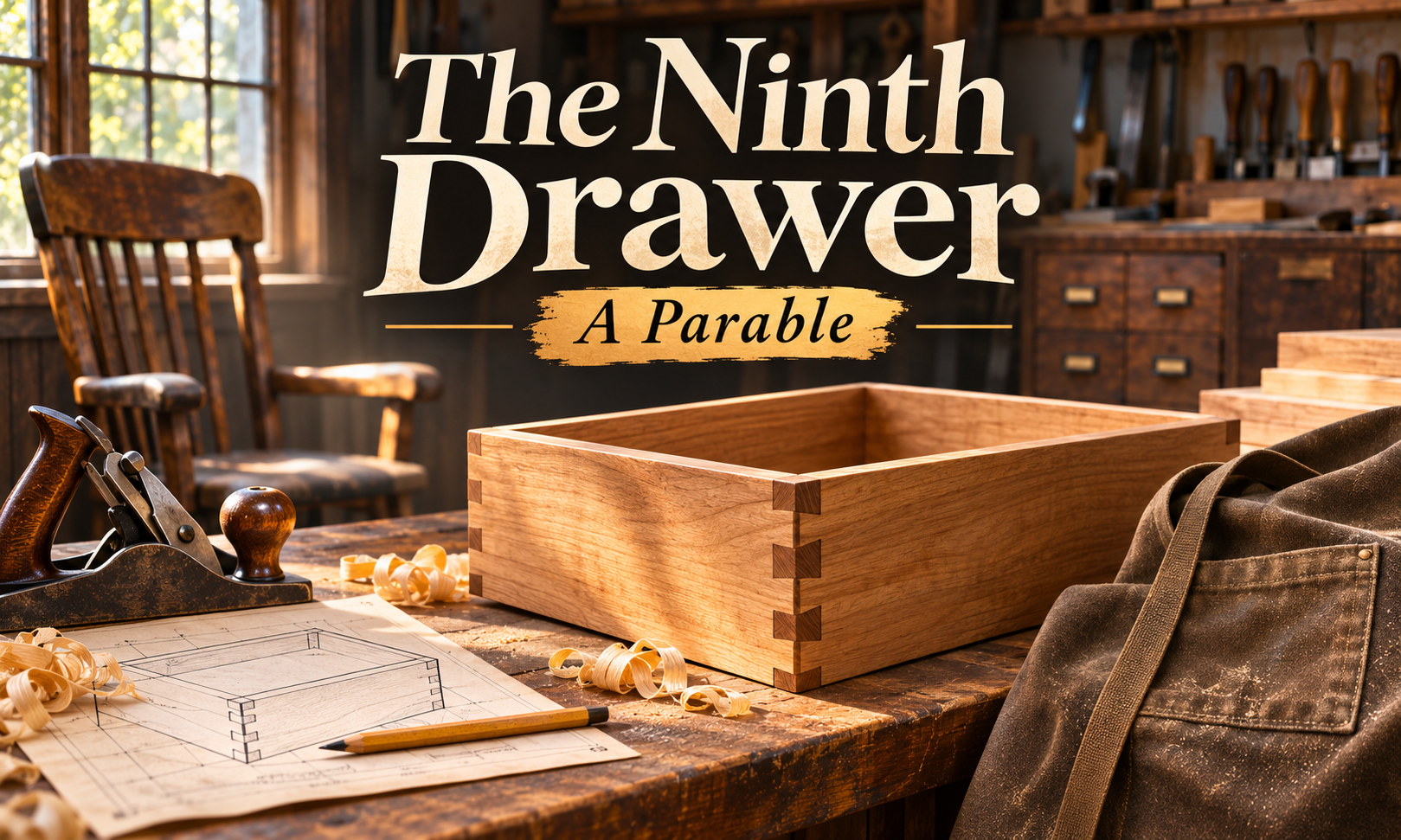
The Ninth Drawer
Ruth Baptiste had run the cabinet shop on Orchard Row for thirty-one years, ever since her father handed her the keys and moved to a chair by the front window. Her father was gone now, but the chair was still there.
Her nephew Darnell Hughes came to the shop the summer he turned nineteen, after he was let go from a warehouse job. Ruth told his mother he should be there at seven.
He was there at seven-twenty the first day. Ruth said nothing about it. She handed him an apron, showed him the bench, and gave him a drawing for a simple drawer. Four sides, a bottom and dovetails at the corners.
By the end of the week he brought her the drawer. Ruth turned it over in her hands. She ran her thumb along a joint and held it up to the light from the window. Then she set it on the bench.
"Again," she said.
"What's wrong with it?"
"The back corner is out by the thickness of a fingernail. Your dovetails have gaps. You can fill gaps with glue, but they will open up in five years."
"Nobody's going to see the back corner."
"I will," she said. "Again."
He made a second drawer. She said again. He made a third and a fourth. On the fifth he set it down hard on the bench and walked out the back door, and she let him go. When he came back in an hour later, she had swept up his shavings and laid out fresh boards.
"You think I'm trying to make you quit," she said.
"Aren't you?"
"If I wanted you to quit, I'd tell you the drawers were fine."
That stopped him.
On the sixth drawer she sat beside him and showed him how she held the saw. He started arriving at a quarter to seven. He stopped asking whether anyone would see the back corner. On the eighth she was quiet for a long time, and then she said again, but softer.
The ninth drawer took him nine days. When he brought it to her, his hands were sore and his jaw was tight. Ruth turned it over, ran her thumb along every corner and held it to the light. She pulled it in and out of the test frame a dozen times. It made no sound at all.
She set it down. Then she went to the cabinet behind her father's chair and came back with an old drawer, dark with age, the corners worn smooth by years of hands.
"My father made me build nine before he let me sell one," she said. "This is the ninth. I was seventeen, and I cried on the fourth. I thought he was the hardest man in the county."
Darnell looked at the drawer, then at her.
"He wasn't hard," Ruth said. "He just knew I'd be building for people who would trust me with the things they love most. He wanted my hands ready before anybody trusted them."
Two years later, a family on Orchard Row ordered a cradle for their first grandchild. Darnell built it start to finish. When they came to pick it up, the grandmother ran her hand along the rail and asked who had made it.
"He did," Ruth said, nodding toward him.
That fall a boy named Tomas Ferreira started sweeping floors at the shop on Saturdays. He watched Darnell work the way Darnell had once watched Ruth, and one afternoon he asked whether he could try a drawer.
Darnell glanced across the shop. Ruth was in her father's chair, reading glasses on her nose, pretending to look at an invoice.
Darnell handed Tomas an apron and a drawing. A week later the boy brought him a drawer with a gap in the back corner, and Darnell turned it over in his hands, ran his thumb along the joint and held it up to the light.
He saw the boy's face fall before he said a word. So he pulled a stool up to the bench, picked up a saw, and sat down beside him.
"Again," he said. "But I'll show you how I hold it."
Go Deeper
Ready to put this teaching into practice? Just as He Had Done Before is a guided workbook drawn from Daniel 1 and 6, Proverbs 6 and 24, 1 Corinthians 9 and Hebrews 12. Work through four movements at your own pace and finish with one page you build for yourself: Your Daily Rule.
No discipline seems pleasant at the time, but God does not waste the hard season. Here is what Hebrews 12 teaches about the Father's discipline, the pain we feel now and the harvest of righteousness and peace that comes later on.
The Season That Will Not Lift
The people who first heard the letter to the Hebrews were tired. Years earlier they had stood firm under insult and loss. Some had been thrown in prison, and others had watched their property taken (Hebrews 10:32-34). They had held on. But the pressure did not lift, and some were starting to wonder whether following Jesus was worth the cost.
The writer does not promise the hardship will end next month. He does something better. He gives it a name, discipline, and he tells them who is behind it.
The Question Under the Hardship
Most of us have a season we would not have chosen. A business that will not turn. A child who will not come home. A body that does not heal, or a long stretch where prayer feels like talking to the ceiling. In those seasons the loudest question is usually why.
Hebrews 12 does not answer every why. It answers a deeper question: what is God doing with me while this is happening? Its answer is that a Father is at work, and that He is growing something in you that you cannot see yet. The pain is real and it is now. The fruit is real, and it is later on. A steward of time learns to live faithfully in the space between the two.
Lesson One: Discipline Is Family Language
The writer starts by reminding his readers of words they should have known by heart. "And have you completely forgotten this word of encouragement that addresses you as a father addresses his son? It says, 'My son, do not make light of the Lord's discipline, and do not lose heart when he rebukes you, because the Lord disciplines the one he loves, and he chastens everyone he accepts as his son.'" (Hebrews 12:5-6, NIV).
He is quoting Proverbs 3:11-12, and he calls it a word of encouragement. Most of us do not hear discipline as good news. But in this passage discipline is family language. It is what a father does for a child he loves and intends to raise.
Then comes the line that turns the whole question around. "Endure hardship as discipline; God is treating you as his children. For what children are not disciplined by their father?" (Hebrews 12:7, NIV).
Hardship had made these believers wonder whether God had forgotten them. The writer says the opposite is true. The very fact that God is training you is evidence that you belong to Him. A man does not correct the children playing in his neighbor's yard. He corrects his own.
The writer presses the point even harder. "If you are not disciplined—and everyone undergoes discipline—then you are not legitimate, not true sons and daughters at all." (Hebrews 12:8, NIV). The absence of discipline would be the frightening thing, because it would mean God had let you go your own way.
This does not mean God delights in our pain. It means no hardship falls outside His fatherly care. You are not an orphan in this season. You are a son or a daughter being raised.
Lesson Two: Two Ways to Waste a Hard Season
Look again at the two warnings in that old proverb. Do not make light of the Lord's discipline. Do not lose heart when He rebukes you. These are two opposite ditches on either side of the same road, and most of us know which one we tend to fall into.
Making light of it is the shrug. We treat the hard season as bad luck, a rough patch to wait out. We grit our teeth and refuse to ask what God might be saying. The season ends, and we are unchanged. All the pain, and none of the training.
Losing heart is the collapse. The hardship swallows us. We decide God is against us, or that nothing good can come from this. We stop praying and stop showing up. Here too the season is wasted, not because we ignored it but because we despaired in it.
The writer has already named both dangers. A few verses earlier he urges the readers to consider Jesus so that they will not grow weary and lose heart. He then puts their suffering in perspective. "In your struggle against sin, you have not yet resisted to the point of shedding your blood." (Hebrews 12:4, NIV). That is not a scolding. It is a reminder that their story is not over, and that Someone else has gone further down this road than they have.
Between the shrug and the collapse there is a third way. Take the hardship seriously enough to listen, and trust the Father enough not to give up. That is what it means to receive discipline well. You do not pretend it does not hurt, and you do not decide the hurt has the final word.
Lesson Three: For Our Good, Not His Mood
Next the writer compares two kinds of fathers. "Moreover, we have all had human fathers who disciplined us and we respected them for it. How much more should we submit to the Father of spirits and live!" (Hebrews 12:9, NIV).
Some readers will feel a catch in their throat at that verse. Not everyone had a father worth respecting. Some fathers were absent, some were harsh, and some disciplined out of anger rather than love. The writer is honest about the limits of even the good ones. "They disciplined us for a little while as they thought best; but God disciplines us for our good, in order that we may share in his holiness." (Hebrews 12:10, NIV).
Look at the contrast. Human fathers disciplined for a little while, and then we grew up and left. They did it as they thought best, which means they sometimes got it wrong. Even the best of them could not always see what we needed.
God has none of those limits. He is never tired or mistaken, and He does not discipline to vent His frustration or to make His own life easier. He disciplines for our good. And the good He has in mind is not merely that we behave better. It is that we share in His holiness. He is making us like Himself.
That changes how we read a hard season. If God's goal were our comfort, the hardship would mean He had failed. Because His goal is our holiness, the hardship can be part of His success. A steward who knows this stops asking only how to get out of the season. He begins to ask what kind of person God is shaping in it.
And notice the little word live. Submit to the Father of spirits and live. Discipline from God is not a slow death. It is the way into real life.
Lesson Four: Painful Is Allowed
Now we come to the verse at the center of this whole passage. "No discipline seems pleasant at the time, but painful. Later on, however, it produces a harvest of righteousness and peace for those who have been trained by it." (Hebrews 12:11, NIV).
Start with the first half, because many of us rush past it. No discipline seems pleasant at the time. The Bible does not ask you to pretend. It does not tell you to smile through a diagnosis or to call a layoff a blessing before you have even told your family. It simply says that discipline hurts. Painful is the honest word, and God put it in His own book.
That matters, because many believers think that if their faith were strong, they would not feel the pain so much. So they hide it and add shame to sorrow.
Hebrews 12:11 lifts that weight. The pain of discipline is not a sign that you are doing it wrong. It is a sign that it is discipline. If it did not hurt, it would not train anything. You are allowed to feel the season you are in.
The phrase at the time is also worth noticing. The writer is speaking about how things seem in the present moment. In the middle of the season, all we can see is the cost. Our view is close, narrow and short. God's view is long. He sees the harvest while we can only see the plowed field.
This is where stewardship of time comes in. One of the hardest disciplines of the Christian life is refusing to judge God's work by the calendar of the present moment. Today may look like loss, but today is not the whole story.
Lesson Five: Trained by It
Then comes the turn. Later on, however. The pain is real, but it is not final. Something grows out of it, and the writer calls it a harvest of righteousness and peace.
Both words are worth weighing. Righteousness is a life that is right with God and right with others, a character that has been straightened. Peace is the settled rest of a soul that is no longer at war with God or itself. Those are not small rewards. They are the very things most of us are hungry for, and they do not grow in easy soil.
But look closely at the end of the verse, because the harvest has a condition. It comes for those who have been trained by it. Not for everyone who suffers. Not automatically, just because time passes. The same hard season can leave one person gentler and wiser and another person bitter and hard. The difference is not the hardship. It is whether we let the hardship train us.
To be trained by discipline is to cooperate with it. We ask God what He is teaching. We confess what the pressure has exposed. We take the next small step of obedience even when we do not feel like it. We stay in the place He has put us instead of running from it. Over and over, we choose to receive the season rather than merely survive it.
A harvest also takes time. No farmer plants on Monday and eats on Tuesday. Between seed and fruit there are long weeks when nothing seems to happen above the ground. Patience and trust grow like that. You may not see the change for months, but you will see it later on.
This is good news for anyone in a long season. You do not have to produce the harvest. God does. Your part is to stay in the field and keep being trained.
Lesson Six: Strengthen the Knees, Level the Path
The passage does not end with private reflection. It ends with a call to action. "Therefore, strengthen your feeble arms and weak knees." (Hebrews 12:12, NIV).
That is a picture of a tired body. Arms hanging down, knees ready to give out. The writer does not deny that his readers feel this way. He tells them to brace up anyway, because the God who disciplines them is for them. The therefore matters. Because God is a Father, because the pain has a purpose, because a harvest is coming, you can stand up again.
Then he widens the circle. "'Make level paths for your feet,' so that the lame may not be disabled, but rather healed." (Hebrews 12:13, NIV).
Think of a group walking a rough road together. Some of them are limping. If the strong ones take reckless shortcuts, the weak ones will fall and get hurt worse. But if the strong ones clear the stones and smooth the way, the lame can follow and even heal along the way.
Your response to discipline is never only about you. Your children, your employees, your church and your friends are watching how you walk through your hard season. If you shrug it off or collapse in it, you make the road harder for those behind you. If you receive it with honest pain and steady trust, you level a path they can walk on.
That is one of the quiet fruits of the harvest. People who have been trained by discipline become the ones others lean on. They know what the valley is like, and they know the way through. God does not only grow righteousness and peace in you for your sake. He grows it so that someone limping behind you can make it home.
For Business Leaders: Build a Culture That Welcomes Correction
Many leaders say they want honest feedback, and then make it costly to give. Over time the people around them learn to say only pleasant things, and the leader ends up surrounded by agreement and starved of truth.
A leader who has received God's discipline can lead differently. You know that correction, though painful, produces fruit. So you can invite it, thank the people who bring it and act on it in public.
"Whoever loves discipline loves knowledge, but whoever hates correction is stupid." (Proverbs 12:1, NIV).
Your Obedience Step
This month, ask two people who report to you for one honest correction each: something you do that makes their work harder. Thank them, write it down, and tell them in thirty days what you changed.
For Community Leaders: Correct Like a Father, Not a Critic
Some leaders avoid correction because they fear conflict. Others correct too sharply, and people leave wounded. Hebrews 12 offers a better pattern. God's discipline is personal, purposeful and for the other person's good. It aims at healing, not at winning.
When someone in your care needs correction, go to them in person, speak plainly, and make clear that you are for them. Then stay close long enough to help them walk the path you pointed out.
"As iron sharpens iron, so one person sharpens another." (Proverbs 27:17, NIV).
Your Obedience Step
Think of one conversation you have been avoiding with someone you lead. Pray for that person by name, then schedule the conversation this week. Before you go, write down the good you want for them, and say it to them.
For Home Leaders: Discipline for Their Good, Not Your Relief
Parents discipline as they think best, and we all get it wrong sometimes. The danger is correcting mainly to stop the noise or vent our frustration. That trains children to manage our moods, not to grow in character.
Let God's discipline be your model. Correct calmly, explain why, and keep the goal in view: a child who becomes righteous and at peace. Then let them see you receive correction too.
"Discipline your children, and they will give you peace; they will bring you the delights you desire." (Proverbs 29:17, NIV).
Your Obedience Step
The next time you need to correct a child, wait until you are calm. Name what they did, name what you want them to become, and end with a word of love. If you have corrected in anger recently, go back and apologize for the anger.
For the Everyday Believer: Do Not Quit Before the Harvest
You may be in the middle of a season that feels like it will never end. You have prayed, waited and tried, and very little seems to have changed. It is tempting to conclude that nothing is happening and to give up.
But a harvest is never visible on planting day. If God is training you, the fruit is growing even when you cannot see it. Your job today is not to produce the harvest. It is to stay in the field and keep doing the good in front of you.
"Let us not become weary in doing good, for at the proper time we will reap a harvest if we do not give up." (Galatians 6:9, NIV).
Your Obedience Step
Write down the hard season you are in. Under it, write one question: Lord, what are you training in me? Read it each morning for a week, and do one small faithful thing each day before you look for results.
The Joy Set Before Him
Just before his teaching on discipline, the writer points his readers to the faithful of Hebrews 11 and then to the One who went before them all. "Therefore, since we are surrounded by such a great cloud of witnesses, let us throw off everything that hinders and the sin that so easily entangles. And let us run with perseverance the race marked out for us, fixing our eyes on Jesus, the pioneer and perfecter of faith. For the joy set before him he endured the cross, scorning its shame, and sat down at the right hand of the throne of God." (Hebrews 12:1-2, NIV).
Jesus had no sin to be trained out of, but He knew pain at the time and joy later on better than anyone. "Consider him who endured such opposition from sinners, so that you will not grow weary and lose heart." (Hebrews 12:3, NIV).
When your season feels endless, look at Him. He is proof that the Father does not waste pain, and that later on is real.
Questions for Reflection
- What hard season am I in right now, and have I thought of it as the Father's training?
- Do I tend to make light of hardship or to lose heart in it?
- How has my experience of a human father shaped the way I picture God's discipline?
- Where am I judging God's work by how things seem at the time?
- What would it look like for me to be trained by this season instead of only enduring it?
- Who is walking behind me, and how can I level a path for them?
Closing Prayer
Father, I confess that I do not like this season. It is painful, and I have often wanted you to simply take it away. Thank you for treating me as your child and not leaving me to myself. Forgive me for the times I have shrugged off your correction, and for the times I have lost heart and assumed you were against me. Teach me what you are training in me. Give me patience to stay in the field when I cannot see the harvest yet. Strengthen my weak knees, and help me walk in a way that makes the path easier for those behind me. Make me holy, and grow in me the righteousness and peace that only you can give. I fix my eyes on Jesus, who endured the cross for the joy set before Him. In Jesus' name, Amen.
The Ninth Drawer
Ruth Baptiste had run the cabinet shop on Orchard Row for thirty-one years, ever since her father handed her the keys and moved to a chair by the front window. Her father was gone now, but the chair was still there.
Her nephew Darnell Hughes came to the shop the summer he turned nineteen, after he was let go from a warehouse job. Ruth told his mother he should be there at seven.
He was there at seven-twenty the first day. Ruth said nothing about it. She handed him an apron, showed him the bench, and gave him a drawing for a simple drawer. Four sides, a bottom and dovetails at the corners.
By the end of the week he brought her the drawer. Ruth turned it over in her hands. She ran her thumb along a joint and held it up to the light from the window. Then she set it on the bench.
"Again," she said.
"What's wrong with it?"
"The back corner is out by the thickness of a fingernail. Your dovetails have gaps. You can fill gaps with glue, but they will open up in five years."
"Nobody's going to see the back corner."
"I will," she said. "Again."
He made a second drawer. She said again. He made a third and a fourth. On the fifth he set it down hard on the bench and walked out the back door, and she let him go. When he came back in an hour later, she had swept up his shavings and laid out fresh boards.
"You think I'm trying to make you quit," she said.
"Aren't you?"
"If I wanted you to quit, I'd tell you the drawers were fine."
That stopped him.
On the sixth drawer she sat beside him and showed him how she held the saw. He started arriving at a quarter to seven. He stopped asking whether anyone would see the back corner. On the eighth she was quiet for a long time, and then she said again, but softer.
The ninth drawer took him nine days. When he brought it to her, his hands were sore and his jaw was tight. Ruth turned it over, ran her thumb along every corner and held it to the light. She pulled it in and out of the test frame a dozen times. It made no sound at all.
She set it down. Then she went to the cabinet behind her father's chair and came back with an old drawer, dark with age, the corners worn smooth by years of hands.
"My father made me build nine before he let me sell one," she said. "This is the ninth. I was seventeen, and I cried on the fourth. I thought he was the hardest man in the county."
Darnell looked at the drawer, then at her.
"He wasn't hard," Ruth said. "He just knew I'd be building for people who would trust me with the things they love most. He wanted my hands ready before anybody trusted them."
Two years later, a family on Orchard Row ordered a cradle for their first grandchild. Darnell built it start to finish. When they came to pick it up, the grandmother ran her hand along the rail and asked who had made it.
"He did," Ruth said, nodding toward him.
That fall a boy named Tomas Ferreira started sweeping floors at the shop on Saturdays. He watched Darnell work the way Darnell had once watched Ruth, and one afternoon he asked whether he could try a drawer.
Darnell glanced across the shop. Ruth was in her father's chair, reading glasses on her nose, pretending to look at an invoice.
Darnell handed Tomas an apron and a drawing. A week later the boy brought him a drawer with a gap in the back corner, and Darnell turned it over in his hands, ran his thumb along the joint and held it up to the light.
He saw the boy's face fall before he said a word. So he pulled a stool up to the bench, picked up a saw, and sat down beside him.
"Again," he said. "But I'll show you how I hold it."
Go Deeper
Ready to put this teaching into practice? Just as He Had Done Before is a guided workbook drawn from Daniel 1 and 6, Proverbs 6 and 24, 1 Corinthians 9 and Hebrews 12. Work through four movements at your own pace and finish with one page you build for yourself: Your Daily Rule.
Comments
Keep it kind and on topic. See something that doesn't belong? Tap Report under it and we'll review it.