
Stewardship of Time and Discipline · Stewardship of Life
This or That: Ephesians 5 and James 4 on Wise Days, Held Plans and the Good You Already Know
Qunetin Robinson

Paul tells us to be very careful how we live. James tells us to stop boasting about tomorrow. Here is what Ephesians 5 and James 4 teach about wise days, plans held under God's will and the good you already know to do.
Two Letters, One Calendar
Paul and James never wrote a book on time management, but between them they gave the church most of what it needs. Paul told believers in Ephesus, a busy city of trade and temples, to watch how they walked through their days. James told scattered believers to watch how they talked about their tomorrows.
One passage is about using the days well. The other is about holding the future humbly. Put them side by side and they correct each other. Paul keeps us from drifting. James keeps us from presuming. Together they describe a steward who works hard on today and holds tomorrow with an open hand.
The Question Behind the Planner
Most of us have a planner of some kind: a paper calendar, an app, a whiteboard in the garage. Either way, it tells the truth about what we believe our days are for.
These passages do not ask whether you plan. Neither writer tells us to stop. They ask two harder questions. First, is the shape of your week wise, or is it just full? Second, when you say what you will do next year, who do you think is holding next year? A steward has to answer both. One answer without the other leaves you either busy and proud or humble and idle.
Lesson One: Look Carefully at How You Walk
Paul starts with a warning that sounds almost like a parent at the curb. "Be very careful, then, how you live—not as unwise but as wise, making the most of every opportunity, because the days are evil." (Ephesians 5:15-16, NIV).
The word then ties this to everything before it. Paul has just told these believers that they were once darkness and are now light in the Lord, and that they should find out what pleases Him (Ephesians 5:10). Careful living is not a productivity technique. It is what people do when they know they have been moved from darkness to light and do not want to wander back.
Very careful is strong language. It describes someone walking a narrow path who keeps checking where his feet are going. Most of us do not lose our days in one big decision. We lose them in small, unexamined steps. A habit that starts at nine at night and runs to midnight. A meeting that becomes a standing meeting nobody remembers why we hold. A year that slips by because no one stopped to ask whether this is how we meant to live.
Paul gives two categories, unwise and wise, and nothing in between. That should sober us. Drift is not neutral. A life that is not being walked wisely is being walked some other way.
Then Paul gives the reason: the days are evil. He is not saying time itself is bad. He is saying the age we live in pulls against God, and it will gladly take the hours we do not guard. Every opportunity is contested. Something will fill this evening. The only question is whether it will be something chosen in the light.
So the first discipline is attention. Before you can use your days well, you have to look at them. Where did last week actually go? What would a wise person see if they read your calendar?
Lesson Two: Find Out What the Lord Wants
Paul then turns from caution to clarity. "Therefore do not be foolish, but understand what the Lord's will is." (Ephesians 5:17, NIV).
Notice that Paul treats the will of God as something we can understand. He does not say guess at it, or wait for a feeling, or hope you stumble into it. Understand it. That means the Lord's will is not a hidden riddle kept from His people. Most of it is written down plainly, and the rest becomes clearer as we walk in what is plain.
Many believers lose years waiting for God to reveal the one right job, the one right city or the one right person, while ignoring the will He has already spelled out. Paul, in this very chapter, names it: walk in love, live in the light, be filled with the Spirit, give thanks, submit to one another. Romans 12:2 says that a renewed mind is able to test and approve what God's will is. Understanding grows by obedience, not by delay.
This matters for how we plan. A foolish person asks, what do I want to do with my time? A wise person asks, what does the Lord want done with the time He gave me? The first question puts me at the center of the calendar. The second puts me in the role of a manager who serves an Owner.
There is real freedom here. You do not have to know everything about next year to know what God wants from you this Tuesday. He wants you honest at work, kind at home, faithful in prayer and generous with your attention. Those are not small things. Most of a wise life is built out of them.
So before you fill the next week, open the Book and ask what the Lord has already said. Then put that on the calendar first, and let your own plans fit around it.
Lesson Three: Filled, Not Fogged
Next comes a contrast that seems to change the subject, until you see that it does not. "Do not get drunk on wine, which leads to debauchery. Instead, be filled with the Spirit, speaking to one another with psalms, hymns, and songs from the Spirit. Sing and make music from your heart to the Lord, always giving thanks to God the Father for everything, in the name of our Lord Jesus Christ." (Ephesians 5:18-20, NIV).
Why talk about wine in a passage about using time? Because drunkenness is one of the oldest ways people escape their days rather than steward them. The word debauchery carries the idea of waste, of a life poured out with nothing to show for it. In our day the escape may be wine, but it may also be endless scrolling, binge watching or work that never stops long enough to feel anything. Each one fogs the mind and lets the hours run out unnoticed.
Paul does not answer with an empty schedule. He answers with fullness. Be filled with the Spirit. The opposite of a wasted evening is not a rigid one. It is an evening under a different influence.
And look at what Spirit-filled time sounds like. People speaking to one another. Singing. Making music in the heart. Giving thanks. This is the texture of a wise week. It has room in it for other people, for worship and for gratitude. A calendar packed so tight that no one can sing or say thank you is not wise, no matter how productive it looks.
Giving thanks for everything is the hardest part. It does not mean pretending that every hard thing is good. It means that a believer can bring every part of the day, the meeting that went badly included, back to the Father in Jesus' name. Paul says the same in 1 Thessalonians 5:18. Gratitude keeps a busy person from becoming a bitter one. It turns hours into offerings.
Lesson Four: A Calendar That Makes Room for Others
Paul closes this paragraph with one short command that opens the next section of his letter. "Submit to one another out of reverence for Christ." (Ephesians 5:21, NIV).
It may not look like a verse about time, but it is. Submission is about whose needs we let shape our plans. Paul goes on to apply it to husbands and wives, parents and children, masters and servants. In every case, a believer's life is bound up with other people, and the order of his days has to account for them.
A self-centered calendar has one question: what do I need to get done? A submitted calendar asks more. Who depends on me this week? Whose plans did my plans just cancel? Did I schedule my priorities and leave my family the leftovers? Did I fill my team's days with my urgency without asking what theirs required?
Reverence for Christ is the motive. We do not yield to others because they are always right or because we are weak. We yield because Christ is Lord over all of us, and He has given us to one another. The leader who honors Christ will often find that the wisest thing to do with a free hour is to give it to someone who needs it.
This is where Ephesians begins to meet James. Both writers are confronting a person who imagines that his time is his own. Paul answers with a life lived in community and under the Spirit. James will answer with a life lived under the will of God. Either way, the steward hears the same message. Your days are not a private possession. They are entrusted to you for the Lord and for the people He has placed around you.
Lesson Five: The Plan That Forgot Who Holds Tomorrow
Now James speaks, and his tone is sharper. "Now listen, you who say, 'Today or tomorrow we will go to this or that city, spend a year there, carry on business and make money.'" (James 4:13, NIV).
Look carefully at what this person is doing. He is making a plan. He has a city, a timeline and a business goal. None of that is the sin. Scripture praises the ant for planning and the prudent for thinking ahead. The problem is what is missing. There is no God anywhere in the sentence.
James answers with a question that ends the argument. "Why, you do not even know what will happen tomorrow. What is your life? You are a mist that appears for a little while and then vanishes." (James 4:14, NIV).
The confident planner had a year mapped out. James reminds him he cannot see one day ahead. Markets turn. Health fails. A phone rings at the wrong hour. The whole plan rested on an assumption that tomorrow belonged to him.
Then James names the root. "As it is, you boast in your arrogant schemes. All such boasting is evil." (James 4:16, NIV).
That is a strong word for something many of us do at every planning meeting. But James is not condemning planning. He is condemning the boast inside it, the quiet belief that I am the one who decides how my life will go. It is possible to write a five-year plan in a spirit of total self-reliance and never notice. It is possible to talk about next year at dinner as if God were not at the table.
A steward plans with the knowledge that he is a mist. That does not make him passive. It makes him humble. He works hard on the plan, and then he hands it back to the One who actually owns the years.
Lesson Six: Say It and Mean It, Then Do the Good You Know
James does not leave us with only a rebuke. He gives us new words to say. "Instead, you ought to say, 'If it is the Lord's will, we will live and do this or that.'" (James 4:15, NIV).
Notice that the planning stays. We will live and do this or that. James expects the believer to go to the city, run the business and make the money, if that is God's will. What changes is the posture. The plan is held, not clutched. Paul spoke this way himself when he told friends he would come back if it was God's will (Acts 18:21; 1 Corinthians 16:7).
These words can become a habit that means nothing, a phrase tacked on to sound spiritual. James is not asking for a phrase. He is asking for a heart that actually expects God to have the final say, and is at peace with that. The test is simple. When the plan falls apart, do you still trust Him?
Then James adds a sentence that catches almost everyone. "If anyone, then, knows the good they ought to do and doesn't do it, it is sin for them." (James 4:17, NIV).
Here the two passages meet again. The person who boasts about tomorrow often neglects today. He is so busy with the big plan that he walks past the small good right in front of him. The call he meant to return. The neighbor he meant to visit. The apology he meant to make. He tells himself there will be time later. James reminds him that later is a mist.
This verse turns humility into action. Because you do not own tomorrow, do the good you know about today. That is what it means to make the most of every opportunity. The wise steward does not wait for a perfect plan. He obeys the good he can already see, and he trusts God with the rest.
For Business Leaders: Plan Hard, Hold Loosely
You are paid to plan. Forecasts, budgets, hiring plans and growth targets are part of faithful work, and James never tells you to stop. But you can build every one of them as if God were not in the room. Make it a habit to plan as hard as you can and then put the whole plan into His hands, out loud, with the people who will carry it out.
"Many are the plans in a person's heart, but it is the Lord's purpose that prevails." (Proverbs 19:21, NIV).
Your Obedience Step
At your next planning meeting, open by praying over the plan and naming that it rests on the Lord's will. Then write down one good thing your company knows it ought to do and has delayed, and set a date to do it this quarter.
For Community Leaders: Spend the Open Doors
Ministries, nonprofits and civic groups can become so full of internal meetings that they miss the people they exist to serve. Paul's call to make the most of every opportunity is not only about private time. It is about the doors God opens to the people outside your walls. Look at your calendar and ask how much of it touches anyone who does not already belong.
"Be wise in the way you act toward outsiders; make the most of every opportunity." (Colossians 4:5, NIV).
Your Obedience Step
Review the last month of your group's schedule. Cancel or shorten one meeting that serves no one outside the room, and give that hour to a person or neighborhood your ministry has been meaning to reach.
For Home Leaders: Let the Lord Build the Week
A home has a calendar too, and it can be full of good things that crowd out the best ones. Practices, lessons, shifts and errands can leave no room for a meal together, a song, a prayer or a slow evening. Ask whether your family's week has room for the Spirit-filled life Paul describes: speaking to one another, singing and giving thanks.
"Unless the Lord builds the house, the builders labor in vain. Unless the Lord watches over the city, the guards stand watch in vain." (Psalm 127:1, NIV).
Your Obedience Step
Sit down with your family this week and look at the coming seven days together. Protect one evening for a meal with no screens, end it with thanks to God for specific things, and pray over the week's plans with the words if it is the Lord's will.
For the Everyday Believer: Take the Next Step
You may not run a company or lead a ministry, but you have a calendar and a tomorrow you do not control. That can feel unsettling. It is meant to be freeing. You do not need to see the whole road. You need to take the next faithful step in the light you have, and trust that the Lord is keeping your steps.
"The Lord makes firm the steps of the one who delights in him; though he may stumble, he will not fall, for the Lord upholds him with his hand." (Psalm 37:23-24, NIV).
Your Obedience Step
Name one good thing you know you ought to do and have been putting off. Do it within the next two days. Then, when you plan anything beyond this week, say if it is the Lord's will and mean it.
Wise Today, Humble About Tomorrow
Paul and James meet in the same place. Paul tells us not to waste today. James tells us not to presume on tomorrow. A foolish person does the opposite of both. He drifts through the present and boasts about the future. A wise steward pays close attention to today and holds tomorrow with an open hand.
This is the shape of a life lived before God. Our days are His gift, our plans are under His will, and our hope rests in Jesus Christ, whose life was not a mist and whose kingdom does not vanish.
Questions for Reflection
- If a wise friend read my calendar from last week, what would they say I value most?
- What part of the Lord's will is already plain to me, and have I put it on my schedule first?
- Where do I escape my days instead of stewarding them?
- Whose needs have my plans been crowding out?
- When I talk about next year, do I speak as though God holds it or as though I do?
- What good do I know I ought to do that I have been putting off?
Closing Prayer
Father, my days are yours, and so is every tomorrow I have talked about as if it were mine. Forgive me for the hours I have wasted and the plans I have made without you. Teach me to be careful how I live. Show me your will, and give me the courage to do what you have already made plain. Fill me with your Spirit instead of the things I use to escape. Give me a thankful heart and a week with room for the people you have given me. When I plan, keep me humble. When my plans fall apart, keep me trusting. And help me do the good I know to do, today, while it is still today. In Jesus' name, Amen.
The Whiteboard in the Garage
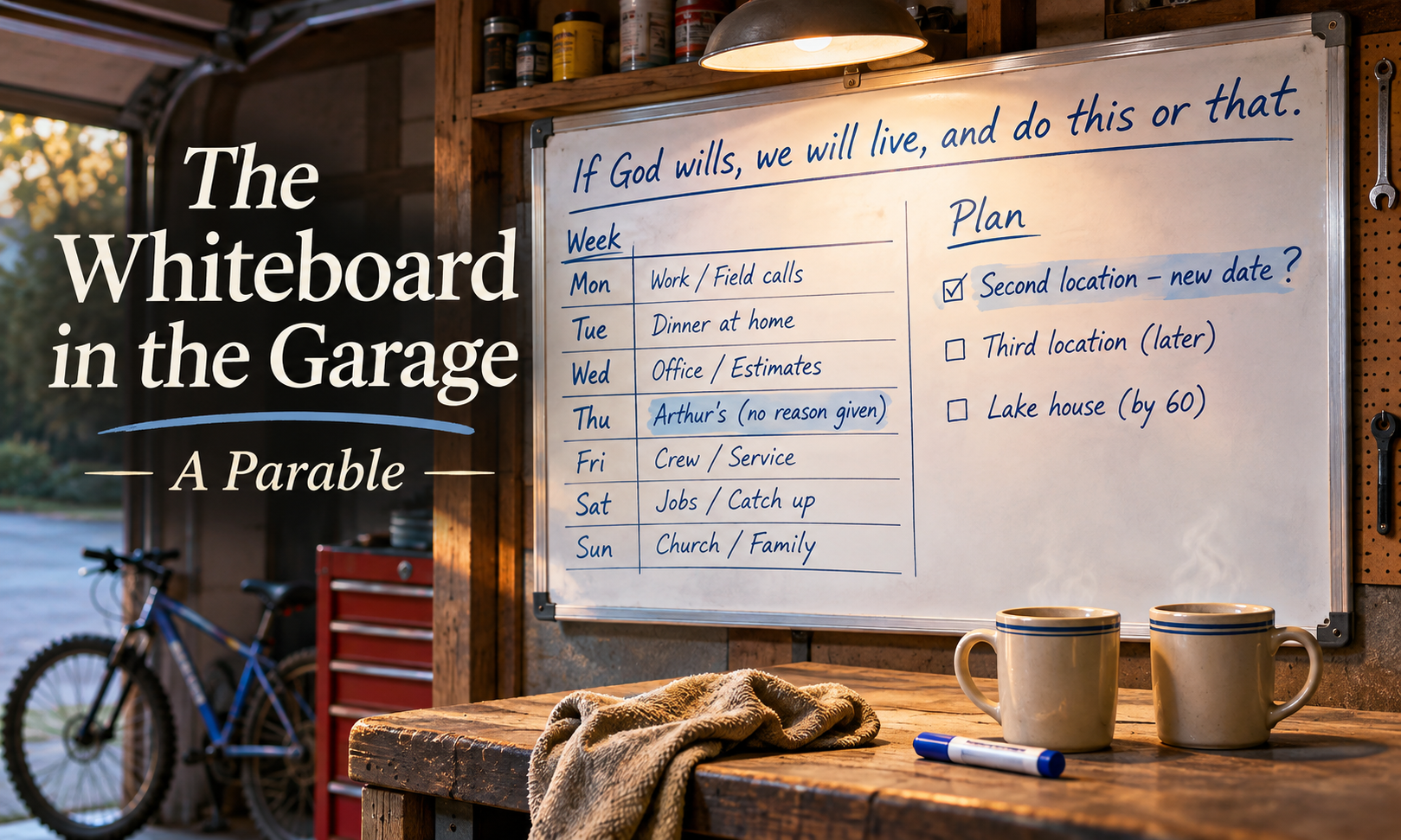
Desmond Avery kept a whiteboard on the wall of his garage on Briar Hill Road. It was four feet wide, and it held his whole life in blue marker. The left side was the week, every hour in a box. The right side was the plan: a second location for Avery Heating and Air by spring, a third by the year after, and a lake house by the time he turned sixty.
His wife Lydia called it the altar. She did not mean it kindly.
In the bottom corner of the board, in small letters, someone had written: "Tues 7 pm, Mr. Penrose." It had been there for eleven weeks. Every Monday night Desmond erased the week and drew it again, and every Monday night he carefully drew around that one line. Arthur Penrose lived three doors down. He was eighty-one, a widower, and he had asked Desmond in August to come look at a furnace that was making a noise. Desmond had said he would. He meant to. Tuesdays filled up.
One Sunday after church, Lydia picked up a marker and wrote two more words across the top of the board, above the plan. If God.
Desmond laughed. "That's not even a sentence."
"Neither is a lake house," she said.
On a Thursday in November the bank called. The loan for the second location had been approved, then reviewed, then pulled. The building he had picked was going to someone else. Three suppliers had been told to hold their orders. Desmond sat in his truck in the bank's parking lot for forty minutes and did not start the engine.
That night he stood in front of the board with the eraser in his hand. The right side was all wrong now. He wiped it clean. Then he looked at the left side, and for the first time in months there was room in it. The meetings about the new building were gone. The calls with the contractor were gone. Tuesday at seven was empty, except for the small line in the corner.
He walked down to the Penrose house with his tool bag. Arthur opened the door in a cardigan, with a blanket over his shoulders.
"I figured you forgot," Arthur said.
"I didn't forget," Desmond said. "I just didn't come."
The furnace was worse than a noise. The heat exchanger had a crack in it. Desmond shut it off, opened two windows, and stood in the kitchen doing arithmetic he did not like. Arthur had been sleeping in the living room in his coat. He had not wanted to bother anyone.
Desmond called his best installer, a quiet man named Felix Ambrose, and they had a new unit in by Saturday noon. Desmond did not send a bill.
While they were packing up, Desmond noticed a bicycle in the back hall, a boy's bike, with new tires and a fresh chain.
"Whose is that?"
"Your boy's," Arthur said. "Caleb brought it by in September with a bent wheel. Said his dad was going to fix it but his dad was busy. I had the time." He shrugged. "I've had a lot of time."
Desmond stood in the hall for a while.
On Monday night he went out to the garage. He erased the whole board, both sides. On the left he drew the week again, but slower. He put in Tuesday dinner at home. He put in Thursday at Arthur's, no reason given. He put the business on the board too, because the business still mattered, and he wrote down a new plan for the second location with a new date and a question mark beside it.
Then he looked at the top of the board, where Lydia's two words still sat.
He picked up the marker and finished her sentence, in small letters, so that it ran across the whole width of his life. If God wills, we will live, and do this or that.
Lydia came out with two cups of coffee and read it.
"That's a sentence," she said.
"It's the only one I'm sure of," Desmond said. He capped the marker. "Arthur wants us for dinner Thursday. I said yes."
Paul tells us to be very careful how we live. James tells us to stop boasting about tomorrow. Here is what Ephesians 5 and James 4 teach about wise days, plans held under God's will and the good you already know to do.
Two Letters, One Calendar
Paul and James never wrote a book on time management, but between them they gave the church most of what it needs. Paul told believers in Ephesus, a busy city of trade and temples, to watch how they walked through their days. James told scattered believers to watch how they talked about their tomorrows.
One passage is about using the days well. The other is about holding the future humbly. Put them side by side and they correct each other. Paul keeps us from drifting. James keeps us from presuming. Together they describe a steward who works hard on today and holds tomorrow with an open hand.
The Question Behind the Planner
Most of us have a planner of some kind: a paper calendar, an app, a whiteboard in the garage. Either way, it tells the truth about what we believe our days are for.
These passages do not ask whether you plan. Neither writer tells us to stop. They ask two harder questions. First, is the shape of your week wise, or is it just full? Second, when you say what you will do next year, who do you think is holding next year? A steward has to answer both. One answer without the other leaves you either busy and proud or humble and idle.
Lesson One: Look Carefully at How You Walk
Paul starts with a warning that sounds almost like a parent at the curb. "Be very careful, then, how you live—not as unwise but as wise, making the most of every opportunity, because the days are evil." (Ephesians 5:15-16, NIV).
The word then ties this to everything before it. Paul has just told these believers that they were once darkness and are now light in the Lord, and that they should find out what pleases Him (Ephesians 5:10). Careful living is not a productivity technique. It is what people do when they know they have been moved from darkness to light and do not want to wander back.
Very careful is strong language. It describes someone walking a narrow path who keeps checking where his feet are going. Most of us do not lose our days in one big decision. We lose them in small, unexamined steps. A habit that starts at nine at night and runs to midnight. A meeting that becomes a standing meeting nobody remembers why we hold. A year that slips by because no one stopped to ask whether this is how we meant to live.
Paul gives two categories, unwise and wise, and nothing in between. That should sober us. Drift is not neutral. A life that is not being walked wisely is being walked some other way.
Then Paul gives the reason: the days are evil. He is not saying time itself is bad. He is saying the age we live in pulls against God, and it will gladly take the hours we do not guard. Every opportunity is contested. Something will fill this evening. The only question is whether it will be something chosen in the light.
So the first discipline is attention. Before you can use your days well, you have to look at them. Where did last week actually go? What would a wise person see if they read your calendar?
Lesson Two: Find Out What the Lord Wants
Paul then turns from caution to clarity. "Therefore do not be foolish, but understand what the Lord's will is." (Ephesians 5:17, NIV).
Notice that Paul treats the will of God as something we can understand. He does not say guess at it, or wait for a feeling, or hope you stumble into it. Understand it. That means the Lord's will is not a hidden riddle kept from His people. Most of it is written down plainly, and the rest becomes clearer as we walk in what is plain.
Many believers lose years waiting for God to reveal the one right job, the one right city or the one right person, while ignoring the will He has already spelled out. Paul, in this very chapter, names it: walk in love, live in the light, be filled with the Spirit, give thanks, submit to one another. Romans 12:2 says that a renewed mind is able to test and approve what God's will is. Understanding grows by obedience, not by delay.
This matters for how we plan. A foolish person asks, what do I want to do with my time? A wise person asks, what does the Lord want done with the time He gave me? The first question puts me at the center of the calendar. The second puts me in the role of a manager who serves an Owner.
There is real freedom here. You do not have to know everything about next year to know what God wants from you this Tuesday. He wants you honest at work, kind at home, faithful in prayer and generous with your attention. Those are not small things. Most of a wise life is built out of them.
So before you fill the next week, open the Book and ask what the Lord has already said. Then put that on the calendar first, and let your own plans fit around it.
Lesson Three: Filled, Not Fogged
Next comes a contrast that seems to change the subject, until you see that it does not. "Do not get drunk on wine, which leads to debauchery. Instead, be filled with the Spirit, speaking to one another with psalms, hymns, and songs from the Spirit. Sing and make music from your heart to the Lord, always giving thanks to God the Father for everything, in the name of our Lord Jesus Christ." (Ephesians 5:18-20, NIV).
Why talk about wine in a passage about using time? Because drunkenness is one of the oldest ways people escape their days rather than steward them. The word debauchery carries the idea of waste, of a life poured out with nothing to show for it. In our day the escape may be wine, but it may also be endless scrolling, binge watching or work that never stops long enough to feel anything. Each one fogs the mind and lets the hours run out unnoticed.
Paul does not answer with an empty schedule. He answers with fullness. Be filled with the Spirit. The opposite of a wasted evening is not a rigid one. It is an evening under a different influence.
And look at what Spirit-filled time sounds like. People speaking to one another. Singing. Making music in the heart. Giving thanks. This is the texture of a wise week. It has room in it for other people, for worship and for gratitude. A calendar packed so tight that no one can sing or say thank you is not wise, no matter how productive it looks.
Giving thanks for everything is the hardest part. It does not mean pretending that every hard thing is good. It means that a believer can bring every part of the day, the meeting that went badly included, back to the Father in Jesus' name. Paul says the same in 1 Thessalonians 5:18. Gratitude keeps a busy person from becoming a bitter one. It turns hours into offerings.
Lesson Four: A Calendar That Makes Room for Others
Paul closes this paragraph with one short command that opens the next section of his letter. "Submit to one another out of reverence for Christ." (Ephesians 5:21, NIV).
It may not look like a verse about time, but it is. Submission is about whose needs we let shape our plans. Paul goes on to apply it to husbands and wives, parents and children, masters and servants. In every case, a believer's life is bound up with other people, and the order of his days has to account for them.
A self-centered calendar has one question: what do I need to get done? A submitted calendar asks more. Who depends on me this week? Whose plans did my plans just cancel? Did I schedule my priorities and leave my family the leftovers? Did I fill my team's days with my urgency without asking what theirs required?
Reverence for Christ is the motive. We do not yield to others because they are always right or because we are weak. We yield because Christ is Lord over all of us, and He has given us to one another. The leader who honors Christ will often find that the wisest thing to do with a free hour is to give it to someone who needs it.
This is where Ephesians begins to meet James. Both writers are confronting a person who imagines that his time is his own. Paul answers with a life lived in community and under the Spirit. James will answer with a life lived under the will of God. Either way, the steward hears the same message. Your days are not a private possession. They are entrusted to you for the Lord and for the people He has placed around you.
Lesson Five: The Plan That Forgot Who Holds Tomorrow
Now James speaks, and his tone is sharper. "Now listen, you who say, 'Today or tomorrow we will go to this or that city, spend a year there, carry on business and make money.'" (James 4:13, NIV).
Look carefully at what this person is doing. He is making a plan. He has a city, a timeline and a business goal. None of that is the sin. Scripture praises the ant for planning and the prudent for thinking ahead. The problem is what is missing. There is no God anywhere in the sentence.
James answers with a question that ends the argument. "Why, you do not even know what will happen tomorrow. What is your life? You are a mist that appears for a little while and then vanishes." (James 4:14, NIV).
The confident planner had a year mapped out. James reminds him he cannot see one day ahead. Markets turn. Health fails. A phone rings at the wrong hour. The whole plan rested on an assumption that tomorrow belonged to him.
Then James names the root. "As it is, you boast in your arrogant schemes. All such boasting is evil." (James 4:16, NIV).
That is a strong word for something many of us do at every planning meeting. But James is not condemning planning. He is condemning the boast inside it, the quiet belief that I am the one who decides how my life will go. It is possible to write a five-year plan in a spirit of total self-reliance and never notice. It is possible to talk about next year at dinner as if God were not at the table.
A steward plans with the knowledge that he is a mist. That does not make him passive. It makes him humble. He works hard on the plan, and then he hands it back to the One who actually owns the years.
Lesson Six: Say It and Mean It, Then Do the Good You Know
James does not leave us with only a rebuke. He gives us new words to say. "Instead, you ought to say, 'If it is the Lord's will, we will live and do this or that.'" (James 4:15, NIV).
Notice that the planning stays. We will live and do this or that. James expects the believer to go to the city, run the business and make the money, if that is God's will. What changes is the posture. The plan is held, not clutched. Paul spoke this way himself when he told friends he would come back if it was God's will (Acts 18:21; 1 Corinthians 16:7).
These words can become a habit that means nothing, a phrase tacked on to sound spiritual. James is not asking for a phrase. He is asking for a heart that actually expects God to have the final say, and is at peace with that. The test is simple. When the plan falls apart, do you still trust Him?
Then James adds a sentence that catches almost everyone. "If anyone, then, knows the good they ought to do and doesn't do it, it is sin for them." (James 4:17, NIV).
Here the two passages meet again. The person who boasts about tomorrow often neglects today. He is so busy with the big plan that he walks past the small good right in front of him. The call he meant to return. The neighbor he meant to visit. The apology he meant to make. He tells himself there will be time later. James reminds him that later is a mist.
This verse turns humility into action. Because you do not own tomorrow, do the good you know about today. That is what it means to make the most of every opportunity. The wise steward does not wait for a perfect plan. He obeys the good he can already see, and he trusts God with the rest.
For Business Leaders: Plan Hard, Hold Loosely
You are paid to plan. Forecasts, budgets, hiring plans and growth targets are part of faithful work, and James never tells you to stop. But you can build every one of them as if God were not in the room. Make it a habit to plan as hard as you can and then put the whole plan into His hands, out loud, with the people who will carry it out.
"Many are the plans in a person's heart, but it is the Lord's purpose that prevails." (Proverbs 19:21, NIV).
Your Obedience Step
At your next planning meeting, open by praying over the plan and naming that it rests on the Lord's will. Then write down one good thing your company knows it ought to do and has delayed, and set a date to do it this quarter.
For Community Leaders: Spend the Open Doors
Ministries, nonprofits and civic groups can become so full of internal meetings that they miss the people they exist to serve. Paul's call to make the most of every opportunity is not only about private time. It is about the doors God opens to the people outside your walls. Look at your calendar and ask how much of it touches anyone who does not already belong.
"Be wise in the way you act toward outsiders; make the most of every opportunity." (Colossians 4:5, NIV).
Your Obedience Step
Review the last month of your group's schedule. Cancel or shorten one meeting that serves no one outside the room, and give that hour to a person or neighborhood your ministry has been meaning to reach.
For Home Leaders: Let the Lord Build the Week
A home has a calendar too, and it can be full of good things that crowd out the best ones. Practices, lessons, shifts and errands can leave no room for a meal together, a song, a prayer or a slow evening. Ask whether your family's week has room for the Spirit-filled life Paul describes: speaking to one another, singing and giving thanks.
"Unless the Lord builds the house, the builders labor in vain. Unless the Lord watches over the city, the guards stand watch in vain." (Psalm 127:1, NIV).
Your Obedience Step
Sit down with your family this week and look at the coming seven days together. Protect one evening for a meal with no screens, end it with thanks to God for specific things, and pray over the week's plans with the words if it is the Lord's will.
For the Everyday Believer: Take the Next Step
You may not run a company or lead a ministry, but you have a calendar and a tomorrow you do not control. That can feel unsettling. It is meant to be freeing. You do not need to see the whole road. You need to take the next faithful step in the light you have, and trust that the Lord is keeping your steps.
"The Lord makes firm the steps of the one who delights in him; though he may stumble, he will not fall, for the Lord upholds him with his hand." (Psalm 37:23-24, NIV).
Your Obedience Step
Name one good thing you know you ought to do and have been putting off. Do it within the next two days. Then, when you plan anything beyond this week, say if it is the Lord's will and mean it.
Wise Today, Humble About Tomorrow
Paul and James meet in the same place. Paul tells us not to waste today. James tells us not to presume on tomorrow. A foolish person does the opposite of both. He drifts through the present and boasts about the future. A wise steward pays close attention to today and holds tomorrow with an open hand.
This is the shape of a life lived before God. Our days are His gift, our plans are under His will, and our hope rests in Jesus Christ, whose life was not a mist and whose kingdom does not vanish.
Questions for Reflection
- If a wise friend read my calendar from last week, what would they say I value most?
- What part of the Lord's will is already plain to me, and have I put it on my schedule first?
- Where do I escape my days instead of stewarding them?
- Whose needs have my plans been crowding out?
- When I talk about next year, do I speak as though God holds it or as though I do?
- What good do I know I ought to do that I have been putting off?
Closing Prayer
Father, my days are yours, and so is every tomorrow I have talked about as if it were mine. Forgive me for the hours I have wasted and the plans I have made without you. Teach me to be careful how I live. Show me your will, and give me the courage to do what you have already made plain. Fill me with your Spirit instead of the things I use to escape. Give me a thankful heart and a week with room for the people you have given me. When I plan, keep me humble. When my plans fall apart, keep me trusting. And help me do the good I know to do, today, while it is still today. In Jesus' name, Amen.
The Whiteboard in the Garage
Desmond Avery kept a whiteboard on the wall of his garage on Briar Hill Road. It was four feet wide, and it held his whole life in blue marker. The left side was the week, every hour in a box. The right side was the plan: a second location for Avery Heating and Air by spring, a third by the year after, and a lake house by the time he turned sixty.
His wife Lydia called it the altar. She did not mean it kindly.
In the bottom corner of the board, in small letters, someone had written: "Tues 7 pm, Mr. Penrose." It had been there for eleven weeks. Every Monday night Desmond erased the week and drew it again, and every Monday night he carefully drew around that one line. Arthur Penrose lived three doors down. He was eighty-one, a widower, and he had asked Desmond in August to come look at a furnace that was making a noise. Desmond had said he would. He meant to. Tuesdays filled up.
One Sunday after church, Lydia picked up a marker and wrote two more words across the top of the board, above the plan. If God.
Desmond laughed. "That's not even a sentence."
"Neither is a lake house," she said.
On a Thursday in November the bank called. The loan for the second location had been approved, then reviewed, then pulled. The building he had picked was going to someone else. Three suppliers had been told to hold their orders. Desmond sat in his truck in the bank's parking lot for forty minutes and did not start the engine.
That night he stood in front of the board with the eraser in his hand. The right side was all wrong now. He wiped it clean. Then he looked at the left side, and for the first time in months there was room in it. The meetings about the new building were gone. The calls with the contractor were gone. Tuesday at seven was empty, except for the small line in the corner.
He walked down to the Penrose house with his tool bag. Arthur opened the door in a cardigan, with a blanket over his shoulders.
"I figured you forgot," Arthur said.
"I didn't forget," Desmond said. "I just didn't come."
The furnace was worse than a noise. The heat exchanger had a crack in it. Desmond shut it off, opened two windows, and stood in the kitchen doing arithmetic he did not like. Arthur had been sleeping in the living room in his coat. He had not wanted to bother anyone.
Desmond called his best installer, a quiet man named Felix Ambrose, and they had a new unit in by Saturday noon. Desmond did not send a bill.
While they were packing up, Desmond noticed a bicycle in the back hall, a boy's bike, with new tires and a fresh chain.
"Whose is that?"
"Your boy's," Arthur said. "Caleb brought it by in September with a bent wheel. Said his dad was going to fix it but his dad was busy. I had the time." He shrugged. "I've had a lot of time."
Desmond stood in the hall for a while.
On Monday night he went out to the garage. He erased the whole board, both sides. On the left he drew the week again, but slower. He put in Tuesday dinner at home. He put in Thursday at Arthur's, no reason given. He put the business on the board too, because the business still mattered, and he wrote down a new plan for the second location with a new date and a question mark beside it.
Then he looked at the top of the board, where Lydia's two words still sat.
He picked up the marker and finished her sentence, in small letters, so that it ran across the whole width of his life. If God wills, we will live, and do this or that.
Lydia came out with two cups of coffee and read it.
"That's a sentence," she said.
"It's the only one I'm sure of," Desmond said. He capped the marker. "Arthur wants us for dinner Thursday. I said yes."
Comments
Keep it kind and on topic. See something that doesn't belong? Tap Report under it and we'll review it.