
Stewardship of Life · Stewardship Faith-Spiritual Growth
The Letter on the Altar: Isaiah 37 to 39 on Trusting God With Your Days
Qunetin Robinson

Hezekiah spread a threatening letter before the Lord, received fifteen more years, then nearly lost it all to pride. Isaiah 37 to 39 on trusting God with your days.
A Letter No Leader Wants to Read
Every leader eventually receives the letter. Sometimes it is an actual letter: a lawsuit, a termination notice, a lease that will not renew. Sometimes it is a call from a doctor, a report that the numbers will not cover payroll, or a conversation with a child that ends with a slammed door.
Whatever its form, the message is the same. You are not in control, and the thing you were counting on may not hold.
Isaiah 37 to 39 tells the story of a king who received three of those letters in a row. First an empire surrounded his city. Then a prophet told him he would die. Then, after God rescued him from both, the most dangerous visitors of all arrived: men who came to admire him.
The first two drove Hezekiah to his knees. The third caught him standing tall.
Together these chapters teach the Stewardship of Life. Our days, our purpose and our future are not ours to secure. God has already planned them, and He can be trusted to bring His plans to fruition for His glory.
Our part is to stop living in worry, fear and concern, and to do three things instead: repent, be patient, and remain humble. When we do, something remarkable happens. His glory becomes our blessing.
Lesson One: Spread the Letter Before the Lord
Isaiah 36 ends with Jerusalem surrounded. The Assyrian field commander has stood outside the walls and mocked Hezekiah in the language of the common people, so every listener on the wall would hear it. Then Sennacherib sends a letter. Its message is simple: every god of every nation I have conquered failed, and yours will too.
Hezekiah's first response is not a strategy session. He tears his clothes, puts on sackcloth, and sends for the prophet (Isaiah 37:1-2). When the letter arrives, he takes it straight to the temple. "Then he went up to the temple of the LORD and spread it out before the LORD" (Isaiah 37:14, NIV).
Notice what he does with the threat. He does not hide it, minimize it, or rehearse it at two in the morning. He opens it fully and lays it in front of God.
Then he prays, and his prayer begins with who God is before it gets to what Hezekiah needs. God is enthroned. God alone rules the kingdoms of the earth. God made heaven and earth (Isaiah 37:16).
Worry is a letter we keep folded in our pocket. We take it out, reread it, and put it back, and every reading makes the threat larger. Prayer is the letter spread out before the Lord. The words on the page do not change, but the One reading them with us does.
Hezekiah's request also tells us what he wanted most. "Now, LORD our God, deliver us from his hand, so that all the kingdoms of the earth may know that you, LORD, are the only God" (Isaiah 37:20, NIV). He asks for rescue, and he asks for it for the sake of God's name.
That is the first move of a steward under pressure. The threat is real. The life under threat is not yours. So you take what frightens you to the One who owns it.
Lesson Two: The Plan Was Written Before the Threat
God's answer comes through Isaiah, and most of it is addressed not to Hezekiah but to Sennacherib. The Assyrian king believed he was the author of his own success. He had dried up streams, crossed mountains and flattened cities, and he said so (Isaiah 37:24-25).
God's reply turns the whole story around. "Have you not heard? Long ago I ordained it. In days of old I planned it; now I have brought it to pass, that you have turned fortified cities into piles of stone" (Isaiah 37:26, NIV).
Read that slowly. The most powerful man on earth thought he was writing history, and God says the script was His all along. Even Assyria's victories had been inside God's plan. The threat at Jerusalem's gate was real, but it was never in charge.
God also knows the enemy's every move. "Because you rage against me and because your insolence has reached my ears" (Isaiah 37:29, NIV), God promises to turn him around and send him home by the road he came.
And He does. In one night the angel of the LORD strikes the Assyrian camp, and Sennacherib returns to Nineveh, where he dies at the hands of his own sons (Isaiah 37:36-38).
Why does God act? He tells us. "I will defend this city and save it, for my sake and for the sake of David my servant!" (Isaiah 37:35, NIV). God moves for His own glory and for the promise He made. Jerusalem lives because God's name is at stake.
This is the heart of the passage. When God acts for His glory, His people are blessed in the process. His glory becomes our blessing. We never have to choose between them.
For the steward of life, this is the cure for fear. You are not living inside the plans of the people who threaten you. You are living inside a plan God made long ago, and He has already said who will finish it: "The zeal of the LORD Almighty will accomplish this" (Isaiah 37:32, NIV).
Lesson Three: Your Days Are Numbered by God, Not by Fear
Chapter 38 opens with a different kind of threat. No army this time. Just a diagnosis, delivered by the prophet himself. "Put your house in order, because you are going to die; you will not recover" (Isaiah 38:1, NIV).
Hezekiah turns his face to the wall and prays. He reminds God of his faithfulness, and then Scripture records a short, honest line: Hezekiah wept bitterly (Isaiah 38:3).
The parallel account says Isaiah had not yet left the palace courtyard when God sent him back (2 Kings 20:4). "Go and tell Hezekiah, 'This is what the LORD, the God of your father David, says: I have heard your prayer and seen your tears; I will add fifteen years to your life'" (Isaiah 38:5, NIV). God confirms it with a sign. The shadow on the stairway of Ahaz goes back ten steps (Isaiah 38:8).
Think about what this teaches about the length of a life. A doctor's report, a bank statement, a bad quarter, a broken relationship: these speak loudly about our future. But they do not hold the pen. God does.
"All the days ordained for me were written in your book before one of them came to be" (Psalm 139:16, NIV). The God who wrote the book can add a chapter, and for Hezekiah He did.
Notice what moved God's hand. Not Hezekiah's planning, not his position, not his anxiety. His prayer and his tears. Jesus would later ask whether anyone can add a single hour to life by worrying (Matthew 6:27). Worry adds nothing. Honest prayer, offered in humility, is heard.
This does not mean every prayer for healing gets a yes. Hezekiah's fifteen years were a gift, not a formula. But it does mean the number of your days is not set by fear. It is held by a Father who sees your tears.
The steward's response is to stop clutching the calendar. Your days are counted. They are not yours to secure. They are yours to steward.
Lesson Four: The Anguish Was for Your Benefit
After his recovery, Hezekiah writes a song (Isaiah 38:9-20). It is honest about the dark. He describes his house pulled down like a shepherd's tent, his life rolled up like a weaver's cloth, his eyes growing weak as he looked to the heavens (Isaiah 38:12-14).
Then the song turns. "Surely it was for my benefit that I suffered such anguish. In your love you kept me from the pit of destruction; you have put all my sins behind your back" (Isaiah 38:17, NIV).
This is a repentant man speaking. He does not claim he earned his recovery. He names his sins and celebrates that God has put them where He no longer looks at them. The crisis drove him to mercy, and mercy gave him a new way to see the crisis. What felt like the end of his life became the place where he met God's love.
He also makes a promise in the song. "I will walk humbly all my years because of this anguish of my soul" (Isaiah 38:15, NIV).
Hold on to that vow. It is exactly the right response to grace. A life that has been handed back should be walked humbly, because it was never ours to begin with. And as the next chapter shows, it is a vow that is easier to make in the sickbed than to keep in the throne room.
For the steward of life, this lesson reframes suffering. Repentance is not only what we do after we fail. It is the posture that lets God use the hard season. The anguish you are in may be the very place God is keeping you from a pit you cannot see.
Patience is not passive waiting. It is trusting that God is doing something good in the anguish before you can see the benefit.
Hezekiah could not see the fifteen years when he faced the wall. He could only pray. That was enough.
Lesson Five: The Storehouse Test
Then the envoys arrive. Marduk-Baladan, king of Babylon, has heard about Hezekiah's illness and recovery, and he sends letters and a gift (Isaiah 39:1). Babylon is a rising power looking for allies against Assyria. The visit is flattering.
Hezekiah receives them gladly and shows them everything: the silver, the gold, the spices, the fine olive oil, the armory, all his treasures. There was nothing in his palace or his kingdom that he did not show them (Isaiah 39:2).
The Chronicler tells us what was really happening. "God left him to test him and to know everything that was in his heart" (2 Chronicles 32:31, NIV). And he tells us what the test revealed. "But Hezekiah's heart was proud and he did not respond to the kindness shown him" (2 Chronicles 32:25, NIV).
Here is the heartbreak. The envoys had come to ask about the miraculous sign (2 Chronicles 32:31). Hezekiah held one of the greatest testimonies a king ever had: a God who turned back an empire and moved the shadow backward for him. Instead of telling that story, he gave a tour of his treasure.
Isaiah's verdict is swift. "The time will surely come when everything in your palace, and all that your predecessors have stored up until this day, will be carried off to Babylon" (Isaiah 39:6, NIV).
Hezekiah's reply is the most sobering line in the passage. "There will be peace and security in my lifetime" (Isaiah 39:8, NIV). Pride shrinks the horizon of a life down to my days.
There is one more quiet detail. Manasseh was twelve when he became king (2 Kings 21:1), which means he was born during the fifteen added years. The gift of extra time produced the son who would lead Judah into its darkest idolatry. Added years are a blessing, and they are also a stewardship.
Yet grace has the last word. "Then Hezekiah repented of the pride of his heart, as did the people of Jerusalem; therefore the LORD's wrath did not come on them during the days of Hezekiah" (2 Chronicles 32:26, NIV).
This is the Storehouse Test. What you show people after God rescues you reveals whether you believe you own your life or steward it.
For Business Leaders: Plan With an Open Hand
Business leaders live by plans. Forecasts, budgets, hiring plans, five-year visions. None of that is wrong. Hezekiah's problem was never that he had storehouses. It was what he did with them when someone important came to look.
The temptation for a business leader runs in two directions. When the letter comes (a lost client, a lender calling a note, a competitor moving into your market), the temptation is to lie awake rereading it. When success comes, the temptation is to give tours of the storehouse: the revenue slide, the growth chart, the press mention, with no word about the One who supplied it.
Both temptations forget the same truth. Sennacherib believed his victories were his own, and God answered that He had planned them long ago. Your company exists inside a plan you did not write.
James gives the posture. "Instead, you ought to say, 'If it is the Lord's will, we will live and do this or that'" (James 4:15, NIV). That is not a lack of ambition. It is ambition held in an open hand.
Your Obedience Step
Take the one business threat you have been carrying this month and write it out in full. Before your next planning meeting, spread it out before the Lord in prayer, by name. Then open that meeting with one sentence naming something God provided this year that no plan of yours produced.
For Community Leaders: Tell the Story, Not the Treasury
Community leaders live in public. Council members, nonprofit directors, coaches, association presidents: your platform is built on visible results. Every grant, every ribbon cutting, every successful event becomes something to report.
That makes the Storehouse Test your daily test. Hezekiah's visitors came to hear about a miracle, and he showed them his armory. Community leaders face the same choice whenever someone asks how the work is going. You can give the tour of accomplishments, or you can tell the story of what God did when the work looked impossible.
It also matters who gets the credit. A city stands because of many hands. When the leader becomes the hero of every story, people stop seeing God's hand and start seeing only the leader's.
"Let someone else praise you, and not your own mouth; an outsider, and not your own lips" (Proverbs 27:2, NIV).
Your Obedience Step
Before your next public report, update or speech, cut one line that celebrates what you did and replace it with a line that honors what others did and what God made possible. Then thank one volunteer or staff member publicly, by name, for work no one saw.
For Home Leaders: Your Children Inherit the Story
Hezekiah's fifteen added years included the birth of a son. That son, Manasseh, would undo almost everything his father had restored. Scripture does not tell us everything that happened in that home, but it does show us a father whose horizon had shrunk to peace and security in his own lifetime.
Home leaders are tempted toward the same short horizon. We want the next few years to be calm. We protect our children from hard conversations. We give them a comfortable house without the testimony of how God carried us to it.
Your children will inherit your storehouse one way or another. The question is whether they also inherit the story. A child who knows what God did when the family faced the layoff, the diagnosis or the empty account has something no savings account can give.
"We will not hide them from their descendants; we will tell the next generation the praiseworthy deeds of the LORD, his power, and the wonders he has done" (Psalm 78:4, NIV).
Your Obedience Step
This week at the dinner table, tell your family the story of one time God rescued you, including the part where you were afraid. Let them ask questions. Then pray together over one worry your family is carrying right now, spreading it out before the Lord the way Hezekiah did.
For the Everyday Believer: Your Days Are in Good Hands
You may not lead a company, a city or even a household. But you have been entrusted with a life, and Isaiah 37 to 39 speaks directly to it.
Maybe your letter is a medical result you are waiting on. Maybe it is a debt, a lonely season, or a fear about what the next ten years will hold. The pull is to live there: to plan for every outcome and lie awake running the numbers.
Hezekiah's story says something different. Your days were written before one of them came to be. The God who added fifteen years to a dying king has not lost track of you.
Your job is not to secure your future. Your job is to repent where you need to, wait patiently for God to work, and walk humbly with whatever days He gives you.
"Cast all your anxiety on him because he cares for you" (1 Peter 5:7, NIV).
Your Obedience Step
Write down the worry you return to most often. Take it somewhere quiet, lay the paper open in front of you, and pray over it by name. When the worry comes back this week, say out loud, "That letter belongs to God," and thank Him for one specific way He has already carried you.
Repent, Wait, and Walk Humbly
Hezekiah's story holds the whole lesson together. He faced an empire with prayer instead of panic, and God defended the city for His own name. He faced death with tears and repentance, and God added fifteen years. He faced flattery with pride, and his storehouse became a prophecy of loss. Then he repented again, and grace held back the judgment in his day.
That is the pattern for the steward of life.
Repent, because a humble heart is where God's mercy lands. Be patient, because roots come before fruit (Isaiah 37:31), and God's timing is part of God's plan. Remain humble, because the moment after the rescue is the moment pride looks for an open door.
"Humble yourselves before the Lord, and he will lift you up" (James 4:10, NIV).
You do not need to live in worry, fear or concern about your life or your purpose. Long ago God planned it. He can be trusted to bring it to pass, and He will do it for His glory.
When you stop trying to own your days and start stewarding them, you discover what Jerusalem discovered the morning the Assyrian camp went silent. God's glory and your good were never rivals. His glory becomes your blessing.
Questions for Reflection
- What letter are you carrying folded in your pocket right now, and what would it look like to spread it out before the Lord this week?
- Where have you been treating a threat as if it were in charge of your future, rather than inside God's plan?
- Looking back on a season of anguish, where can you now say it was for your benefit?
- If God gave you fifteen added years, what would you want them to be known for? What does that say about how to steward the years you have now?
- When people admire your work, your home or your success, what do you show them: the storehouse or the story?
Closing Prayer
Father, I have carried letters I was never meant to carry alone. Today I spread them out before You. You planned my life long before I ever worried about it, and You hold every one of my days. Forgive me for the fear that has crowded out my trust, and for the pride that has taken credit for what You gave. Teach me to wait on You with patience, and to walk humbly all my years. When You rescue me, let me tell Your story instead of showing my storehouse. Let my life bring glory to Your name, and let that glory be my blessing. In Jesus' name, Amen.
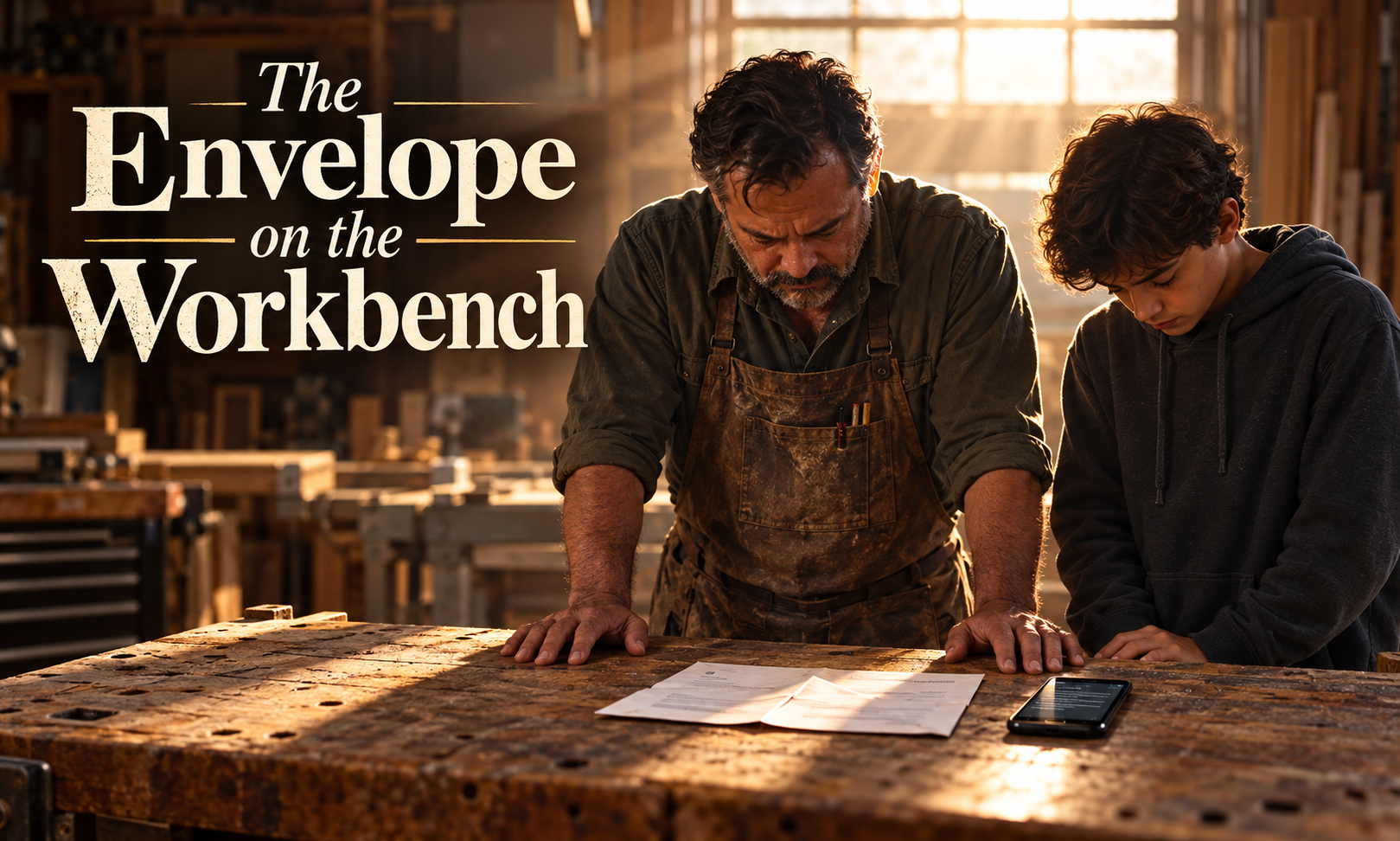
The Envelope on the Workbench
Ray Delgado kept the letter in his shirt pocket for four days.
It had come certified, the kind you sign for, from a law firm in the city. Hollis Construction, the general contractor that sent his cabinet shop nearly half its work, was refusing to pay the last three invoices. Worse, they were claiming his crew had installed defective cabinets on a hospital job, and they wanted the shop to cover the replacement. The number at the bottom of the second page was more than the shop had made in its best year.
He told no one. Not his wife, Dana. Not his foreman. He went to work, ran the saws, signed the payroll checks, and every hour or so his hand drifted to his pocket to feel the envelope there, as if it might have changed.
At night he read it again in the truck before going inside. Every reading made it worse. By the fourth night he had already sold the building in his mind, laid off all eleven men, and explained to his son why they were moving.
On the fifth morning he got to the shop before anyone else and stood in front of his father's workbench.
It was the oldest thing in the building, maple worn smooth in the middle from forty years of hands. His father had started the shop in a one-car garage. Ray remembered being nine years old and watching his dad come in from the mailbox with a letter from the bank. His father had not sat down at the desk. He had walked to the bench, unfolded the letter, flattened it with both palms, and stood there with his head down for a long time.
"What are you doing?" Ray had asked.
"Letting the Boss read it," his father said. "It's His shop. I just run it."
Ray took the envelope out of his pocket. He unfolded both pages and pressed them flat on the maple, and the creases fought him. Then he stood there the way his father had, and for the first time in four days he said the whole thing out loud. The invoices. The hospital. The number. The eleven men. His son.
He did not hear a voice. Nothing in the shop changed. But when he picked the letter up again, it was just paper.
He called Dana that morning and told her everything. She was quiet for a long moment and then said, "Why didn't you tell me four days ago?" He did not have a good answer.
He called a lawyer. He pulled every inspection photo from the hospital job. And then, slowly, the thing began to turn in ways he had nothing to do with.
The hospital's own inspector found that the water damage had come from a plumbing failure two floors up, months after Ray's crew had finished. Then word got around that Hollis had done the same thing to three other subcontractors, pushing its own losses onto smaller shops. By spring Hollis was in bankruptcy, the claim was dismissed, and two of its biggest clients called Ray directly. They had heard he was the one who stood his ground.
The shop finished that year with more work than it could handle.
The second letter came in the summer, and it was not on paper.
Ray was loading a truck when the pain hit his chest. A week later a cardiologist sat across from him with a scan on the screen and told him plainly that two of his arteries were nearly closed. Without surgery, he said, Ray probably had months.
The night before the operation, Ray could not sleep. He drove to the shop at two in the morning, let himself in, and stood at the workbench with nothing to lay on it but his own hands.
He told God he was afraid. He told Him about his son, who was fifteen and quiet and spent most evenings behind a closed door. He asked for more time. Then, without planning to, he started confessing things: the four days of silence, the pride he took in never needing anyone, the way he talked about the shop as if he had built it alone.
He came through surgery well. The doctor said he could reasonably expect many more years. Ray cried in the recovery room, and he meant it when he told Dana, "I'm going to live differently."
In the fall, a regional business magazine called. They were doing a feature on family companies that had survived hard years, and someone had told them Ray's story.
The reporter and a photographer spent a whole afternoon at the shop. Ray walked them through everything: the new CNC router, the finishing room, the showroom with the walnut kitchen they had built for a judge. He showed them the contracts board, crowded with names. He told them about standing up to Hollis, about the clients who came to him afterward, about doubling the crew. The photographer had him pose with his arms crossed in front of the new spray booth.
His son, Marcus, had come by after school and was sweeping near the back. He heard all of it.
When the reporter asked what got him through the hardest season, Ray laughed. "Stubbornness, mostly. And good cabinets."
The workbench sat in the corner the whole time, under a stack of offcuts. No one photographed it. Ray never mentioned it.
The article came out in November. Dana framed it for the office. Ray read it twice and felt good.
That weekend he found Marcus at the kitchen table, staring at the framed copy Dana had left there.
"Stubbornness," Marcus said, without looking up.
"What?"
"That's what you told them. That's how we made it." Marcus pushed the frame away a little. "I thought you were going to lose the shop. I heard you and Mom that night. I thought you were going to die in that hospital. And the whole story is that you were tough."
Ray started to answer and stopped. He thought about the letter pressed flat on the maple, and two in the morning, and every promise he had made in the recovery room. He had been given the shop back and his life back, and when someone finally asked him how, he had shown them the spray booth.
"You're right," he said. "That's not the story."
The next morning Ray took Marcus to the shop before anyone else arrived. He cleared the offcuts off the old bench and wiped the dust away with his sleeve.
From his wallet he took the Hollis letter. He had never thrown it away. He unfolded it and pressed it flat on the maple, and he told his son all of it. The four days with the envelope in his pocket. His grandfather and the bank letter. The morning he finally laid it down. The night before surgery, when he had nothing to lay down but himself.
"I didn't save this place," Ray said. "And I didn't save me. I'm sorry I told it the way I did."
Marcus looked at the letter for a long time. Then he reached into his own pocket, pulled out his phone, and set it face up on the bench next to the letter. On the screen was an email from his school counselor about grades he had not told anyone about.
"Can I do that too?" he asked.
Ray put a hand on his son's shoulder, and the two of them stood at the bench with their heads down, the way his father used to stand, letting the Boss read it.
Hezekiah spread a threatening letter before the Lord, received fifteen more years, then nearly lost it all to pride. Isaiah 37 to 39 on trusting God with your days.
A Letter No Leader Wants to Read
Every leader eventually receives the letter. Sometimes it is an actual letter: a lawsuit, a termination notice, a lease that will not renew. Sometimes it is a call from a doctor, a report that the numbers will not cover payroll, or a conversation with a child that ends with a slammed door.
Whatever its form, the message is the same. You are not in control, and the thing you were counting on may not hold.
Isaiah 37 to 39 tells the story of a king who received three of those letters in a row. First an empire surrounded his city. Then a prophet told him he would die. Then, after God rescued him from both, the most dangerous visitors of all arrived: men who came to admire him.
The first two drove Hezekiah to his knees. The third caught him standing tall.
Together these chapters teach the Stewardship of Life. Our days, our purpose and our future are not ours to secure. God has already planned them, and He can be trusted to bring His plans to fruition for His glory.
Our part is to stop living in worry, fear and concern, and to do three things instead: repent, be patient, and remain humble. When we do, something remarkable happens. His glory becomes our blessing.
Lesson One: Spread the Letter Before the Lord
Isaiah 36 ends with Jerusalem surrounded. The Assyrian field commander has stood outside the walls and mocked Hezekiah in the language of the common people, so every listener on the wall would hear it. Then Sennacherib sends a letter. Its message is simple: every god of every nation I have conquered failed, and yours will too.
Hezekiah's first response is not a strategy session. He tears his clothes, puts on sackcloth, and sends for the prophet (Isaiah 37:1-2). When the letter arrives, he takes it straight to the temple. "Then he went up to the temple of the LORD and spread it out before the LORD" (Isaiah 37:14, NIV).
Notice what he does with the threat. He does not hide it, minimize it, or rehearse it at two in the morning. He opens it fully and lays it in front of God.
Then he prays, and his prayer begins with who God is before it gets to what Hezekiah needs. God is enthroned. God alone rules the kingdoms of the earth. God made heaven and earth (Isaiah 37:16).
Worry is a letter we keep folded in our pocket. We take it out, reread it, and put it back, and every reading makes the threat larger. Prayer is the letter spread out before the Lord. The words on the page do not change, but the One reading them with us does.
Hezekiah's request also tells us what he wanted most. "Now, LORD our God, deliver us from his hand, so that all the kingdoms of the earth may know that you, LORD, are the only God" (Isaiah 37:20, NIV). He asks for rescue, and he asks for it for the sake of God's name.
That is the first move of a steward under pressure. The threat is real. The life under threat is not yours. So you take what frightens you to the One who owns it.
Lesson Two: The Plan Was Written Before the Threat
God's answer comes through Isaiah, and most of it is addressed not to Hezekiah but to Sennacherib. The Assyrian king believed he was the author of his own success. He had dried up streams, crossed mountains and flattened cities, and he said so (Isaiah 37:24-25).
God's reply turns the whole story around. "Have you not heard? Long ago I ordained it. In days of old I planned it; now I have brought it to pass, that you have turned fortified cities into piles of stone" (Isaiah 37:26, NIV).
Read that slowly. The most powerful man on earth thought he was writing history, and God says the script was His all along. Even Assyria's victories had been inside God's plan. The threat at Jerusalem's gate was real, but it was never in charge.
God also knows the enemy's every move. "Because you rage against me and because your insolence has reached my ears" (Isaiah 37:29, NIV), God promises to turn him around and send him home by the road he came.
And He does. In one night the angel of the LORD strikes the Assyrian camp, and Sennacherib returns to Nineveh, where he dies at the hands of his own sons (Isaiah 37:36-38).
Why does God act? He tells us. "I will defend this city and save it, for my sake and for the sake of David my servant!" (Isaiah 37:35, NIV). God moves for His own glory and for the promise He made. Jerusalem lives because God's name is at stake.
This is the heart of the passage. When God acts for His glory, His people are blessed in the process. His glory becomes our blessing. We never have to choose between them.
For the steward of life, this is the cure for fear. You are not living inside the plans of the people who threaten you. You are living inside a plan God made long ago, and He has already said who will finish it: "The zeal of the LORD Almighty will accomplish this" (Isaiah 37:32, NIV).
Lesson Three: Your Days Are Numbered by God, Not by Fear
Chapter 38 opens with a different kind of threat. No army this time. Just a diagnosis, delivered by the prophet himself. "Put your house in order, because you are going to die; you will not recover" (Isaiah 38:1, NIV).
Hezekiah turns his face to the wall and prays. He reminds God of his faithfulness, and then Scripture records a short, honest line: Hezekiah wept bitterly (Isaiah 38:3).
The parallel account says Isaiah had not yet left the palace courtyard when God sent him back (2 Kings 20:4). "Go and tell Hezekiah, 'This is what the LORD, the God of your father David, says: I have heard your prayer and seen your tears; I will add fifteen years to your life'" (Isaiah 38:5, NIV). God confirms it with a sign. The shadow on the stairway of Ahaz goes back ten steps (Isaiah 38:8).
Think about what this teaches about the length of a life. A doctor's report, a bank statement, a bad quarter, a broken relationship: these speak loudly about our future. But they do not hold the pen. God does.
"All the days ordained for me were written in your book before one of them came to be" (Psalm 139:16, NIV). The God who wrote the book can add a chapter, and for Hezekiah He did.
Notice what moved God's hand. Not Hezekiah's planning, not his position, not his anxiety. His prayer and his tears. Jesus would later ask whether anyone can add a single hour to life by worrying (Matthew 6:27). Worry adds nothing. Honest prayer, offered in humility, is heard.
This does not mean every prayer for healing gets a yes. Hezekiah's fifteen years were a gift, not a formula. But it does mean the number of your days is not set by fear. It is held by a Father who sees your tears.
The steward's response is to stop clutching the calendar. Your days are counted. They are not yours to secure. They are yours to steward.
Lesson Four: The Anguish Was for Your Benefit
After his recovery, Hezekiah writes a song (Isaiah 38:9-20). It is honest about the dark. He describes his house pulled down like a shepherd's tent, his life rolled up like a weaver's cloth, his eyes growing weak as he looked to the heavens (Isaiah 38:12-14).
Then the song turns. "Surely it was for my benefit that I suffered such anguish. In your love you kept me from the pit of destruction; you have put all my sins behind your back" (Isaiah 38:17, NIV).
This is a repentant man speaking. He does not claim he earned his recovery. He names his sins and celebrates that God has put them where He no longer looks at them. The crisis drove him to mercy, and mercy gave him a new way to see the crisis. What felt like the end of his life became the place where he met God's love.
He also makes a promise in the song. "I will walk humbly all my years because of this anguish of my soul" (Isaiah 38:15, NIV).
Hold on to that vow. It is exactly the right response to grace. A life that has been handed back should be walked humbly, because it was never ours to begin with. And as the next chapter shows, it is a vow that is easier to make in the sickbed than to keep in the throne room.
For the steward of life, this lesson reframes suffering. Repentance is not only what we do after we fail. It is the posture that lets God use the hard season. The anguish you are in may be the very place God is keeping you from a pit you cannot see.
Patience is not passive waiting. It is trusting that God is doing something good in the anguish before you can see the benefit.
Hezekiah could not see the fifteen years when he faced the wall. He could only pray. That was enough.
Lesson Five: The Storehouse Test
Then the envoys arrive. Marduk-Baladan, king of Babylon, has heard about Hezekiah's illness and recovery, and he sends letters and a gift (Isaiah 39:1). Babylon is a rising power looking for allies against Assyria. The visit is flattering.
Hezekiah receives them gladly and shows them everything: the silver, the gold, the spices, the fine olive oil, the armory, all his treasures. There was nothing in his palace or his kingdom that he did not show them (Isaiah 39:2).
The Chronicler tells us what was really happening. "God left him to test him and to know everything that was in his heart" (2 Chronicles 32:31, NIV). And he tells us what the test revealed. "But Hezekiah's heart was proud and he did not respond to the kindness shown him" (2 Chronicles 32:25, NIV).
Here is the heartbreak. The envoys had come to ask about the miraculous sign (2 Chronicles 32:31). Hezekiah held one of the greatest testimonies a king ever had: a God who turned back an empire and moved the shadow backward for him. Instead of telling that story, he gave a tour of his treasure.
Isaiah's verdict is swift. "The time will surely come when everything in your palace, and all that your predecessors have stored up until this day, will be carried off to Babylon" (Isaiah 39:6, NIV).
Hezekiah's reply is the most sobering line in the passage. "There will be peace and security in my lifetime" (Isaiah 39:8, NIV). Pride shrinks the horizon of a life down to my days.
There is one more quiet detail. Manasseh was twelve when he became king (2 Kings 21:1), which means he was born during the fifteen added years. The gift of extra time produced the son who would lead Judah into its darkest idolatry. Added years are a blessing, and they are also a stewardship.
Yet grace has the last word. "Then Hezekiah repented of the pride of his heart, as did the people of Jerusalem; therefore the LORD's wrath did not come on them during the days of Hezekiah" (2 Chronicles 32:26, NIV).
This is the Storehouse Test. What you show people after God rescues you reveals whether you believe you own your life or steward it.
For Business Leaders: Plan With an Open Hand
Business leaders live by plans. Forecasts, budgets, hiring plans, five-year visions. None of that is wrong. Hezekiah's problem was never that he had storehouses. It was what he did with them when someone important came to look.
The temptation for a business leader runs in two directions. When the letter comes (a lost client, a lender calling a note, a competitor moving into your market), the temptation is to lie awake rereading it. When success comes, the temptation is to give tours of the storehouse: the revenue slide, the growth chart, the press mention, with no word about the One who supplied it.
Both temptations forget the same truth. Sennacherib believed his victories were his own, and God answered that He had planned them long ago. Your company exists inside a plan you did not write.
James gives the posture. "Instead, you ought to say, 'If it is the Lord's will, we will live and do this or that'" (James 4:15, NIV). That is not a lack of ambition. It is ambition held in an open hand.
Your Obedience Step
Take the one business threat you have been carrying this month and write it out in full. Before your next planning meeting, spread it out before the Lord in prayer, by name. Then open that meeting with one sentence naming something God provided this year that no plan of yours produced.
For Community Leaders: Tell the Story, Not the Treasury
Community leaders live in public. Council members, nonprofit directors, coaches, association presidents: your platform is built on visible results. Every grant, every ribbon cutting, every successful event becomes something to report.
That makes the Storehouse Test your daily test. Hezekiah's visitors came to hear about a miracle, and he showed them his armory. Community leaders face the same choice whenever someone asks how the work is going. You can give the tour of accomplishments, or you can tell the story of what God did when the work looked impossible.
It also matters who gets the credit. A city stands because of many hands. When the leader becomes the hero of every story, people stop seeing God's hand and start seeing only the leader's.
"Let someone else praise you, and not your own mouth; an outsider, and not your own lips" (Proverbs 27:2, NIV).
Your Obedience Step
Before your next public report, update or speech, cut one line that celebrates what you did and replace it with a line that honors what others did and what God made possible. Then thank one volunteer or staff member publicly, by name, for work no one saw.
For Home Leaders: Your Children Inherit the Story
Hezekiah's fifteen added years included the birth of a son. That son, Manasseh, would undo almost everything his father had restored. Scripture does not tell us everything that happened in that home, but it does show us a father whose horizon had shrunk to peace and security in his own lifetime.
Home leaders are tempted toward the same short horizon. We want the next few years to be calm. We protect our children from hard conversations. We give them a comfortable house without the testimony of how God carried us to it.
Your children will inherit your storehouse one way or another. The question is whether they also inherit the story. A child who knows what God did when the family faced the layoff, the diagnosis or the empty account has something no savings account can give.
"We will not hide them from their descendants; we will tell the next generation the praiseworthy deeds of the LORD, his power, and the wonders he has done" (Psalm 78:4, NIV).
Your Obedience Step
This week at the dinner table, tell your family the story of one time God rescued you, including the part where you were afraid. Let them ask questions. Then pray together over one worry your family is carrying right now, spreading it out before the Lord the way Hezekiah did.
For the Everyday Believer: Your Days Are in Good Hands
You may not lead a company, a city or even a household. But you have been entrusted with a life, and Isaiah 37 to 39 speaks directly to it.
Maybe your letter is a medical result you are waiting on. Maybe it is a debt, a lonely season, or a fear about what the next ten years will hold. The pull is to live there: to plan for every outcome and lie awake running the numbers.
Hezekiah's story says something different. Your days were written before one of them came to be. The God who added fifteen years to a dying king has not lost track of you.
Your job is not to secure your future. Your job is to repent where you need to, wait patiently for God to work, and walk humbly with whatever days He gives you.
"Cast all your anxiety on him because he cares for you" (1 Peter 5:7, NIV).
Your Obedience Step
Write down the worry you return to most often. Take it somewhere quiet, lay the paper open in front of you, and pray over it by name. When the worry comes back this week, say out loud, "That letter belongs to God," and thank Him for one specific way He has already carried you.
Repent, Wait, and Walk Humbly
Hezekiah's story holds the whole lesson together. He faced an empire with prayer instead of panic, and God defended the city for His own name. He faced death with tears and repentance, and God added fifteen years. He faced flattery with pride, and his storehouse became a prophecy of loss. Then he repented again, and grace held back the judgment in his day.
That is the pattern for the steward of life.
Repent, because a humble heart is where God's mercy lands. Be patient, because roots come before fruit (Isaiah 37:31), and God's timing is part of God's plan. Remain humble, because the moment after the rescue is the moment pride looks for an open door.
"Humble yourselves before the Lord, and he will lift you up" (James 4:10, NIV).
You do not need to live in worry, fear or concern about your life or your purpose. Long ago God planned it. He can be trusted to bring it to pass, and He will do it for His glory.
When you stop trying to own your days and start stewarding them, you discover what Jerusalem discovered the morning the Assyrian camp went silent. God's glory and your good were never rivals. His glory becomes your blessing.
Questions for Reflection
- What letter are you carrying folded in your pocket right now, and what would it look like to spread it out before the Lord this week?
- Where have you been treating a threat as if it were in charge of your future, rather than inside God's plan?
- Looking back on a season of anguish, where can you now say it was for your benefit?
- If God gave you fifteen added years, what would you want them to be known for? What does that say about how to steward the years you have now?
- When people admire your work, your home or your success, what do you show them: the storehouse or the story?
Closing Prayer
Father, I have carried letters I was never meant to carry alone. Today I spread them out before You. You planned my life long before I ever worried about it, and You hold every one of my days. Forgive me for the fear that has crowded out my trust, and for the pride that has taken credit for what You gave. Teach me to wait on You with patience, and to walk humbly all my years. When You rescue me, let me tell Your story instead of showing my storehouse. Let my life bring glory to Your name, and let that glory be my blessing. In Jesus' name, Amen.
The Envelope on the Workbench
Ray Delgado kept the letter in his shirt pocket for four days.
It had come certified, the kind you sign for, from a law firm in the city. Hollis Construction, the general contractor that sent his cabinet shop nearly half its work, was refusing to pay the last three invoices. Worse, they were claiming his crew had installed defective cabinets on a hospital job, and they wanted the shop to cover the replacement. The number at the bottom of the second page was more than the shop had made in its best year.
He told no one. Not his wife, Dana. Not his foreman. He went to work, ran the saws, signed the payroll checks, and every hour or so his hand drifted to his pocket to feel the envelope there, as if it might have changed.
At night he read it again in the truck before going inside. Every reading made it worse. By the fourth night he had already sold the building in his mind, laid off all eleven men, and explained to his son why they were moving.
On the fifth morning he got to the shop before anyone else and stood in front of his father's workbench.
It was the oldest thing in the building, maple worn smooth in the middle from forty years of hands. His father had started the shop in a one-car garage. Ray remembered being nine years old and watching his dad come in from the mailbox with a letter from the bank. His father had not sat down at the desk. He had walked to the bench, unfolded the letter, flattened it with both palms, and stood there with his head down for a long time.
"What are you doing?" Ray had asked.
"Letting the Boss read it," his father said. "It's His shop. I just run it."
Ray took the envelope out of his pocket. He unfolded both pages and pressed them flat on the maple, and the creases fought him. Then he stood there the way his father had, and for the first time in four days he said the whole thing out loud. The invoices. The hospital. The number. The eleven men. His son.
He did not hear a voice. Nothing in the shop changed. But when he picked the letter up again, it was just paper.
He called Dana that morning and told her everything. She was quiet for a long moment and then said, "Why didn't you tell me four days ago?" He did not have a good answer.
He called a lawyer. He pulled every inspection photo from the hospital job. And then, slowly, the thing began to turn in ways he had nothing to do with.
The hospital's own inspector found that the water damage had come from a plumbing failure two floors up, months after Ray's crew had finished. Then word got around that Hollis had done the same thing to three other subcontractors, pushing its own losses onto smaller shops. By spring Hollis was in bankruptcy, the claim was dismissed, and two of its biggest clients called Ray directly. They had heard he was the one who stood his ground.
The shop finished that year with more work than it could handle.
The second letter came in the summer, and it was not on paper.
Ray was loading a truck when the pain hit his chest. A week later a cardiologist sat across from him with a scan on the screen and told him plainly that two of his arteries were nearly closed. Without surgery, he said, Ray probably had months.
The night before the operation, Ray could not sleep. He drove to the shop at two in the morning, let himself in, and stood at the workbench with nothing to lay on it but his own hands.
He told God he was afraid. He told Him about his son, who was fifteen and quiet and spent most evenings behind a closed door. He asked for more time. Then, without planning to, he started confessing things: the four days of silence, the pride he took in never needing anyone, the way he talked about the shop as if he had built it alone.
He came through surgery well. The doctor said he could reasonably expect many more years. Ray cried in the recovery room, and he meant it when he told Dana, "I'm going to live differently."
In the fall, a regional business magazine called. They were doing a feature on family companies that had survived hard years, and someone had told them Ray's story.
The reporter and a photographer spent a whole afternoon at the shop. Ray walked them through everything: the new CNC router, the finishing room, the showroom with the walnut kitchen they had built for a judge. He showed them the contracts board, crowded with names. He told them about standing up to Hollis, about the clients who came to him afterward, about doubling the crew. The photographer had him pose with his arms crossed in front of the new spray booth.
His son, Marcus, had come by after school and was sweeping near the back. He heard all of it.
When the reporter asked what got him through the hardest season, Ray laughed. "Stubbornness, mostly. And good cabinets."
The workbench sat in the corner the whole time, under a stack of offcuts. No one photographed it. Ray never mentioned it.
The article came out in November. Dana framed it for the office. Ray read it twice and felt good.
That weekend he found Marcus at the kitchen table, staring at the framed copy Dana had left there.
"Stubbornness," Marcus said, without looking up.
"What?"
"That's what you told them. That's how we made it." Marcus pushed the frame away a little. "I thought you were going to lose the shop. I heard you and Mom that night. I thought you were going to die in that hospital. And the whole story is that you were tough."
Ray started to answer and stopped. He thought about the letter pressed flat on the maple, and two in the morning, and every promise he had made in the recovery room. He had been given the shop back and his life back, and when someone finally asked him how, he had shown them the spray booth.
"You're right," he said. "That's not the story."
The next morning Ray took Marcus to the shop before anyone else arrived. He cleared the offcuts off the old bench and wiped the dust away with his sleeve.
From his wallet he took the Hollis letter. He had never thrown it away. He unfolded it and pressed it flat on the maple, and he told his son all of it. The four days with the envelope in his pocket. His grandfather and the bank letter. The morning he finally laid it down. The night before surgery, when he had nothing to lay down but himself.
"I didn't save this place," Ray said. "And I didn't save me. I'm sorry I told it the way I did."
Marcus looked at the letter for a long time. Then he reached into his own pocket, pulled out his phone, and set it face up on the bench next to the letter. On the screen was an email from his school counselor about grades he had not told anyone about.
"Can I do that too?" he asked.
Ray put a hand on his son's shoulder, and the two of them stood at the bench with their heads down, the way his father used to stand, letting the Boss read it.
Comments
Keep it kind and on topic. See something that doesn't belong? Tap Report under it and we'll review it.