
Stewardship of Life · Stewardship Faith-Spiritual Growth
Children Yet to Be Born: Deuteronomy 6 and Psalm 78 on Passing Faith to the Next Generation
Qunetin Robinson

Faith is always one generation from being forgotten. Deuteronomy 6 and Psalm 78 hand parents, grandparents and leaders the same assignment: carry God's words on your own heart, tell the story at the kitchen table, answer the questions, and pass it on to children who are not yet born.
The Generation That Did Not Know
One of the saddest verses in the Bible comes just a few pages after Israel entered the promised land. Joshua had died. The elders who had crossed the Jordan and watched the walls of Jericho fall were gone. Then this: "After that whole generation had been gathered to their ancestors, another generation grew up who knew neither the Lord nor what he had done for Israel." (Judges 2:10, NIV).
It took one generation. The people who had seen the Red Sea part and eaten manna in the wilderness did not manage to hand that faith to their own children. The miracles were real. The memory did not survive.
Moses had warned them this could happen. Before they ever crossed the Jordan, he told them that comfort would be the danger. When they lived in houses they did not build and ate from vineyards they did not plant, they would need to "be careful that you do not forget the Lord, who brought you out of Egypt, out of the land of slavery." (Deuteronomy 6:12, NIV).
They forgot anyway. And the book of Judges is the story of what that forgetting cost.
Two Texts, One Assignment
Deuteronomy 6 and Psalm 78 are written centuries apart, but they carry the same assignment. Deuteronomy 6 is Moses preparing a generation to enter the land. It contains the Shema, Israel's great confession that the Lord is one and must be loved with all the heart, soul and strength, and it tells parents to talk about God's commands at home, on the road, at bedtime and in the morning.
Psalm 78 is a teacher looking back. It retells Israel's history, the wonders and the rebellions, so that the next generation will not repeat their ancestors' mistakes.
Together they answer one of the most urgent stewardship questions a believer faces. You have received faith. How do you pass it on? Not just to your children, but to grandchildren, younger colleagues, and people in your church and community who will carry it after you are gone.
Lesson One: It Starts on Your Heart
The first instruction about children in Deuteronomy 6 is not about children at all. "These commandments that I give you today are to be on your hearts." (Deuteronomy 6:6, NIV).
Your hearts. Before Moses said a word about teaching the next generation, he addressed the people who would do the teaching. Faith cannot be passed on by people who do not have it.
This is where many well-meaning parents and leaders go wrong. They want their children to love God, so they focus on programs, rules and church attendance. Those things matter. But children are remarkably good at detecting whether the faith being taught to them is actually alive in the person teaching it.
A parent who tells a child to pray but never prays will not raise a praying child. A leader who talks about integrity but cuts corners will raise people who learn to cut corners. What is on your heart will leak out, whether you intend it to or not.
That is why the Shema comes before the instructions about children. The love of God with all your heart, soul and strength is not just the content you are passing on. It is the source. When God's words are on your heart, teaching them becomes less like delivering a lesson and more like sharing what you are living.
So the first question for anyone who wants to pass on faith is not, how do I get my children to believe? It is, what is on my heart right now? Are God's words there, or only the memory of them? If they have grown faint, the place to begin is not with the next generation. It is with your own return to the Lord.
Lesson Two: Doorframes and Gates
Moses told parents to talk about God's commands when they sat at home and when they walked along the road, when they lay down and when they got up. That covers nearly every hour of an ordinary day. Then he went further. "Write them on the doorframes of your houses and on your gates." (Deuteronomy 6:9, NIV).
The doorframe was the place you passed every time you went in or out. The gate was where the town met to do business and settle disputes. God's words were meant to be visible at home and in public, in private routines and community life.
Notice what is missing. Moses did not tell parents to set aside one hour a week for religious instruction and keep the rest of life separate. Faith was not a subject. It was the air the household breathed.
This is a relief for many parents, because it means passing on faith does not require being a theologian. It requires being present and honest in ordinary moments. A conversation in the car. A prayer before a hard test. A question at the dinner table about why you made a costly decision. A story at bedtime about a time God was faithful to you.
It also explains why faith fades. When God is only mentioned on Sunday, children conclude that He belongs to Sunday. When He shows up in how the family spends money, handles conflict, treats neighbors and faces fear, children learn that He is Lord of everything.
Look at your own doorframes and gates. Where is God visible in the ordinary rhythms of your home and your work? The answer will tell you a lot about what the next generation is learning.
Lesson Three: When Your Son Asks
Deuteronomy 6 expects children to ask questions. "In the future, when your son asks you, 'What is the meaning of the stipulations, decrees and laws the Lord our God has commanded you?'" (Deuteronomy 6:20, NIV).
That is a fair question. Why do we do things this way? Why do we give when we could keep? Why do we rest when others work? Why does this family go to church, forgive people who hurt us, or refuse to lie on a tax return?
Moses did not tell parents to answer with a list of rules. He told them to answer with a story. "We were slaves of Pharaoh in Egypt, but the Lord brought us out of Egypt with a mighty hand." (Deuteronomy 6:21, NIV).
The commands made sense only in light of the rescue. We obey because we were slaves and God set us free. The rules are not the foundation. The rescue is.
This changes how we answer the next generation's questions. When a child asks why, a defensive answer, because I said so, or because that is what Christians do, will not carry faith very far. But a personal answer will. Here is what God did for us. Here is what I was like before He found me. Here is why I trust Him.
Questions are not a threat to passing on faith. They are an invitation. A child who asks why is opening a door. A young believer at work who asks why you handle things differently is giving you an opening to tell your story.
If you have never told the people closest to you how God rescued you, they may know your rules without knowing your reasons. Tell them. The story of what God has done is the strongest answer you can give.
Lesson Four: We Will Not Hide Them
Psalm 78 begins with a teacher calling for attention. "My people, hear my teaching; listen to the words of my mouth." (Psalm 78:1, NIV). He announces his method: "I will open my mouth with a parable; I will utter hidden things, things from of old—" (Psalm 78:2, NIV). Then he explains what he will teach: "things we have heard and known, things our ancestors have told us." (Psalm 78:3, NIV).
His commitment follows. "We will not hide them from their descendants; we will tell the next generation the praiseworthy deeds of the Lord, his power, and the wonders he has done." (Psalm 78:4, NIV).
But read the rest of the psalm and you notice something. It does not only tell the wonders. It tells the failures too. The psalmist wants the next generation to be different. "They would not be like their ancestors— a stubborn and rebellious generation, whose hearts were not loyal to God, whose spirits were not faithful to him." (Psalm 78:8, NIV). He records that "They forgot what he had done, the wonders he had shown them." (Psalm 78:11, NIV).
Passing on faith includes passing on honesty. The psalm does not present Israel's history as a highlight reel. It shows God's faithfulness against the background of the people's unfaithfulness, because that is where His grace is clearest.
Many parents and leaders are tempted to hide their failures from those who come after them. They want to look strong. But children and young believers who only see polished faith often conclude that faith is for people who never struggle. When they struggle, they assume they have failed.
The psalmist's approach is better. Tell them what God did. Tell them where we went wrong. Tell them how God kept His promises anyway. A faith that includes honest failure is a faith the next generation can actually hold.
Lesson Five: Children Yet to Be Born
Psalm 78 explains why God gave His law to Israel in the first place. "He decreed statutes for Jacob and established the law in Israel, which he commanded our ancestors to teach their children," (Psalm 78:5, NIV). Then the purpose: "so the next generation would know them, even the children yet to be born, and they in turn would tell their children." (Psalm 78:6, NIV).
Count the generations in those verses. The ancestors teach their children. Those children are the next generation. Then come children yet to be born, who in turn tell their own children. Four generations in a single sentence.
This is stewardship on a long timeline. The faith you pass on today is not only for the child in front of you. It is for grandchildren and great-grandchildren you may never meet. You are stewarding a story that is meant to outlive you.
The psalm also explains what success looks like. "Then they would put their trust in God and would not forget his deeds but would keep his commands." (Psalm 78:7, NIV).
Trust, memory and obedience. The goal is not that children will repeat the right words or attend the right church. It is that they will trust God for themselves, remember what He has done and walk in His ways.
You cannot control whether that happens. Every generation must choose to trust God. But you can be faithful with your part of the chain. You can make sure the story reaches the next generation with your own testimony added to it. Then the children yet to be born will have something to receive.
For Business Leaders: Entrust It to Reliable People
Business leaders build more than products. They shape people. The values, habits and character you model will outlast your time in the role, for better or worse.
Succession is a stewardship question. Who are you training to carry what you have learned? Are you passing on only skills, or also the integrity and faith that guide how you use them?
"And the things you have heard me say in the presence of many witnesses entrust to reliable people who will also be qualified to teach others." (2 Timothy 2:2, NIV).
Your Obedience Step
Choose one younger leader in your organization and schedule a regular conversation with them. In the first one, tell them about a hard decision you made and why your faith shaped it.
For Community Leaders: One Generation to Another
Churches and communities are often divided by generation. Older members feel unheard, and younger ones feel unwelcome. Psalm 78 imagines something better: generations telling each other what God has done.
Community leaders can create the spaces where those stories are told. A testimony from an older member on a Sunday. A young adult paired with someone who has walked with God for fifty years.
"One generation commends your works to another; they tell of your mighty acts." (Psalm 145:4, NIV).
Your Obedience Step
Plan one gathering this season where an older believer tells the story of God's faithfulness in their life to a group of younger people, and leave time for questions.
For Home Leaders: Start Them Off on the Way
The home is where Deuteronomy 6 does most of its work. Doorframes, dinner tables, car rides and bedtime prayers. Home leaders do not need to be perfect teachers. They need to be present, honest and consistent.
Start small. Pray together at one meal. Tell one story of God's faithfulness each week. Answer questions with your testimony, not just with rules.
"Start children off on the way they should go, and even when they are old they will not turn from it." (Proverbs 22:6, NIV).
Your Obedience Step
This week, tell your children or grandchildren the story of how you came to trust God, including a part you have never told them. Then ask them what questions they have.
For the Everyday Believer: Declare It to the Next Generation
You do not have to be a parent to pass on faith. Single believers, grandparents, aunts, uncles, mentors and neighbors all have someone younger watching them.
Psalm 78 assumes that every believer has a story worth telling. What God has done for you is not only for you. It is meant to be handed on.
"Even when I am old and gray, do not forsake me, my God, till I declare your power to the next generation, your mighty acts to all who are to come." (Psalm 71:18, NIV).
Your Obedience Step
Write down three things God has done in your life. Choose one younger person you know and share one of those stories with them this month.
Tell the Children Yet to Be Born
The generation after Joshua forgot the Lord because the story was not passed on. Deuteronomy 6 and Psalm 78 are God's answer to that danger. Keep His words on your own heart. Talk about Him in ordinary moments. Answer questions with the story of His rescue. Tell the failures honestly. And think beyond your own lifetime to children who are not yet born.
The faith you received was carried to you by someone. A parent, a grandparent, a pastor, a friend. Now it is in your hands. You cannot make the next generation believe, but you can make sure they have heard.
Questions for Reflection
- Are God's words on my own heart, or only in my memory?
- Where is God visible in the ordinary rhythms of my home and work?
- Have I told the people closest to me how God rescued me?
- Am I hiding my failures from the next generation, or letting them see God's grace in my story?
- Who are the children yet to be born that my faithfulness today might reach?
Closing Prayer
Lord, you have been faithful to every generation. Thank you for the people who carried your story to me. I confess that your words have not always been on my heart, and that I have sometimes kept my faith to myself. Forgive me. Write your commands on my heart again, and make them visible in my home, my work and my conversations. Give me courage to answer questions with the story of your rescue, and honesty to tell where I have failed. Let the children in my life, and the children yet to be born, put their trust in you, remember your deeds and keep your commands. In Jesus' name, Amen.
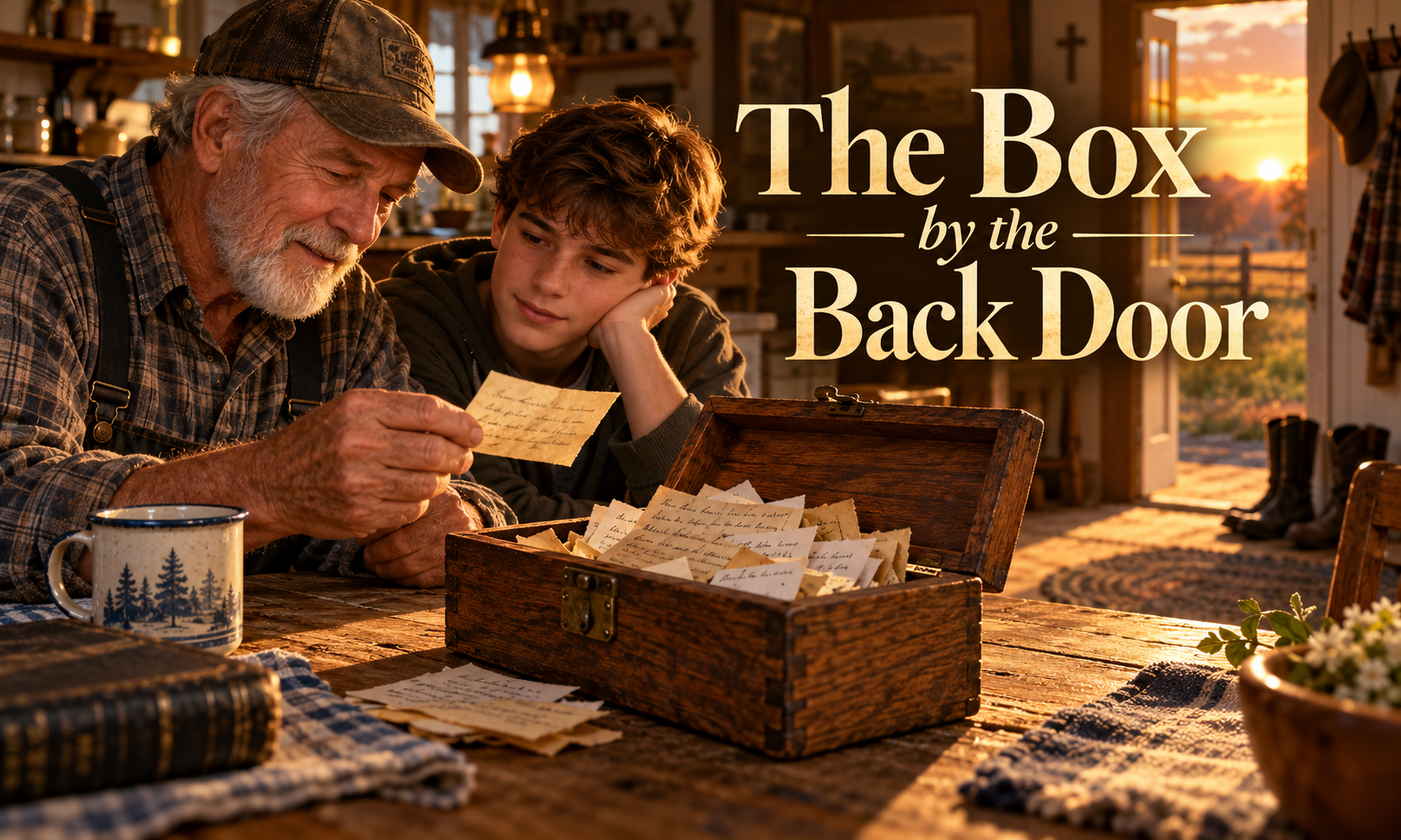
The Box by the Back Door
Walter Haynes kept a wooden box on a shelf by the back door of the farmhouse. It was the size of a shoebox, made from scrap oak, with a brass latch that had gone green.
His grandson Eli had walked past it a thousand times. He had never asked about it until the summer he turned sixteen, when his parents sent him to stay with his grandfather for two months after a rough year at school.
"What's in the box?" Eli asked one morning, reaching for his boots.
Walter looked up from his coffee. "Open it and see."
Inside were slips of paper. Hundreds of them. Some were yellowed and brittle. Some were torn from feed store receipts. A few were written on the backs of church bulletins. Each one had a date and a few words in his grandfather's slanted handwriting.
Eli pulled one out. "March 1981. Hail took the wheat. Ate beans all winter. No one went hungry."
Another. "June 1987. Nora's surgery. Doctor said fifty-fifty. She came home."
Another. "October 1993. I was wrong about Dale. Asked his forgiveness. He gave it."
Eli looked up. "What is all this?"
"That," Walter said, "is the Lord's record. Or the part of it I was paying attention to."
That night after supper, Eli brought the box to the kitchen table. Walter set two cups of coffee down and pulled out a slip at random.
"Nineteen seventy-four," he read. "Lost the north forty. Bank took it." He was quiet for a moment. "I was angry at God for about two years over that one."
"What happened?"
So Walter told him. About the loan he never should have taken, the pride that made him take it, and the neighbor who quietly helped him plant the rest of his land the next spring. About the night he finally knelt in the barn and told God he was sorry.
Eli had never heard any of it. He had thought his grandfather was the kind of man who had never made a mistake.
They did it most nights after that. Walter would pull out a slip, and Eli would ask questions. Some stories were about rain coming at the right time. Some were about money. A lot of them were about people: a hired hand who stole from him, a pastor who sat with him all night after Eli's grandmother died, a stranger who stopped on the highway when his truck caught fire.
Not every slip was a happy ending. "Prayed for Hal's boy," one said. "He didn't make it." Eli asked about that one too. Walter took a long time to answer.
"I don't know why," he said finally. "I don't. But I wrote it down because I still trusted Him. That's part of the record too."
Near the end of the summer, Eli came in from the field and found a fresh slip of paper on the table, along with a pencil.
"Your turn," Walter said.
Eli frowned. "I don't have anything."
"Sure you do. What happened this summer?"
Eli thought about the spring at school, the friends he had lost, the trouble he had gotten into, and how angry he had been when his parents sent him away. He thought about the nights at the kitchen table.
He picked up the pencil and wrote. "August. Came to Grandpa's mad. Leaving different."
Walter read it and nodded. He did not say anything. He just put it in the box on top of the others.
Walter died eleven years later. The farm was sold, and most of the furniture went to an auction. The box went to Eli.
It sits now on a shelf by the back door of a small house in town, next to a row of hooks with children's coats on them. There are new slips in it, in a different handwriting. Some are about jobs and rent. One is about a baby who came early and came home.
Last week Eli's daughter, who is six, pointed at the box and asked what was inside.
Eli set down his coffee. "Open it and see," he said.
Go Deeper
Ready to put this teaching into practice? Children Yet to Be Born is a guided workbook drawn from Deuteronomy 6 and Psalm 78. Work through four movements at your own pace and finish with one page you build for yourself: Your Handoff.
Faith is always one generation from being forgotten. Deuteronomy 6 and Psalm 78 hand parents, grandparents and leaders the same assignment: carry God's words on your own heart, tell the story at the kitchen table, answer the questions, and pass it on to children who are not yet born.
The Generation That Did Not Know
One of the saddest verses in the Bible comes just a few pages after Israel entered the promised land. Joshua had died. The elders who had crossed the Jordan and watched the walls of Jericho fall were gone. Then this: "After that whole generation had been gathered to their ancestors, another generation grew up who knew neither the Lord nor what he had done for Israel." (Judges 2:10, NIV).
It took one generation. The people who had seen the Red Sea part and eaten manna in the wilderness did not manage to hand that faith to their own children. The miracles were real. The memory did not survive.
Moses had warned them this could happen. Before they ever crossed the Jordan, he told them that comfort would be the danger. When they lived in houses they did not build and ate from vineyards they did not plant, they would need to "be careful that you do not forget the Lord, who brought you out of Egypt, out of the land of slavery." (Deuteronomy 6:12, NIV).
They forgot anyway. And the book of Judges is the story of what that forgetting cost.
Two Texts, One Assignment
Deuteronomy 6 and Psalm 78 are written centuries apart, but they carry the same assignment. Deuteronomy 6 is Moses preparing a generation to enter the land. It contains the Shema, Israel's great confession that the Lord is one and must be loved with all the heart, soul and strength, and it tells parents to talk about God's commands at home, on the road, at bedtime and in the morning.
Psalm 78 is a teacher looking back. It retells Israel's history, the wonders and the rebellions, so that the next generation will not repeat their ancestors' mistakes.
Together they answer one of the most urgent stewardship questions a believer faces. You have received faith. How do you pass it on? Not just to your children, but to grandchildren, younger colleagues, and people in your church and community who will carry it after you are gone.
Lesson One: It Starts on Your Heart
The first instruction about children in Deuteronomy 6 is not about children at all. "These commandments that I give you today are to be on your hearts." (Deuteronomy 6:6, NIV).
Your hearts. Before Moses said a word about teaching the next generation, he addressed the people who would do the teaching. Faith cannot be passed on by people who do not have it.
This is where many well-meaning parents and leaders go wrong. They want their children to love God, so they focus on programs, rules and church attendance. Those things matter. But children are remarkably good at detecting whether the faith being taught to them is actually alive in the person teaching it.
A parent who tells a child to pray but never prays will not raise a praying child. A leader who talks about integrity but cuts corners will raise people who learn to cut corners. What is on your heart will leak out, whether you intend it to or not.
That is why the Shema comes before the instructions about children. The love of God with all your heart, soul and strength is not just the content you are passing on. It is the source. When God's words are on your heart, teaching them becomes less like delivering a lesson and more like sharing what you are living.
So the first question for anyone who wants to pass on faith is not, how do I get my children to believe? It is, what is on my heart right now? Are God's words there, or only the memory of them? If they have grown faint, the place to begin is not with the next generation. It is with your own return to the Lord.
Lesson Two: Doorframes and Gates
Moses told parents to talk about God's commands when they sat at home and when they walked along the road, when they lay down and when they got up. That covers nearly every hour of an ordinary day. Then he went further. "Write them on the doorframes of your houses and on your gates." (Deuteronomy 6:9, NIV).
The doorframe was the place you passed every time you went in or out. The gate was where the town met to do business and settle disputes. God's words were meant to be visible at home and in public, in private routines and community life.
Notice what is missing. Moses did not tell parents to set aside one hour a week for religious instruction and keep the rest of life separate. Faith was not a subject. It was the air the household breathed.
This is a relief for many parents, because it means passing on faith does not require being a theologian. It requires being present and honest in ordinary moments. A conversation in the car. A prayer before a hard test. A question at the dinner table about why you made a costly decision. A story at bedtime about a time God was faithful to you.
It also explains why faith fades. When God is only mentioned on Sunday, children conclude that He belongs to Sunday. When He shows up in how the family spends money, handles conflict, treats neighbors and faces fear, children learn that He is Lord of everything.
Look at your own doorframes and gates. Where is God visible in the ordinary rhythms of your home and your work? The answer will tell you a lot about what the next generation is learning.
Lesson Three: When Your Son Asks
Deuteronomy 6 expects children to ask questions. "In the future, when your son asks you, 'What is the meaning of the stipulations, decrees and laws the Lord our God has commanded you?'" (Deuteronomy 6:20, NIV).
That is a fair question. Why do we do things this way? Why do we give when we could keep? Why do we rest when others work? Why does this family go to church, forgive people who hurt us, or refuse to lie on a tax return?
Moses did not tell parents to answer with a list of rules. He told them to answer with a story. "We were slaves of Pharaoh in Egypt, but the Lord brought us out of Egypt with a mighty hand." (Deuteronomy 6:21, NIV).
The commands made sense only in light of the rescue. We obey because we were slaves and God set us free. The rules are not the foundation. The rescue is.
This changes how we answer the next generation's questions. When a child asks why, a defensive answer, because I said so, or because that is what Christians do, will not carry faith very far. But a personal answer will. Here is what God did for us. Here is what I was like before He found me. Here is why I trust Him.
Questions are not a threat to passing on faith. They are an invitation. A child who asks why is opening a door. A young believer at work who asks why you handle things differently is giving you an opening to tell your story.
If you have never told the people closest to you how God rescued you, they may know your rules without knowing your reasons. Tell them. The story of what God has done is the strongest answer you can give.
Lesson Four: We Will Not Hide Them
Psalm 78 begins with a teacher calling for attention. "My people, hear my teaching; listen to the words of my mouth." (Psalm 78:1, NIV). He announces his method: "I will open my mouth with a parable; I will utter hidden things, things from of old—" (Psalm 78:2, NIV). Then he explains what he will teach: "things we have heard and known, things our ancestors have told us." (Psalm 78:3, NIV).
His commitment follows. "We will not hide them from their descendants; we will tell the next generation the praiseworthy deeds of the Lord, his power, and the wonders he has done." (Psalm 78:4, NIV).
But read the rest of the psalm and you notice something. It does not only tell the wonders. It tells the failures too. The psalmist wants the next generation to be different. "They would not be like their ancestors— a stubborn and rebellious generation, whose hearts were not loyal to God, whose spirits were not faithful to him." (Psalm 78:8, NIV). He records that "They forgot what he had done, the wonders he had shown them." (Psalm 78:11, NIV).
Passing on faith includes passing on honesty. The psalm does not present Israel's history as a highlight reel. It shows God's faithfulness against the background of the people's unfaithfulness, because that is where His grace is clearest.
Many parents and leaders are tempted to hide their failures from those who come after them. They want to look strong. But children and young believers who only see polished faith often conclude that faith is for people who never struggle. When they struggle, they assume they have failed.
The psalmist's approach is better. Tell them what God did. Tell them where we went wrong. Tell them how God kept His promises anyway. A faith that includes honest failure is a faith the next generation can actually hold.
Lesson Five: Children Yet to Be Born
Psalm 78 explains why God gave His law to Israel in the first place. "He decreed statutes for Jacob and established the law in Israel, which he commanded our ancestors to teach their children," (Psalm 78:5, NIV). Then the purpose: "so the next generation would know them, even the children yet to be born, and they in turn would tell their children." (Psalm 78:6, NIV).
Count the generations in those verses. The ancestors teach their children. Those children are the next generation. Then come children yet to be born, who in turn tell their own children. Four generations in a single sentence.
This is stewardship on a long timeline. The faith you pass on today is not only for the child in front of you. It is for grandchildren and great-grandchildren you may never meet. You are stewarding a story that is meant to outlive you.
The psalm also explains what success looks like. "Then they would put their trust in God and would not forget his deeds but would keep his commands." (Psalm 78:7, NIV).
Trust, memory and obedience. The goal is not that children will repeat the right words or attend the right church. It is that they will trust God for themselves, remember what He has done and walk in His ways.
You cannot control whether that happens. Every generation must choose to trust God. But you can be faithful with your part of the chain. You can make sure the story reaches the next generation with your own testimony added to it. Then the children yet to be born will have something to receive.
For Business Leaders: Entrust It to Reliable People
Business leaders build more than products. They shape people. The values, habits and character you model will outlast your time in the role, for better or worse.
Succession is a stewardship question. Who are you training to carry what you have learned? Are you passing on only skills, or also the integrity and faith that guide how you use them?
"And the things you have heard me say in the presence of many witnesses entrust to reliable people who will also be qualified to teach others." (2 Timothy 2:2, NIV).
Your Obedience Step
Choose one younger leader in your organization and schedule a regular conversation with them. In the first one, tell them about a hard decision you made and why your faith shaped it.
For Community Leaders: One Generation to Another
Churches and communities are often divided by generation. Older members feel unheard, and younger ones feel unwelcome. Psalm 78 imagines something better: generations telling each other what God has done.
Community leaders can create the spaces where those stories are told. A testimony from an older member on a Sunday. A young adult paired with someone who has walked with God for fifty years.
"One generation commends your works to another; they tell of your mighty acts." (Psalm 145:4, NIV).
Your Obedience Step
Plan one gathering this season where an older believer tells the story of God's faithfulness in their life to a group of younger people, and leave time for questions.
For Home Leaders: Start Them Off on the Way
The home is where Deuteronomy 6 does most of its work. Doorframes, dinner tables, car rides and bedtime prayers. Home leaders do not need to be perfect teachers. They need to be present, honest and consistent.
Start small. Pray together at one meal. Tell one story of God's faithfulness each week. Answer questions with your testimony, not just with rules.
"Start children off on the way they should go, and even when they are old they will not turn from it." (Proverbs 22:6, NIV).
Your Obedience Step
This week, tell your children or grandchildren the story of how you came to trust God, including a part you have never told them. Then ask them what questions they have.
For the Everyday Believer: Declare It to the Next Generation
You do not have to be a parent to pass on faith. Single believers, grandparents, aunts, uncles, mentors and neighbors all have someone younger watching them.
Psalm 78 assumes that every believer has a story worth telling. What God has done for you is not only for you. It is meant to be handed on.
"Even when I am old and gray, do not forsake me, my God, till I declare your power to the next generation, your mighty acts to all who are to come." (Psalm 71:18, NIV).
Your Obedience Step
Write down three things God has done in your life. Choose one younger person you know and share one of those stories with them this month.
Tell the Children Yet to Be Born
The generation after Joshua forgot the Lord because the story was not passed on. Deuteronomy 6 and Psalm 78 are God's answer to that danger. Keep His words on your own heart. Talk about Him in ordinary moments. Answer questions with the story of His rescue. Tell the failures honestly. And think beyond your own lifetime to children who are not yet born.
The faith you received was carried to you by someone. A parent, a grandparent, a pastor, a friend. Now it is in your hands. You cannot make the next generation believe, but you can make sure they have heard.
Questions for Reflection
- Are God's words on my own heart, or only in my memory?
- Where is God visible in the ordinary rhythms of my home and work?
- Have I told the people closest to me how God rescued me?
- Am I hiding my failures from the next generation, or letting them see God's grace in my story?
- Who are the children yet to be born that my faithfulness today might reach?
Closing Prayer
Lord, you have been faithful to every generation. Thank you for the people who carried your story to me. I confess that your words have not always been on my heart, and that I have sometimes kept my faith to myself. Forgive me. Write your commands on my heart again, and make them visible in my home, my work and my conversations. Give me courage to answer questions with the story of your rescue, and honesty to tell where I have failed. Let the children in my life, and the children yet to be born, put their trust in you, remember your deeds and keep your commands. In Jesus' name, Amen.
The Box by the Back Door
Walter Haynes kept a wooden box on a shelf by the back door of the farmhouse. It was the size of a shoebox, made from scrap oak, with a brass latch that had gone green.
His grandson Eli had walked past it a thousand times. He had never asked about it until the summer he turned sixteen, when his parents sent him to stay with his grandfather for two months after a rough year at school.
"What's in the box?" Eli asked one morning, reaching for his boots.
Walter looked up from his coffee. "Open it and see."
Inside were slips of paper. Hundreds of them. Some were yellowed and brittle. Some were torn from feed store receipts. A few were written on the backs of church bulletins. Each one had a date and a few words in his grandfather's slanted handwriting.
Eli pulled one out. "March 1981. Hail took the wheat. Ate beans all winter. No one went hungry."
Another. "June 1987. Nora's surgery. Doctor said fifty-fifty. She came home."
Another. "October 1993. I was wrong about Dale. Asked his forgiveness. He gave it."
Eli looked up. "What is all this?"
"That," Walter said, "is the Lord's record. Or the part of it I was paying attention to."
That night after supper, Eli brought the box to the kitchen table. Walter set two cups of coffee down and pulled out a slip at random.
"Nineteen seventy-four," he read. "Lost the north forty. Bank took it." He was quiet for a moment. "I was angry at God for about two years over that one."
"What happened?"
So Walter told him. About the loan he never should have taken, the pride that made him take it, and the neighbor who quietly helped him plant the rest of his land the next spring. About the night he finally knelt in the barn and told God he was sorry.
Eli had never heard any of it. He had thought his grandfather was the kind of man who had never made a mistake.
They did it most nights after that. Walter would pull out a slip, and Eli would ask questions. Some stories were about rain coming at the right time. Some were about money. A lot of them were about people: a hired hand who stole from him, a pastor who sat with him all night after Eli's grandmother died, a stranger who stopped on the highway when his truck caught fire.
Not every slip was a happy ending. "Prayed for Hal's boy," one said. "He didn't make it." Eli asked about that one too. Walter took a long time to answer.
"I don't know why," he said finally. "I don't. But I wrote it down because I still trusted Him. That's part of the record too."
Near the end of the summer, Eli came in from the field and found a fresh slip of paper on the table, along with a pencil.
"Your turn," Walter said.
Eli frowned. "I don't have anything."
"Sure you do. What happened this summer?"
Eli thought about the spring at school, the friends he had lost, the trouble he had gotten into, and how angry he had been when his parents sent him away. He thought about the nights at the kitchen table.
He picked up the pencil and wrote. "August. Came to Grandpa's mad. Leaving different."
Walter read it and nodded. He did not say anything. He just put it in the box on top of the others.
Walter died eleven years later. The farm was sold, and most of the furniture went to an auction. The box went to Eli.
It sits now on a shelf by the back door of a small house in town, next to a row of hooks with children's coats on them. There are new slips in it, in a different handwriting. Some are about jobs and rent. One is about a baby who came early and came home.
Last week Eli's daughter, who is six, pointed at the box and asked what was inside.
Eli set down his coffee. "Open it and see," he said.
Go Deeper
Ready to put this teaching into practice? Children Yet to Be Born is a guided workbook drawn from Deuteronomy 6 and Psalm 78. Work through four movements at your own pace and finish with one page you build for yourself: Your Handoff.
Comments
Keep it kind and on topic. See something that doesn't belong? Tap Report under it and we'll review it.