
Stewardship of Life · Stewardship Faith-Spiritual Growth
A Mere Handbreadth: Psalm 39 and the Prayer to Know How Fleeting Life Is
Qunetin Robinson

David held his tongue until his heart caught fire, and then he prayed a prayer most of us avoid: Lord, show me my life's end. Here is what Psalm 39 teaches about a handbreadth life, the wealth we heap up for someone else, and the only hope that lasts.
The Prayer Nobody Puts on a Coffee Mug
Some psalms get printed on wall art. Psalm 39 rarely does. It opens with a man biting his tongue, moves through a prayer about how short his life is, and ends with words so raw that some readers wonder whether they belong in the Bible at all.
David is not writing from a mountaintop. He is under pressure. Wicked people are watching him, and God's hand is heavy on him because of his own sin. He tries to stay quiet, and the silence nearly burns him up. When he finally speaks, he does not complain to the people around him. He turns to God and asks to see the truth about his own life.
That truth is not flattering. His days are a handbreadth. Even his security is a breath. The wealth he has gathered will end up in hands he cannot name.
Why a Short Life Is a Stewardship Question
We tend to treat the shortness of life as a topic for funerals. Psalm 39 treats it as a topic for Tuesday. David wants to know how fleeting his life is so that he can stop living as if it were not. A steward manages what belongs to someone else for a limited time, and Psalm 39 presses hard on both halves of that sentence.
The psalm does not leave us in gloom, though. In the middle of it, David asks the question that turns the whole prayer around: what do I look for? His answer is the anchor of this entire study. My hope is in you.
Lesson One: The Silence That Burns
Psalm 39 begins with a resolution. "I said, 'I will watch my ways and keep my tongue from sin; I will put a muzzle on my mouth while in the presence of the wicked.'" (Psalm 39:1, NIV).
There is wisdom in that. David knew that words spoken in anger, in front of people who already mocked God, could do real damage. So he clamped down. But he clamped down too hard. "So I remained utterly silent, not even saying anything good." (Psalm 39:2, NIV).
Notice the phrase not even saying anything good. David's silence was no longer self-control. It had become a kind of shutdown. He was not speaking evil, but he was not speaking truth, praise or prayer either. And the pressure built. "But my anguish increased; my heart grew hot within me. While I meditated, the fire burned; then I spoke with my tongue" (Psalm 39:2-3, NIV).
Many of us know this pattern. We keep it together at work, at church and at home, and we swallow what we feel until the swallowing becomes a fire.
What David did next is the lesson. When the fire finally broke out, he did not aim it at the wicked or at the people near him. He aimed it at God. The very next words are a prayer.
Guarding your tongue before people is a virtue. Going silent before God is not. The steward of a short life cannot afford to spend years smoldering. If something is burning in you, the safest place to let it out is in prayer. God can hold the heat that would scorch everyone else.
Lesson Two: Show Me, Lord
When David finally spoke, this is what he said. "Show me, Lord, my life's end and the number of my days; let me know how fleeting my life is." (Psalm 39:4, NIV).
That is a startling request. Most people do not want to know their life's end. David does something different. He asks God to show him.
There is a difference between calculating your days and being shown them. Calculation gives you a number. Revelation gives you a perspective. David was not asking for a date on the calendar. He was asking God to make the shortness of life real to him, to move it from his head to his heart.
We drift into living as though we have forever, putting off reconciliation and postponing obedience. David knew that only God could correct that. Human beings are skilled at forgetting what they do not want to remember. So he asked the Lord to do what he could not do for himself: make him know how fleeting his life is.
This is a prayer of courage. It asks for clarity even when clarity hurts. It is also a prayer of trust. David does not ask to be shown his end by a crisis or a scare. He asks to be shown by God, who can teach the lesson with mercy.
If you have never prayed this prayer, it may be time. Ask God to show you how fleeting your life is, and then pay attention to how He answers.
Lesson Three: A Mere Handbreadth, Even for the Secure
God answered David's prayer with an image. "You have made my days a mere handbreadth; the span of my years is as nothing before you. Everyone is but a breath, even those who seem secure." (Psalm 39:5, NIV).
A handbreadth was one of the smallest units of measure in Israel, the width of four fingers laid side by side. You do not measure a field or a city wall in handbreadths. You measure small things that way. David looked at his whole life and saw something he could cover with his hand.
Then he added a word that cuts deeper. Everyone is but a breath. The Hebrew word is hevel, the same word Ecclesiastes uses for vapor, a breath that fogs a cold window and is gone. Life is not only short. It is thin, weightless and quick to vanish.
The last phrase is the one that should stop us. Even those who seem secure. David was a king with an army, a palace and a treasury. If anyone looked secure, he did. Yet he included himself in the breath.
Security is one of the great illusions of a prosperous life. A strong balance sheet, good health, a stable job and a paid-off house all whisper that we are settled. Psalm 39 says that the person who seems most secure is still a breath. Money can buy comfort. It cannot buy weight.
When you know your life is a handbreadth, you stop building your identity on what you can lose. You start asking what your few breaths are for.
A good steward measures life honestly. Lay your hand flat and look at it. That is the span. What will you do with it?
Lesson Four: Heaping Up for Whom?
Next David turned from his own life to the way people live. "Surely everyone goes around like a mere phantom; in vain they rush about, heaping up wealth without knowing whose it will finally be." (Psalm 39:6, NIV).
Picture the scene he describes. People rushing about, busy and breathless, filling barns and accounts, adding and stacking and saving. From a distance they look substantial. Up close they are phantoms, shadows moving fast across a wall.
The problem David names is not wealth itself. Scripture often speaks of wealth as a gift. The problem is the rushing, the heaping and especially the not knowing. They gather without knowing whose it will finally be.
That phrase should humble every one of us. You can control how much you save. You cannot control who will hold it when you are gone. It may go to a child who honors God with it or a child who wastes it. It may go to a stranger at an estate sale, a creditor or the government. You will not be there to decide.
A steward does not stop working or saving. He stops heaping without a purpose. He asks God what each season of earning is for, and he gives, plans and invests with eternity in view. If you cannot say whose your wealth will finally be, at least settle whose it is now. It belongs to God, and He has a purpose for it while it is in your hands.
Lesson Five: What Do I Look For?
Right in the middle of this sober psalm, David turns. "But now, Lord, what do I look for? My hope is in you." (Psalm 39:7, NIV).
Those two small words, But now, change everything. David has looked honestly at his short life, at the illusion of security and at the empty rush of heaping up wealth. If the psalm stopped there, it would be a philosophy of despair. Instead he asks the question every human heart must answer. If life is a breath and wealth will pass to others, what do I look for?
His answer is not more time, more money or more control. It is a Person. My hope is in you.
Notice what he asks for next. "Save me from all my transgressions; do not make me the scorn of fools." (Psalm 39:8, NIV). His hope in God leads straight to repentance. He knows that the deepest problem in his life is not its length. It is his sin. A short life lived in sin is a tragedy. A short life forgiven and placed in God's hands is a gift.
Hope placed in God also changes how we steward what we have. When your future rests on Him, you do not need to grip your money, your schedule or your reputation so tightly. You can let go, because none of those things was ever carrying your hope.
Ask yourself honestly: what am I looking for? The answer will show you where your hope really rests.
Lesson Six: The Moth, the Stranger and the Honest Ending
The final verses of Psalm 39 are not easy. David recognizes that God's hand has been heavy on him. "I was silent; I would not open my mouth, for you are the one who has done this." (Psalm 39:9, NIV). This is a different silence from the one in verse two. That silence was a shutdown. This one is surrender. He stops arguing because he sees that God is at work.
He also sees how God's discipline exposes what we trust. "When you rebuke and discipline anyone for their sin, you consume their wealth like a moth— surely everyone is but a breath." (Psalm 39:11, NIV). A moth does not destroy a garment in one violent moment. It eats quietly, a little at a time, until what looked solid is full of holes. God sometimes lets the things we lean on wear thin so that we will lean on Him. Then David circles back to the refrain he first prayed in verse five: everyone is but a breath.
That discipline is not cruelty. "God disciplines us for our good, in order that we may share in his holiness." (Hebrews 12:10, NIV).
Then David names who he really is. "Hear my prayer, Lord, listen to my cry for help; do not be deaf to my weeping. I dwell with you as a foreigner, a stranger, as all my ancestors were." (Psalm 39:12, NIV). A foreigner does not own the land. He lives on it by the host's permission. Yet notice the words with you. David is a stranger, but he dwells with God. Peter later called believers to live the same way: "Dear friends, I urge you, as foreigners and exiles, to abstain from sinful desires, which wage war against your soul." (1 Peter 2:11, NIV).
The psalm ends with a sigh, not a song. "Look away from me, that I may enjoy life again before I depart and am no more." (Psalm 39:13, NIV). Honest prayer is allowed to end unresolved. Faith is not pretending the weight is gone. It is bringing the weight to God and leaving it there.
For Business Leaders: Build for More Than the Next Quarter
Business runs on rushing about. Targets, launches and growth plans keep leaders busy, and busyness can feel like purpose. Psalm 39 asks a harder question: whose will all this finally be? The company you are building will outlast your role in it, or it will not outlast you at all. Either way, you will not control its final hands.
That is not a reason to stop building. It is a reason to build things that matter beyond the balance sheet: people who grow under your leadership, integrity that becomes part of the culture and generosity that blesses the community.
"But store up for yourselves treasures in heaven, where moths and vermin do not destroy, and where thieves do not break in and steal." (Matthew 6:20, NIV).
Your Obedience Step
Block one hour this week to ask God what your current season of work is for. Write down three outcomes you want to outlast you, such as a leader you are developing, a value you are protecting or a cause you are funding, and change one decision on your calendar to serve one of them.
For Community Leaders: Lead People Toward What Is Unseen
People who lead churches, nonprofits and community groups carry the weight of many visible needs. Budgets, buildings, events and attendance numbers press in every week. Those things matter, but they are not the point. Psalm 39 reminds leaders that every person they serve is a breath, and every program is temporary.
The leader's real work is pointing people toward the hope David found. A food pantry, a mentoring program or a Sunday service is a means of showing a fleeting people where lasting hope is found.
"So we fix our eyes not on what is seen, but on what is unseen, since what is seen is temporary, but what is unseen is eternal." (2 Corinthians 4:18, NIV).
Your Obedience Step
At your next team meeting, set aside ten minutes before the agenda to ask one question: what are we doing this month that will matter in eternity? Choose one activity to strengthen and one to simplify based on the answer.
For Home Leaders: Tell Them Whose It Will Be
David said people heap up wealth without knowing whose it will finally be. Parents and grandparents can do something about that. You cannot control every outcome, but you can make sure the people who will inherit your home, your savings and your belongings also inherit the reason behind them.
Children learn what their parents trust by watching how they hold what they have. Let them see you hold it loosely and place your hope in God.
"The life of mortals is like grass, they flourish like a flower of the field; the wind blows over it and it is gone, and its place remembers it no more." (Psalm 103:15-16, NIV).
Your Obedience Step
This month, sit down with your family and talk plainly about what you own and why. Tell them where your hope rests. If you do not have a will or a written plan for your estate, start one, and include a letter that explains the faith behind your choices.
For the Everyday Believer: Find Rest Where Your Hope Is
You may not run a company or lead a ministry, but you know the rush David described. Errands, deadlines, bills and responsibilities can fill every waking hour. You can live for years that way and never stop to ask what you are looking for.
Psalm 39 invites you to stop long enough to pray it. Ask God to show you how fleeting your life is. Then answer His question with David's words: my hope is in you. Rest is not the absence of work. It is the presence of hope in the right place.
"Yes, my soul, find rest in God; my hope comes from him." (Psalm 62:5, NIV).
Your Obedience Step
Each morning this week, before you check your phone, lay your hand flat on the table and pray, "Show me, Lord, how fleeting my life is. My hope is in you." Then choose one thing on that day's list to do for eternity rather than for the rush.
My Hope Is in You
Psalm 39 is a prayer for people who are tired of pretending. David admitted that his silence had turned to fire. He admitted that his days were a handbreadth and that his security was a breath. He admitted that people heap up wealth without knowing whose it will be, and that God's discipline had worn holes in what he trusted.
In the middle of all that honesty, he planted one unshakable sentence. My hope is in you.
That is where a steward of a short life must stand. We do not know the number of our days, but we know the One who does. We do not know whose our wealth will finally be, but we know whose it is now. We are foreigners and strangers, but we dwell with Him. A handbreadth life placed in God's hands is enough.
Questions for Reflection
- Is there anything I have kept silent about that has begun to burn inside me, and have I brought it to God in prayer?
- Have I ever asked God to show me how fleeting my life is? What might change if I did?
- Where am I trusting in things that only make me seem secure?
- What am I heaping up right now, and do I know what it is for?
- If someone asked me what I am looking for, what would my schedule and spending say?
- How has God used discipline or loss to loosen my grip on something I trusted?
Closing Prayer
Lord, I confess that I often live as if I have forever. I keep quiet when I should pray, and I rush about gathering things without asking what they are for. Show me my life's end and the number of my days. Let me know how fleeting my life is, not to frighten me, but to teach me. You have made my days a mere handbreadth, and even when I seem secure, I am only a breath. Save me from all my transgressions. Where you have disciplined me, help me see your hand and trust your purpose. Thank you that I dwell with you, even as a stranger here. Loosen my grip on what will pass to others, and help me invest my few days in what lasts. When I ask what I am looking for, let my answer be you. My hope is in you. In Jesus' name, Amen.
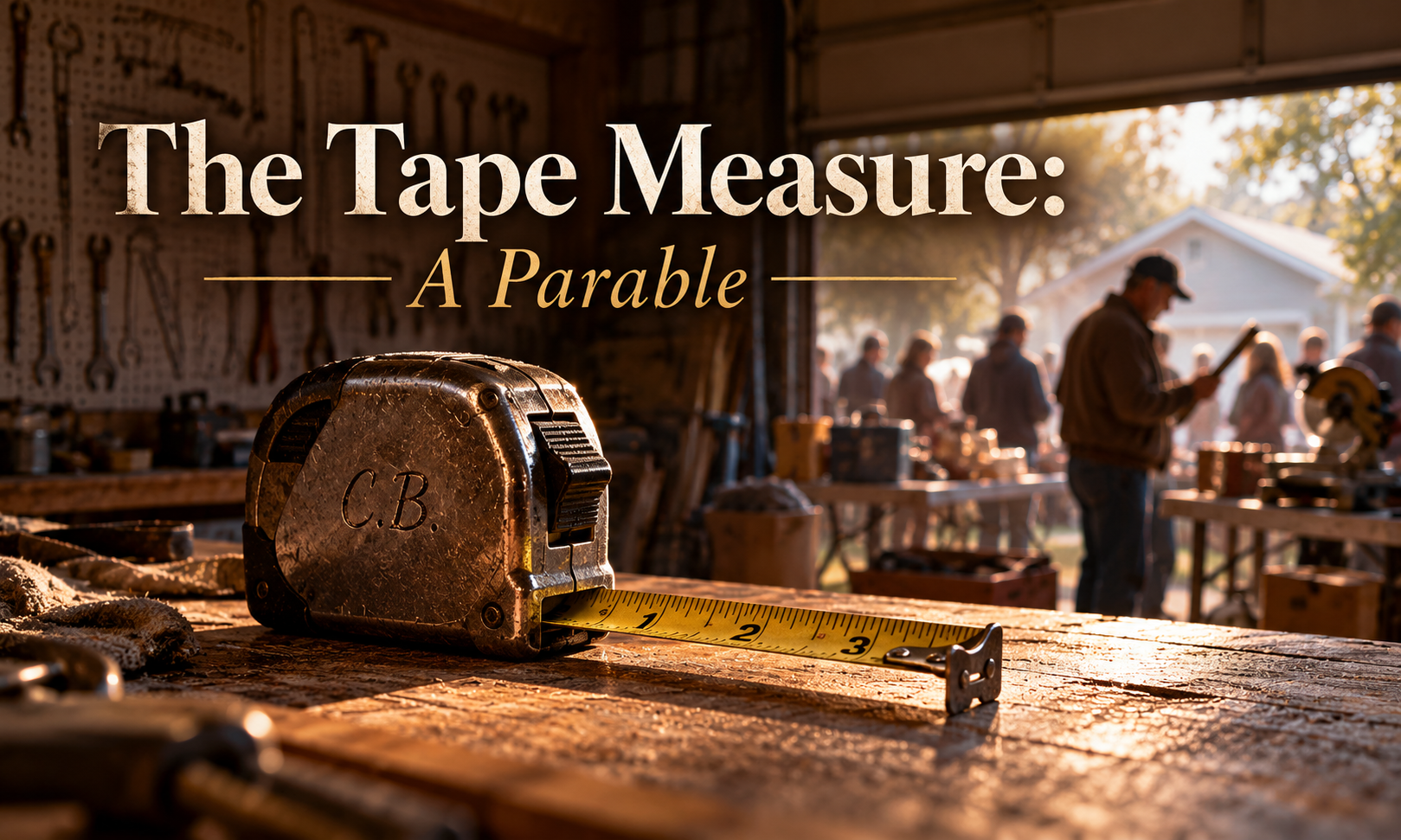
The Tape Measure
The estate sale started at eight on a Saturday, and by nine there were strangers in Curtis Bell's father's garage.
Curtis stood by the folding table with the cash box and watched a man in a ball cap pick up his father's level, the long brass one, and turn it over in his hands.
"How much for this?"
"Two dollars," said the woman from the sale company.
Curtis opened his mouth and then closed it. He had told himself he would not make a scene. He had told himself a lot of things that month. He had told himself it was fine that his brother had not come to help. He had told himself it was fine that the new hardware chain out on the highway was undercutting his store's prices by twenty percent. He had kept every bit of it to himself, and it sat in his chest like a coal.
The man in the ball cap paid two dollars and walked out with the level.
His father had run a small contracting business for forty-one years. Decks, porches, kitchen remodels, half the church's fellowship hall. He had saved carefully and bought good tools and kept them oiled. Curtis had always assumed the tools would go to him, or to his son, or to somebody who knew what they were for.
Instead, a woman bought the miter saw for her nephew who might take up woodworking someday. A teenager bought the socket set to resell online.
By noon the pegboard was mostly bare. Hooks and outlines. His father had traced the shape of every tool in black marker so he would know where it went back.
Curtis found one thing left in the corner of the workbench drawer: a battered steel tape measure with his father's initials scratched into the case.
He took it home that night and sat at the kitchen table after everyone had gone to bed. He was supposed to be working on the plan for a second store. The bank wanted projections by Monday. He had been working eleven-hour days for most of a year to get to this point, and he had barely seen his son play a full baseball game all spring.
Instead he pulled out the tape and, for no good reason, measured his own hand. Four fingers laid flat. A little over three inches.
He looked at it for a long time.
Forty-one years of work, and the tools had gone to strangers in three hours for less than the cost of a dinner out. His father had not known whose they would finally be. Curtis did not know whose his store would finally be either. Or the second store. Or the house. Or any of it.
The coal in his chest flared. And for the first time in a month, he did not swallow it.
"Lord," he said out loud in the empty kitchen, "I am so tired of pretending I'm fine."
He talked to God for an hour. About his brother. About the chain on the highway. About the second store and the bank and the baseball games. About his father, whom he missed more than he had admitted to anyone. Then he asked something he had never asked before.
"Show me how short this is. Please. I keep living like it's long."
Nothing dramatic happened. But on Monday Curtis called the bank and asked for another month on the projections. That afternoon he left the store at four and made it to the second inning.
The following week he stopped by the trade school on Fourth Street, where a young man named Andre had been sweeping floors in the shop program. Curtis had heard he was trying to start his own small repair business with borrowed tools. He brought what was left of his own spare equipment, a drill, a circular saw and a good level, and gave it to him.
"Why?" Andre asked.
Curtis thought about the pegboard full of black outlines.
"Because I want to know whose these will be," he said.
He kept the tape measure in his shirt pocket after that. Most days he forgot it was there. But sometimes, when the store was busy and the old rush started to rise in him, he would set it on the counter, pull out three inches, and let it snap back.
Then he would breathe, and pray one short sentence, and get back to work.
Go Deeper
Ready to put this teaching into practice? Poured Out is a guided workbook drawn from Psalm 139, Psalm 39, Romans 12, Acts 20 and 2 Timothy 4. Work through four movements at your own pace and finish with one page you build for yourself: Your Finish Line.
David held his tongue until his heart caught fire, and then he prayed a prayer most of us avoid: Lord, show me my life's end. Here is what Psalm 39 teaches about a handbreadth life, the wealth we heap up for someone else, and the only hope that lasts.
The Prayer Nobody Puts on a Coffee Mug
Some psalms get printed on wall art. Psalm 39 rarely does. It opens with a man biting his tongue, moves through a prayer about how short his life is, and ends with words so raw that some readers wonder whether they belong in the Bible at all.
David is not writing from a mountaintop. He is under pressure. Wicked people are watching him, and God's hand is heavy on him because of his own sin. He tries to stay quiet, and the silence nearly burns him up. When he finally speaks, he does not complain to the people around him. He turns to God and asks to see the truth about his own life.
That truth is not flattering. His days are a handbreadth. Even his security is a breath. The wealth he has gathered will end up in hands he cannot name.
Why a Short Life Is a Stewardship Question
We tend to treat the shortness of life as a topic for funerals. Psalm 39 treats it as a topic for Tuesday. David wants to know how fleeting his life is so that he can stop living as if it were not. A steward manages what belongs to someone else for a limited time, and Psalm 39 presses hard on both halves of that sentence.
The psalm does not leave us in gloom, though. In the middle of it, David asks the question that turns the whole prayer around: what do I look for? His answer is the anchor of this entire study. My hope is in you.
Lesson One: The Silence That Burns
Psalm 39 begins with a resolution. "I said, 'I will watch my ways and keep my tongue from sin; I will put a muzzle on my mouth while in the presence of the wicked.'" (Psalm 39:1, NIV).
There is wisdom in that. David knew that words spoken in anger, in front of people who already mocked God, could do real damage. So he clamped down. But he clamped down too hard. "So I remained utterly silent, not even saying anything good." (Psalm 39:2, NIV).
Notice the phrase not even saying anything good. David's silence was no longer self-control. It had become a kind of shutdown. He was not speaking evil, but he was not speaking truth, praise or prayer either. And the pressure built. "But my anguish increased; my heart grew hot within me. While I meditated, the fire burned; then I spoke with my tongue" (Psalm 39:2-3, NIV).
Many of us know this pattern. We keep it together at work, at church and at home, and we swallow what we feel until the swallowing becomes a fire.
What David did next is the lesson. When the fire finally broke out, he did not aim it at the wicked or at the people near him. He aimed it at God. The very next words are a prayer.
Guarding your tongue before people is a virtue. Going silent before God is not. The steward of a short life cannot afford to spend years smoldering. If something is burning in you, the safest place to let it out is in prayer. God can hold the heat that would scorch everyone else.
Lesson Two: Show Me, Lord
When David finally spoke, this is what he said. "Show me, Lord, my life's end and the number of my days; let me know how fleeting my life is." (Psalm 39:4, NIV).
That is a startling request. Most people do not want to know their life's end. David does something different. He asks God to show him.
There is a difference between calculating your days and being shown them. Calculation gives you a number. Revelation gives you a perspective. David was not asking for a date on the calendar. He was asking God to make the shortness of life real to him, to move it from his head to his heart.
We drift into living as though we have forever, putting off reconciliation and postponing obedience. David knew that only God could correct that. Human beings are skilled at forgetting what they do not want to remember. So he asked the Lord to do what he could not do for himself: make him know how fleeting his life is.
This is a prayer of courage. It asks for clarity even when clarity hurts. It is also a prayer of trust. David does not ask to be shown his end by a crisis or a scare. He asks to be shown by God, who can teach the lesson with mercy.
If you have never prayed this prayer, it may be time. Ask God to show you how fleeting your life is, and then pay attention to how He answers.
Lesson Three: A Mere Handbreadth, Even for the Secure
God answered David's prayer with an image. "You have made my days a mere handbreadth; the span of my years is as nothing before you. Everyone is but a breath, even those who seem secure." (Psalm 39:5, NIV).
A handbreadth was one of the smallest units of measure in Israel, the width of four fingers laid side by side. You do not measure a field or a city wall in handbreadths. You measure small things that way. David looked at his whole life and saw something he could cover with his hand.
Then he added a word that cuts deeper. Everyone is but a breath. The Hebrew word is hevel, the same word Ecclesiastes uses for vapor, a breath that fogs a cold window and is gone. Life is not only short. It is thin, weightless and quick to vanish.
The last phrase is the one that should stop us. Even those who seem secure. David was a king with an army, a palace and a treasury. If anyone looked secure, he did. Yet he included himself in the breath.
Security is one of the great illusions of a prosperous life. A strong balance sheet, good health, a stable job and a paid-off house all whisper that we are settled. Psalm 39 says that the person who seems most secure is still a breath. Money can buy comfort. It cannot buy weight.
When you know your life is a handbreadth, you stop building your identity on what you can lose. You start asking what your few breaths are for.
A good steward measures life honestly. Lay your hand flat and look at it. That is the span. What will you do with it?
Lesson Four: Heaping Up for Whom?
Next David turned from his own life to the way people live. "Surely everyone goes around like a mere phantom; in vain they rush about, heaping up wealth without knowing whose it will finally be." (Psalm 39:6, NIV).
Picture the scene he describes. People rushing about, busy and breathless, filling barns and accounts, adding and stacking and saving. From a distance they look substantial. Up close they are phantoms, shadows moving fast across a wall.
The problem David names is not wealth itself. Scripture often speaks of wealth as a gift. The problem is the rushing, the heaping and especially the not knowing. They gather without knowing whose it will finally be.
That phrase should humble every one of us. You can control how much you save. You cannot control who will hold it when you are gone. It may go to a child who honors God with it or a child who wastes it. It may go to a stranger at an estate sale, a creditor or the government. You will not be there to decide.
A steward does not stop working or saving. He stops heaping without a purpose. He asks God what each season of earning is for, and he gives, plans and invests with eternity in view. If you cannot say whose your wealth will finally be, at least settle whose it is now. It belongs to God, and He has a purpose for it while it is in your hands.
Lesson Five: What Do I Look For?
Right in the middle of this sober psalm, David turns. "But now, Lord, what do I look for? My hope is in you." (Psalm 39:7, NIV).
Those two small words, But now, change everything. David has looked honestly at his short life, at the illusion of security and at the empty rush of heaping up wealth. If the psalm stopped there, it would be a philosophy of despair. Instead he asks the question every human heart must answer. If life is a breath and wealth will pass to others, what do I look for?
His answer is not more time, more money or more control. It is a Person. My hope is in you.
Notice what he asks for next. "Save me from all my transgressions; do not make me the scorn of fools." (Psalm 39:8, NIV). His hope in God leads straight to repentance. He knows that the deepest problem in his life is not its length. It is his sin. A short life lived in sin is a tragedy. A short life forgiven and placed in God's hands is a gift.
Hope placed in God also changes how we steward what we have. When your future rests on Him, you do not need to grip your money, your schedule or your reputation so tightly. You can let go, because none of those things was ever carrying your hope.
Ask yourself honestly: what am I looking for? The answer will show you where your hope really rests.
Lesson Six: The Moth, the Stranger and the Honest Ending
The final verses of Psalm 39 are not easy. David recognizes that God's hand has been heavy on him. "I was silent; I would not open my mouth, for you are the one who has done this." (Psalm 39:9, NIV). This is a different silence from the one in verse two. That silence was a shutdown. This one is surrender. He stops arguing because he sees that God is at work.
He also sees how God's discipline exposes what we trust. "When you rebuke and discipline anyone for their sin, you consume their wealth like a moth— surely everyone is but a breath." (Psalm 39:11, NIV). A moth does not destroy a garment in one violent moment. It eats quietly, a little at a time, until what looked solid is full of holes. God sometimes lets the things we lean on wear thin so that we will lean on Him. Then David circles back to the refrain he first prayed in verse five: everyone is but a breath.
That discipline is not cruelty. "God disciplines us for our good, in order that we may share in his holiness." (Hebrews 12:10, NIV).
Then David names who he really is. "Hear my prayer, Lord, listen to my cry for help; do not be deaf to my weeping. I dwell with you as a foreigner, a stranger, as all my ancestors were." (Psalm 39:12, NIV). A foreigner does not own the land. He lives on it by the host's permission. Yet notice the words with you. David is a stranger, but he dwells with God. Peter later called believers to live the same way: "Dear friends, I urge you, as foreigners and exiles, to abstain from sinful desires, which wage war against your soul." (1 Peter 2:11, NIV).
The psalm ends with a sigh, not a song. "Look away from me, that I may enjoy life again before I depart and am no more." (Psalm 39:13, NIV). Honest prayer is allowed to end unresolved. Faith is not pretending the weight is gone. It is bringing the weight to God and leaving it there.
For Business Leaders: Build for More Than the Next Quarter
Business runs on rushing about. Targets, launches and growth plans keep leaders busy, and busyness can feel like purpose. Psalm 39 asks a harder question: whose will all this finally be? The company you are building will outlast your role in it, or it will not outlast you at all. Either way, you will not control its final hands.
That is not a reason to stop building. It is a reason to build things that matter beyond the balance sheet: people who grow under your leadership, integrity that becomes part of the culture and generosity that blesses the community.
"But store up for yourselves treasures in heaven, where moths and vermin do not destroy, and where thieves do not break in and steal." (Matthew 6:20, NIV).
Your Obedience Step
Block one hour this week to ask God what your current season of work is for. Write down three outcomes you want to outlast you, such as a leader you are developing, a value you are protecting or a cause you are funding, and change one decision on your calendar to serve one of them.
For Community Leaders: Lead People Toward What Is Unseen
People who lead churches, nonprofits and community groups carry the weight of many visible needs. Budgets, buildings, events and attendance numbers press in every week. Those things matter, but they are not the point. Psalm 39 reminds leaders that every person they serve is a breath, and every program is temporary.
The leader's real work is pointing people toward the hope David found. A food pantry, a mentoring program or a Sunday service is a means of showing a fleeting people where lasting hope is found.
"So we fix our eyes not on what is seen, but on what is unseen, since what is seen is temporary, but what is unseen is eternal." (2 Corinthians 4:18, NIV).
Your Obedience Step
At your next team meeting, set aside ten minutes before the agenda to ask one question: what are we doing this month that will matter in eternity? Choose one activity to strengthen and one to simplify based on the answer.
For Home Leaders: Tell Them Whose It Will Be
David said people heap up wealth without knowing whose it will finally be. Parents and grandparents can do something about that. You cannot control every outcome, but you can make sure the people who will inherit your home, your savings and your belongings also inherit the reason behind them.
Children learn what their parents trust by watching how they hold what they have. Let them see you hold it loosely and place your hope in God.
"The life of mortals is like grass, they flourish like a flower of the field; the wind blows over it and it is gone, and its place remembers it no more." (Psalm 103:15-16, NIV).
Your Obedience Step
This month, sit down with your family and talk plainly about what you own and why. Tell them where your hope rests. If you do not have a will or a written plan for your estate, start one, and include a letter that explains the faith behind your choices.
For the Everyday Believer: Find Rest Where Your Hope Is
You may not run a company or lead a ministry, but you know the rush David described. Errands, deadlines, bills and responsibilities can fill every waking hour. You can live for years that way and never stop to ask what you are looking for.
Psalm 39 invites you to stop long enough to pray it. Ask God to show you how fleeting your life is. Then answer His question with David's words: my hope is in you. Rest is not the absence of work. It is the presence of hope in the right place.
"Yes, my soul, find rest in God; my hope comes from him." (Psalm 62:5, NIV).
Your Obedience Step
Each morning this week, before you check your phone, lay your hand flat on the table and pray, "Show me, Lord, how fleeting my life is. My hope is in you." Then choose one thing on that day's list to do for eternity rather than for the rush.
My Hope Is in You
Psalm 39 is a prayer for people who are tired of pretending. David admitted that his silence had turned to fire. He admitted that his days were a handbreadth and that his security was a breath. He admitted that people heap up wealth without knowing whose it will be, and that God's discipline had worn holes in what he trusted.
In the middle of all that honesty, he planted one unshakable sentence. My hope is in you.
That is where a steward of a short life must stand. We do not know the number of our days, but we know the One who does. We do not know whose our wealth will finally be, but we know whose it is now. We are foreigners and strangers, but we dwell with Him. A handbreadth life placed in God's hands is enough.
Questions for Reflection
- Is there anything I have kept silent about that has begun to burn inside me, and have I brought it to God in prayer?
- Have I ever asked God to show me how fleeting my life is? What might change if I did?
- Where am I trusting in things that only make me seem secure?
- What am I heaping up right now, and do I know what it is for?
- If someone asked me what I am looking for, what would my schedule and spending say?
- How has God used discipline or loss to loosen my grip on something I trusted?
Closing Prayer
Lord, I confess that I often live as if I have forever. I keep quiet when I should pray, and I rush about gathering things without asking what they are for. Show me my life's end and the number of my days. Let me know how fleeting my life is, not to frighten me, but to teach me. You have made my days a mere handbreadth, and even when I seem secure, I am only a breath. Save me from all my transgressions. Where you have disciplined me, help me see your hand and trust your purpose. Thank you that I dwell with you, even as a stranger here. Loosen my grip on what will pass to others, and help me invest my few days in what lasts. When I ask what I am looking for, let my answer be you. My hope is in you. In Jesus' name, Amen.
The Tape Measure
The estate sale started at eight on a Saturday, and by nine there were strangers in Curtis Bell's father's garage.
Curtis stood by the folding table with the cash box and watched a man in a ball cap pick up his father's level, the long brass one, and turn it over in his hands.
"How much for this?"
"Two dollars," said the woman from the sale company.
Curtis opened his mouth and then closed it. He had told himself he would not make a scene. He had told himself a lot of things that month. He had told himself it was fine that his brother had not come to help. He had told himself it was fine that the new hardware chain out on the highway was undercutting his store's prices by twenty percent. He had kept every bit of it to himself, and it sat in his chest like a coal.
The man in the ball cap paid two dollars and walked out with the level.
His father had run a small contracting business for forty-one years. Decks, porches, kitchen remodels, half the church's fellowship hall. He had saved carefully and bought good tools and kept them oiled. Curtis had always assumed the tools would go to him, or to his son, or to somebody who knew what they were for.
Instead, a woman bought the miter saw for her nephew who might take up woodworking someday. A teenager bought the socket set to resell online.
By noon the pegboard was mostly bare. Hooks and outlines. His father had traced the shape of every tool in black marker so he would know where it went back.
Curtis found one thing left in the corner of the workbench drawer: a battered steel tape measure with his father's initials scratched into the case.
He took it home that night and sat at the kitchen table after everyone had gone to bed. He was supposed to be working on the plan for a second store. The bank wanted projections by Monday. He had been working eleven-hour days for most of a year to get to this point, and he had barely seen his son play a full baseball game all spring.
Instead he pulled out the tape and, for no good reason, measured his own hand. Four fingers laid flat. A little over three inches.
He looked at it for a long time.
Forty-one years of work, and the tools had gone to strangers in three hours for less than the cost of a dinner out. His father had not known whose they would finally be. Curtis did not know whose his store would finally be either. Or the second store. Or the house. Or any of it.
The coal in his chest flared. And for the first time in a month, he did not swallow it.
"Lord," he said out loud in the empty kitchen, "I am so tired of pretending I'm fine."
He talked to God for an hour. About his brother. About the chain on the highway. About the second store and the bank and the baseball games. About his father, whom he missed more than he had admitted to anyone. Then he asked something he had never asked before.
"Show me how short this is. Please. I keep living like it's long."
Nothing dramatic happened. But on Monday Curtis called the bank and asked for another month on the projections. That afternoon he left the store at four and made it to the second inning.
The following week he stopped by the trade school on Fourth Street, where a young man named Andre had been sweeping floors in the shop program. Curtis had heard he was trying to start his own small repair business with borrowed tools. He brought what was left of his own spare equipment, a drill, a circular saw and a good level, and gave it to him.
"Why?" Andre asked.
Curtis thought about the pegboard full of black outlines.
"Because I want to know whose these will be," he said.
He kept the tape measure in his shirt pocket after that. Most days he forgot it was there. But sometimes, when the store was busy and the old rush started to rise in him, he would set it on the counter, pull out three inches, and let it snap back.
Then he would breathe, and pray one short sentence, and get back to work.
Go Deeper
Ready to put this teaching into practice? Poured Out is a guided workbook drawn from Psalm 139, Psalm 39, Romans 12, Acts 20 and 2 Timothy 4. Work through four movements at your own pace and finish with one page you build for yourself: Your Finish Line.
Comments
Keep it kind and on topic. See something that doesn't belong? Tap Report under it and we'll review it.