
Stewardship of Resources · Stewardship of Time and Discipline
Know the Condition of Your Flocks: Proverbs 21, 22 and 27 on Margin, Debt and Paying Attention
Qunetin Robinson
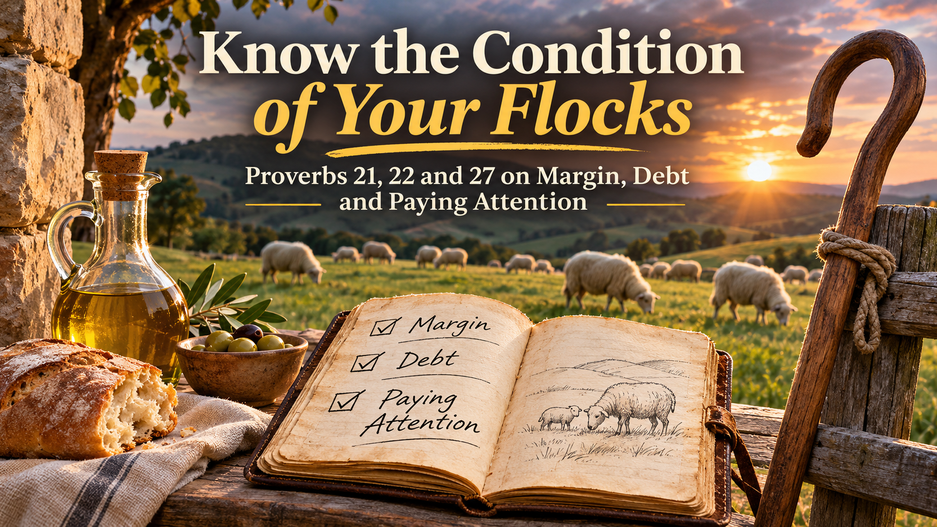
The wise keep a store while fools gulp theirs down, the borrower becomes a servant, and the steward who prospers is the one who knows the condition of the flock. Here is what Proverbs 21, 22 and 27 teach about margin, debt and paying attention to what God has put in your care.
Three Sentences From a Farmer's Notebook
The book of Proverbs does not give a full chapter on money. It scatters its counsel across hundreds of short sayings, the way a farmer might jot notes in the margins of a ledger over a lifetime. Three of those notes belong together. One is about keeping something back. One is about who owns you when you owe. One is about knowing what you actually have.
These sayings are ordinary, and that is why they matter. Most of our financial life is not made of crises. It is made of small daily choices about what to spend, what to sign and what to look at.
Why Ordinary Money Habits Are a Stewardship Question
A steward manages what belongs to someone else. If everything we have comes from God, then the habits we bring to it are not private preferences. They are part of how we answer for the trust. Proverbs treats margin, debt and attention as moral matters because they shape the heart as much as the bank account.
A household with no store lives one surprise away from panic. A person in deep debt gives away tomorrow's hours before they arrive. A leader who never looks at the condition of the flock wakes up one day to find it has wandered off.
Lesson One: The Store and the Gulp
The first saying draws a picture from the kitchen. "The wise store up choice food and olive oil, but fools gulp theirs down." (Proverbs 21:20, NIV).
Choice food and olive oil were the good things of an ancient household. Oil was used for cooking, for light and for medicine. The wise person does not refuse to enjoy it. The verse calls it choice, and Scripture never treats good things as evil. The difference is that the wise person keeps some of it back. There is oil in the jar after the meal is over.
The fool has the same oil. The verse does not say the fool is poor. It says the fool gulps. The word paints someone eating fast and all at once, swallowing what came in before the next thing arrives. The problem is not the supply. It is the appetite and the speed.
Many of us earn more than our grandparents ever did and still have nothing in the jar. The paycheck arrives and is gone before the week is out, not always on luxuries, but on a lifestyle that rises as fast as income does. Proverbs calls that gulping. Often it rests on a quiet assumption that tomorrow will take care of itself, and another proverb answers that directly. "Do not boast about tomorrow, for you do not know what a day may bring." (Proverbs 27:1, NIV). Spending everything today is a kind of boast about a tomorrow that is not in our hands.
A store is what people now call margin: the space between what comes in and what goes out. Margin is not hoarding. Joseph's storehouses in Egypt fed a nation in famine, and a family with something set aside can say yes when God sends a need to its door. Margin turns emergencies into inconveniences and gives generosity room to act.
The first step of stewardship is not a complicated plan. It is the simple discipline of not consuming everything you receive the moment you receive it. Keep some oil in the jar.
Lesson Two: The Borrower Is Slave to the Lender
The second saying is one of the bluntest sentences in Proverbs. "The rich rule over the poor, and the borrower is slave to the lender." (Proverbs 22:7, NIV).
The verse is not a command. It is an observation, the kind a wise elder makes after watching how life works. Wealth gives power, and debt hands that power to someone else. The word is not employee or partner. It is slave. Proverbs wants us to feel the weight of it.
Debt is rarely felt as slavery on the day it is signed. On that day it feels like freedom. It lets you have the thing now. The chains show up later, in small ways. A job you cannot leave because the payments depend on it. A calling you cannot answer because the monthly obligations will not allow it. A gift you cannot give because the money is already promised to the bank. The lender does not need to raise his voice. The schedule of payments quietly decides how you spend your days.
That is why debt is a stewardship issue for time as well as money. Every payment is made with hours of your life. When you borrow, you are spending future hours you have not lived yet, and you are deciding in advance who those hours will serve.
Paul warned the church about another kind of bondage with words that apply here. "You were bought at a price; do not become slaves of human beings." (1 Corinthians 7:23, NIV). Christ purchased us. Our lives belong to Him. Scripture does not say every loan is sin, and there are seasons when borrowing is wise and carefully limited. But a steward of a redeemed life should be slow to hand his future to a human master. The less you owe, the more freely you can say yes to God.
Lesson Three: Do Not Sign What You Cannot Pay
Proverbs adds a warning about a particular kind of debt, the promise made on someone else's behalf. "Do not be one who shakes hands in pledge or puts up security for debts; if you lack the means to pay, your very bed will be snatched from under you." (Proverbs 22:26-27, NIV).
In the ancient world a handshake in pledge meant you guaranteed another person's loan. If he could not pay, you would. Today it might be cosigning, guaranteeing a business loan or promising to cover someone's obligations. The impulse is often kind. We want to help a friend, a child or a coworker. Proverbs does not question the kindness. It questions the arithmetic.
The key phrase is if you lack the means to pay. Proverbs is asking a practical question before an emotional one. If this falls on you, can you carry it? If not, the pledge is not generosity. It is a gamble with your household's bed as the stake. The image is meant to sting. A promise made in a warm moment can leave your own family with nothing to sleep on.
The broader lesson is about the words of our mouths. A steward does not make financial promises lightly. Before you sign, shake hands or say I will cover it, count the cost honestly. Ask what happens if the worst comes. Ask whether this promise honors your duty to the people already under your roof. Wisdom does not make us stingy. It makes our yes trustworthy, because we only give it when we can keep it.
Lesson Four: Know the Condition of Your Flocks
The third saying moves from the kitchen and the marketplace out to the pasture. "Be sure you know the condition of your flocks, give careful attention to your herds; for riches do not endure forever, and a crown is not secure for all generations." (Proverbs 27:23-24, NIV).
For a herdsman, the flock was the household's wealth. You could not keep it in a vault. It had to be watched. Sheep got sick, wandered off, grew thin in a dry season or were lost to predators. The herdsman who rarely counted his flock would not know there was a problem until it was too late to fix.
Notice the words be sure and give careful attention. This is not a casual glance. It is a habit of looking closely and regularly at what you have. Many people avoid looking at their finances for the same reason they avoid the doctor: they are afraid of what they will see. Proverbs says the fear is more dangerous than the facts. You cannot steward what you will not look at.
Knowing the condition of your flocks today might mean knowing what you earn, what you spend, what you owe and what you own. It might mean knowing which part of your business actually makes money and which part only looks busy, and knowing the condition of the people you lead.
This kind of attention is not anxiety. It is faithfulness. Jesus told stories about servants who were given something to manage and were later asked for an account. A steward who never looks at the flock cannot give a good account. A steward who looks often can catch small problems while they are still small.
The principle is simple and humbling. Attention is a form of stewardship. What you regularly look at, you can care for. What you ignore, you slowly lose.
Lesson Five: Riches Do Not Endure, but the Flock Provides
The reason Proverbs gives for watching the flock is surprising. Riches do not endure forever, and a crown is not secure for all generations. Even kings lose their thrones. Even fortunes run out. Wealth that is ignored does not stay put.
That sounds like a reason to give up, but Proverbs draws the opposite conclusion. Because riches are fragile, tend them. Then it describes what faithful attention produces. "When the hay is removed and new growth appears and the grass from the hills is gathered in, the lambs will provide you with clothing, and the goats with the price of a field. You will have plenty of goats' milk to feed your family and to nourish your female servants." (Proverbs 27:25-27, NIV).
This is a picture of quiet provision. The seasons turn. The hay is cut and new growth comes up. The lambs give wool for clothing. The goats can be sold to buy more land. There is milk for the family and for the workers of the household. Nothing here is flashy. It is the steady fruit of a well-kept flock over many seasons.
Proverbs is contrasting two kinds of wealth. One is a crown, impressive and visible, but unstable. The other is a flock, ordinary and daily, but renewable when it is cared for. The wise steward does not chase the crown. He tends the flock, and the flock feeds his household and the people who work beside him.
Notice also who benefits: the family and the servants. Faithful attention is never only about personal security. A well-kept household can provide for the people who depend on it. When we watch our flocks carefully, we are making room to care for others. The goal of margin, freedom from debt and careful attention is not a bigger pile. It is a household that can feed, clothe and bless.
For Business Leaders: Get the Fields Ready First
Businesses fail for many reasons, but one of the most common is growth that outran the foundation. A company expands before it has margin, borrows to cover the expansion and stops paying close attention to the parts that actually produce. Proverbs offers a different order.
Know your flocks. Know which products, clients and teams carry the business, and which only consume. Keep a store in good years so that a slow season does not force your hand. Borrow, if you borrow at all, with your eyes open about who will be your master if things go wrong.
"Put your outdoor work in order and get your fields ready; after that, build your house." (Proverbs 24:27, NIV).
Your Obedience Step
Set a standing hour each week to review the true condition of your business: cash on hand, what is owed, and which work is actually profitable. Before approving any new expansion or loan this quarter, write down how the company would carry it through six slow months.
For Community Leaders: Guard the Name More Than the Budget
Churches, ministries and nonprofits live on trust. A leader who spends ahead of what has been given, carries hidden debts or signs pledges on the organization's behalf without counting the cost puts something more valuable than money at risk. When an organization cannot pay what it promised, people stop believing what it says.
Open books, a modest reserve and careful attention to the condition of the people you serve all protect that trust. The goal is not to look impressive. It is to stay worthy of the confidence people have placed in you.
"A good name is more desirable than great riches; to be esteemed is better than silver or gold." (Proverbs 22:1, NIV).
Your Obedience Step
At your next board or leadership meeting, share a plain report of what the organization owns, owes and keeps in reserve. If there is no reserve, agree together on one small, regular amount to set aside before any new commitment is made.
For Home Leaders: Build the House With Wisdom
Homes are where gulping and borrowing show up first. Children learn from watching what their parents buy, how they talk about money and whether there is peace or panic when the car breaks down. A household that keeps a store and knows its own condition gives children a picture of trust instead of fear.
You do not need a large income to build a wise household. You need honesty about what you have, a willingness to wait for some things, and the habit of talking about money as something God has given you to manage.
"By wisdom a house is built, and through understanding it is established; through knowledge its rooms are filled with rare and beautiful treasures." (Proverbs 24:3-4, NIV).
Your Obedience Step
Sit down with your spouse, or with your older children if you are a single parent, and list together everything the household owes. Choose the smallest debt to pay off first, and decide on one simple way the family will keep some oil in the jar each month.
For the Everyday Believer: A Little With Peace
You may feel that sayings about flocks, storehouses and pledges are for people with more money than you have. They are not. The poorest household in Israel had a jar of oil to keep or gulp, and the smallest flock still needed counting. Stewardship begins with what is in your hand today.
The deepest gift of these proverbs is peace. A person with a small income, no debt and a little set aside often sleeps better than a person with a large income and nothing in reserve. Contentment and freedom are worth more than the things we rush to buy.
"Better a little with the fear of the Lord than great wealth with turmoil." (Proverbs 15:16, NIV).
Your Obedience Step
This week, look honestly at your accounts for twenty minutes without judging yourself. Then set aside one fixed amount, however small, the day your next income arrives, before anything else is spent, and thank God for it as you do.
Count the Flock, Keep the Store
These proverbs do not promise wealth. They promise freedom, steadiness and the ability to care for others.
Keep some oil in the jar instead of gulping everything at once. Remember that the borrower is a servant, and be slow to hand your future hours to a human master. Do not sign what you cannot pay. And look closely, often and without fear, at the condition of your flocks, because riches do not endure on their own.
A steward who does these things is not trusting in money. He is honoring the God who gave it, by treating what he has been given as something worth watching, keeping and using well.
Questions for Reflection
- Where in my life am I gulping, consuming everything as soon as it comes in? What is driving that habit?
- Do I have any store set aside? If an unexpected bill came tomorrow, what would happen?
- What debts do I carry, and how are they shaping my time, my choices and my freedom to obey God?
- Have I made any financial promises for others that I could not keep if they fell on me?
- When was the last time I looked closely at the true condition of my finances, my business or the people I lead?
Closing Prayer
Lord, everything I have comes from you. Forgive me for the times I have gulped down what you gave me without thinking, and for the times I have boasted about tomorrow as if it were mine. Teach me to keep some oil in the jar. Where I am a servant to a lender, give me wisdom, patience and a way toward freedom, so that my hours belong more fully to you. Guard my mouth from promises I cannot keep. Give me the courage to look honestly at the condition of my flocks, and the faithfulness to tend them day after day. Let my household and the work of my hands provide for my family and bless the people around me. Make me content with what you give, and let my peace come from you and not from what I own. In Jesus' name, Amen.
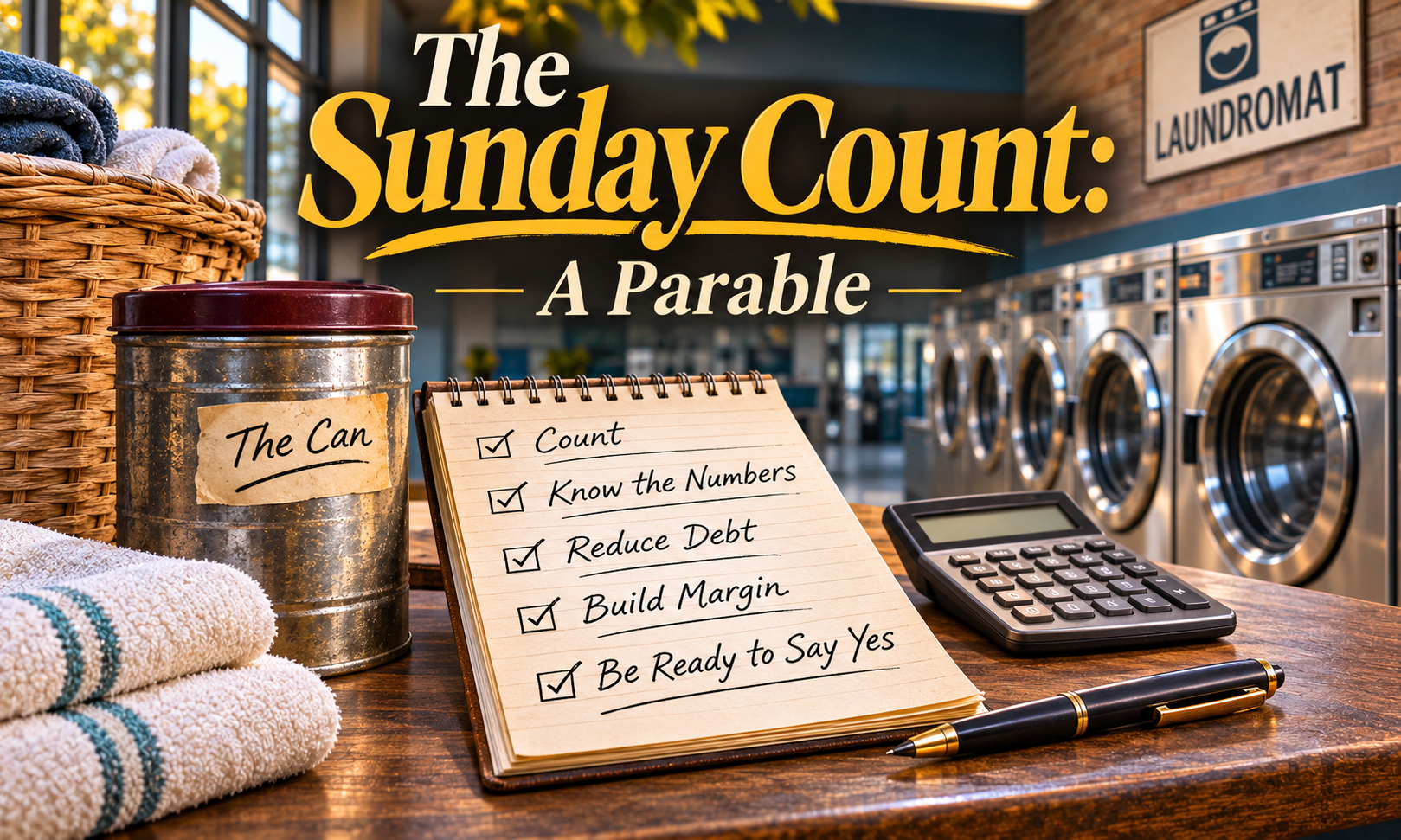
The Sunday Count
Keisha Morgan owned two laundromats on the east side of town, and she had not looked at a full set of numbers in almost a year.
It was not that she did not care. She cared too much. She opened both stores at six, fixed jammed coin slots herself, and knew half her customers by name. But every time she sat down with the books, her stomach tightened, so she stopped sitting down. The business line of credit covered the gaps. The bank sent statements. She filed them unopened in a drawer under the counter.
On a Tuesday in March, the big washer at the Fifth Street store stopped mid-cycle and would not start again. The repairman shook his head before he finished the inspection.
"Motor and control board," he said. "You're looking at more than the machine is worth."
Keisha nodded as if that was fine and walked to the back room to call the bank about raising her limit. The woman on the phone was polite.
"I'm sorry, Ms. Morgan. Your line is at the maximum. Would you like to review your account?"
She hung up without answering.
That evening she drove to her grandmother's house with a bag of groceries, because it was Tuesday and that was what she did on Tuesdays.
Her grandmother had raised four children on a cafeteria salary. Keisha found her at the kitchen table, sorting bills into short stacks with a pencil behind her ear.
"You look like somebody stepped on your shadow," her grandmother said.
Keisha told her about the washer and the bank. Her grandmother listened, then got up slowly and took a coffee can down from the top of the pantry. She pried off the lid and showed Keisha the folded bills inside.
"Every Friday for fifty years," she said. "A little bit before anything else. Some years it was two dollars." She set the can on the table. "And every Sunday after church, I counted. Not just the can. Everything. What came in, what went out, what we owed."
"I don't even know which machines make money," Keisha admitted.
Her grandmother looked at her over her glasses. "Then you don't know your business, baby. You just know you're tired."
That Sunday, Keisha unlocked the Fifth Street store after church, made a pot of coffee in the back room, and opened the drawer under the counter.
It took her four hours to open every statement. The line of credit was bigger than she had let herself believe. The monthly interest alone was more than her own paycheck some weeks. She was working sixty hours a week, and a large share of that time belonged to the bank.
Then she did what her grandmother said. She counted.
She went machine by machine with a notepad, pulling the meter readings and repair receipts. By evening she knew things she had never known. Six machines at the Elm Street store earned almost half of everything. The dry cleaning drop-off she had added at Fifth Street the year before, the one she had borrowed to start, was losing money every single month.
She sat back and looked at the notepad for a long time. The crisis had not come from one broken washer. It had come from a year of not looking.
She bowed her head right there in the back room.
"Lord, I've been running so hard I never stopped to see what you gave me," she prayed. "Help me take care of it. Help me get free."
The next year was not easy. She closed the dry cleaning counter and sold its equipment. She put everything she saved toward the line of credit, every month, without exception. She did not replace the broken washer until she could pay cash. And every Friday, before anything else, she moved a small amount into a separate account she called the can.
Every Sunday after church she counted. Machines, receipts, balances, the people on her payroll. She stopped dreading it.
Eighteen months after the washer died, she made the last payment on the line of credit. She drove straight to her grandmother's house and set a new coffee can on the kitchen table.
Her grandmother pried off the lid. Inside was a slip of paper with the final balance, a zero circled twice.
"Now you count like a shepherd," her grandmother said.
Keisha laughed. "I'm learning to count."
The following week, a young mother came in with three children and a basket of clothes, and quietly asked whether there was any way she could pay next time. Keisha waved her toward the machines.
There was oil in the jar now. She could say yes.
Go Deeper
Ready to put this teaching into practice? Seven Good Years is a guided workbook drawn from Genesis 41 and Proverbs 21 to 27. Work through four movements at your own pace and finish with one page you build for yourself: Your Storehouse Plan.
The wise keep a store while fools gulp theirs down, the borrower becomes a servant, and the steward who prospers is the one who knows the condition of the flock. Here is what Proverbs 21, 22 and 27 teach about margin, debt and paying attention to what God has put in your care.
Three Sentences From a Farmer's Notebook
The book of Proverbs does not give a full chapter on money. It scatters its counsel across hundreds of short sayings, the way a farmer might jot notes in the margins of a ledger over a lifetime. Three of those notes belong together. One is about keeping something back. One is about who owns you when you owe. One is about knowing what you actually have.
These sayings are ordinary, and that is why they matter. Most of our financial life is not made of crises. It is made of small daily choices about what to spend, what to sign and what to look at.
Why Ordinary Money Habits Are a Stewardship Question
A steward manages what belongs to someone else. If everything we have comes from God, then the habits we bring to it are not private preferences. They are part of how we answer for the trust. Proverbs treats margin, debt and attention as moral matters because they shape the heart as much as the bank account.
A household with no store lives one surprise away from panic. A person in deep debt gives away tomorrow's hours before they arrive. A leader who never looks at the condition of the flock wakes up one day to find it has wandered off.
Lesson One: The Store and the Gulp
The first saying draws a picture from the kitchen. "The wise store up choice food and olive oil, but fools gulp theirs down." (Proverbs 21:20, NIV).
Choice food and olive oil were the good things of an ancient household. Oil was used for cooking, for light and for medicine. The wise person does not refuse to enjoy it. The verse calls it choice, and Scripture never treats good things as evil. The difference is that the wise person keeps some of it back. There is oil in the jar after the meal is over.
The fool has the same oil. The verse does not say the fool is poor. It says the fool gulps. The word paints someone eating fast and all at once, swallowing what came in before the next thing arrives. The problem is not the supply. It is the appetite and the speed.
Many of us earn more than our grandparents ever did and still have nothing in the jar. The paycheck arrives and is gone before the week is out, not always on luxuries, but on a lifestyle that rises as fast as income does. Proverbs calls that gulping. Often it rests on a quiet assumption that tomorrow will take care of itself, and another proverb answers that directly. "Do not boast about tomorrow, for you do not know what a day may bring." (Proverbs 27:1, NIV). Spending everything today is a kind of boast about a tomorrow that is not in our hands.
A store is what people now call margin: the space between what comes in and what goes out. Margin is not hoarding. Joseph's storehouses in Egypt fed a nation in famine, and a family with something set aside can say yes when God sends a need to its door. Margin turns emergencies into inconveniences and gives generosity room to act.
The first step of stewardship is not a complicated plan. It is the simple discipline of not consuming everything you receive the moment you receive it. Keep some oil in the jar.
Lesson Two: The Borrower Is Slave to the Lender
The second saying is one of the bluntest sentences in Proverbs. "The rich rule over the poor, and the borrower is slave to the lender." (Proverbs 22:7, NIV).
The verse is not a command. It is an observation, the kind a wise elder makes after watching how life works. Wealth gives power, and debt hands that power to someone else. The word is not employee or partner. It is slave. Proverbs wants us to feel the weight of it.
Debt is rarely felt as slavery on the day it is signed. On that day it feels like freedom. It lets you have the thing now. The chains show up later, in small ways. A job you cannot leave because the payments depend on it. A calling you cannot answer because the monthly obligations will not allow it. A gift you cannot give because the money is already promised to the bank. The lender does not need to raise his voice. The schedule of payments quietly decides how you spend your days.
That is why debt is a stewardship issue for time as well as money. Every payment is made with hours of your life. When you borrow, you are spending future hours you have not lived yet, and you are deciding in advance who those hours will serve.
Paul warned the church about another kind of bondage with words that apply here. "You were bought at a price; do not become slaves of human beings." (1 Corinthians 7:23, NIV). Christ purchased us. Our lives belong to Him. Scripture does not say every loan is sin, and there are seasons when borrowing is wise and carefully limited. But a steward of a redeemed life should be slow to hand his future to a human master. The less you owe, the more freely you can say yes to God.
Lesson Three: Do Not Sign What You Cannot Pay
Proverbs adds a warning about a particular kind of debt, the promise made on someone else's behalf. "Do not be one who shakes hands in pledge or puts up security for debts; if you lack the means to pay, your very bed will be snatched from under you." (Proverbs 22:26-27, NIV).
In the ancient world a handshake in pledge meant you guaranteed another person's loan. If he could not pay, you would. Today it might be cosigning, guaranteeing a business loan or promising to cover someone's obligations. The impulse is often kind. We want to help a friend, a child or a coworker. Proverbs does not question the kindness. It questions the arithmetic.
The key phrase is if you lack the means to pay. Proverbs is asking a practical question before an emotional one. If this falls on you, can you carry it? If not, the pledge is not generosity. It is a gamble with your household's bed as the stake. The image is meant to sting. A promise made in a warm moment can leave your own family with nothing to sleep on.
The broader lesson is about the words of our mouths. A steward does not make financial promises lightly. Before you sign, shake hands or say I will cover it, count the cost honestly. Ask what happens if the worst comes. Ask whether this promise honors your duty to the people already under your roof. Wisdom does not make us stingy. It makes our yes trustworthy, because we only give it when we can keep it.
Lesson Four: Know the Condition of Your Flocks
The third saying moves from the kitchen and the marketplace out to the pasture. "Be sure you know the condition of your flocks, give careful attention to your herds; for riches do not endure forever, and a crown is not secure for all generations." (Proverbs 27:23-24, NIV).
For a herdsman, the flock was the household's wealth. You could not keep it in a vault. It had to be watched. Sheep got sick, wandered off, grew thin in a dry season or were lost to predators. The herdsman who rarely counted his flock would not know there was a problem until it was too late to fix.
Notice the words be sure and give careful attention. This is not a casual glance. It is a habit of looking closely and regularly at what you have. Many people avoid looking at their finances for the same reason they avoid the doctor: they are afraid of what they will see. Proverbs says the fear is more dangerous than the facts. You cannot steward what you will not look at.
Knowing the condition of your flocks today might mean knowing what you earn, what you spend, what you owe and what you own. It might mean knowing which part of your business actually makes money and which part only looks busy, and knowing the condition of the people you lead.
This kind of attention is not anxiety. It is faithfulness. Jesus told stories about servants who were given something to manage and were later asked for an account. A steward who never looks at the flock cannot give a good account. A steward who looks often can catch small problems while they are still small.
The principle is simple and humbling. Attention is a form of stewardship. What you regularly look at, you can care for. What you ignore, you slowly lose.
Lesson Five: Riches Do Not Endure, but the Flock Provides
The reason Proverbs gives for watching the flock is surprising. Riches do not endure forever, and a crown is not secure for all generations. Even kings lose their thrones. Even fortunes run out. Wealth that is ignored does not stay put.
That sounds like a reason to give up, but Proverbs draws the opposite conclusion. Because riches are fragile, tend them. Then it describes what faithful attention produces. "When the hay is removed and new growth appears and the grass from the hills is gathered in, the lambs will provide you with clothing, and the goats with the price of a field. You will have plenty of goats' milk to feed your family and to nourish your female servants." (Proverbs 27:25-27, NIV).
This is a picture of quiet provision. The seasons turn. The hay is cut and new growth comes up. The lambs give wool for clothing. The goats can be sold to buy more land. There is milk for the family and for the workers of the household. Nothing here is flashy. It is the steady fruit of a well-kept flock over many seasons.
Proverbs is contrasting two kinds of wealth. One is a crown, impressive and visible, but unstable. The other is a flock, ordinary and daily, but renewable when it is cared for. The wise steward does not chase the crown. He tends the flock, and the flock feeds his household and the people who work beside him.
Notice also who benefits: the family and the servants. Faithful attention is never only about personal security. A well-kept household can provide for the people who depend on it. When we watch our flocks carefully, we are making room to care for others. The goal of margin, freedom from debt and careful attention is not a bigger pile. It is a household that can feed, clothe and bless.
For Business Leaders: Get the Fields Ready First
Businesses fail for many reasons, but one of the most common is growth that outran the foundation. A company expands before it has margin, borrows to cover the expansion and stops paying close attention to the parts that actually produce. Proverbs offers a different order.
Know your flocks. Know which products, clients and teams carry the business, and which only consume. Keep a store in good years so that a slow season does not force your hand. Borrow, if you borrow at all, with your eyes open about who will be your master if things go wrong.
"Put your outdoor work in order and get your fields ready; after that, build your house." (Proverbs 24:27, NIV).
Your Obedience Step
Set a standing hour each week to review the true condition of your business: cash on hand, what is owed, and which work is actually profitable. Before approving any new expansion or loan this quarter, write down how the company would carry it through six slow months.
For Community Leaders: Guard the Name More Than the Budget
Churches, ministries and nonprofits live on trust. A leader who spends ahead of what has been given, carries hidden debts or signs pledges on the organization's behalf without counting the cost puts something more valuable than money at risk. When an organization cannot pay what it promised, people stop believing what it says.
Open books, a modest reserve and careful attention to the condition of the people you serve all protect that trust. The goal is not to look impressive. It is to stay worthy of the confidence people have placed in you.
"A good name is more desirable than great riches; to be esteemed is better than silver or gold." (Proverbs 22:1, NIV).
Your Obedience Step
At your next board or leadership meeting, share a plain report of what the organization owns, owes and keeps in reserve. If there is no reserve, agree together on one small, regular amount to set aside before any new commitment is made.
For Home Leaders: Build the House With Wisdom
Homes are where gulping and borrowing show up first. Children learn from watching what their parents buy, how they talk about money and whether there is peace or panic when the car breaks down. A household that keeps a store and knows its own condition gives children a picture of trust instead of fear.
You do not need a large income to build a wise household. You need honesty about what you have, a willingness to wait for some things, and the habit of talking about money as something God has given you to manage.
"By wisdom a house is built, and through understanding it is established; through knowledge its rooms are filled with rare and beautiful treasures." (Proverbs 24:3-4, NIV).
Your Obedience Step
Sit down with your spouse, or with your older children if you are a single parent, and list together everything the household owes. Choose the smallest debt to pay off first, and decide on one simple way the family will keep some oil in the jar each month.
For the Everyday Believer: A Little With Peace
You may feel that sayings about flocks, storehouses and pledges are for people with more money than you have. They are not. The poorest household in Israel had a jar of oil to keep or gulp, and the smallest flock still needed counting. Stewardship begins with what is in your hand today.
The deepest gift of these proverbs is peace. A person with a small income, no debt and a little set aside often sleeps better than a person with a large income and nothing in reserve. Contentment and freedom are worth more than the things we rush to buy.
"Better a little with the fear of the Lord than great wealth with turmoil." (Proverbs 15:16, NIV).
Your Obedience Step
This week, look honestly at your accounts for twenty minutes without judging yourself. Then set aside one fixed amount, however small, the day your next income arrives, before anything else is spent, and thank God for it as you do.
Count the Flock, Keep the Store
These proverbs do not promise wealth. They promise freedom, steadiness and the ability to care for others.
Keep some oil in the jar instead of gulping everything at once. Remember that the borrower is a servant, and be slow to hand your future hours to a human master. Do not sign what you cannot pay. And look closely, often and without fear, at the condition of your flocks, because riches do not endure on their own.
A steward who does these things is not trusting in money. He is honoring the God who gave it, by treating what he has been given as something worth watching, keeping and using well.
Questions for Reflection
- Where in my life am I gulping, consuming everything as soon as it comes in? What is driving that habit?
- Do I have any store set aside? If an unexpected bill came tomorrow, what would happen?
- What debts do I carry, and how are they shaping my time, my choices and my freedom to obey God?
- Have I made any financial promises for others that I could not keep if they fell on me?
- When was the last time I looked closely at the true condition of my finances, my business or the people I lead?
Closing Prayer
Lord, everything I have comes from you. Forgive me for the times I have gulped down what you gave me without thinking, and for the times I have boasted about tomorrow as if it were mine. Teach me to keep some oil in the jar. Where I am a servant to a lender, give me wisdom, patience and a way toward freedom, so that my hours belong more fully to you. Guard my mouth from promises I cannot keep. Give me the courage to look honestly at the condition of my flocks, and the faithfulness to tend them day after day. Let my household and the work of my hands provide for my family and bless the people around me. Make me content with what you give, and let my peace come from you and not from what I own. In Jesus' name, Amen.
The Sunday Count
Keisha Morgan owned two laundromats on the east side of town, and she had not looked at a full set of numbers in almost a year.
It was not that she did not care. She cared too much. She opened both stores at six, fixed jammed coin slots herself, and knew half her customers by name. But every time she sat down with the books, her stomach tightened, so she stopped sitting down. The business line of credit covered the gaps. The bank sent statements. She filed them unopened in a drawer under the counter.
On a Tuesday in March, the big washer at the Fifth Street store stopped mid-cycle and would not start again. The repairman shook his head before he finished the inspection.
"Motor and control board," he said. "You're looking at more than the machine is worth."
Keisha nodded as if that was fine and walked to the back room to call the bank about raising her limit. The woman on the phone was polite.
"I'm sorry, Ms. Morgan. Your line is at the maximum. Would you like to review your account?"
She hung up without answering.
That evening she drove to her grandmother's house with a bag of groceries, because it was Tuesday and that was what she did on Tuesdays.
Her grandmother had raised four children on a cafeteria salary. Keisha found her at the kitchen table, sorting bills into short stacks with a pencil behind her ear.
"You look like somebody stepped on your shadow," her grandmother said.
Keisha told her about the washer and the bank. Her grandmother listened, then got up slowly and took a coffee can down from the top of the pantry. She pried off the lid and showed Keisha the folded bills inside.
"Every Friday for fifty years," she said. "A little bit before anything else. Some years it was two dollars." She set the can on the table. "And every Sunday after church, I counted. Not just the can. Everything. What came in, what went out, what we owed."
"I don't even know which machines make money," Keisha admitted.
Her grandmother looked at her over her glasses. "Then you don't know your business, baby. You just know you're tired."
That Sunday, Keisha unlocked the Fifth Street store after church, made a pot of coffee in the back room, and opened the drawer under the counter.
It took her four hours to open every statement. The line of credit was bigger than she had let herself believe. The monthly interest alone was more than her own paycheck some weeks. She was working sixty hours a week, and a large share of that time belonged to the bank.
Then she did what her grandmother said. She counted.
She went machine by machine with a notepad, pulling the meter readings and repair receipts. By evening she knew things she had never known. Six machines at the Elm Street store earned almost half of everything. The dry cleaning drop-off she had added at Fifth Street the year before, the one she had borrowed to start, was losing money every single month.
She sat back and looked at the notepad for a long time. The crisis had not come from one broken washer. It had come from a year of not looking.
She bowed her head right there in the back room.
"Lord, I've been running so hard I never stopped to see what you gave me," she prayed. "Help me take care of it. Help me get free."
The next year was not easy. She closed the dry cleaning counter and sold its equipment. She put everything she saved toward the line of credit, every month, without exception. She did not replace the broken washer until she could pay cash. And every Friday, before anything else, she moved a small amount into a separate account she called the can.
Every Sunday after church she counted. Machines, receipts, balances, the people on her payroll. She stopped dreading it.
Eighteen months after the washer died, she made the last payment on the line of credit. She drove straight to her grandmother's house and set a new coffee can on the kitchen table.
Her grandmother pried off the lid. Inside was a slip of paper with the final balance, a zero circled twice.
"Now you count like a shepherd," her grandmother said.
Keisha laughed. "I'm learning to count."
The following week, a young mother came in with three children and a basket of clothes, and quietly asked whether there was any way she could pay next time. Keisha waved her toward the machines.
There was oil in the jar now. She could say yes.
Go Deeper
Ready to put this teaching into practice? Seven Good Years is a guided workbook drawn from Genesis 41 and Proverbs 21 to 27. Work through four movements at your own pace and finish with one page you build for yourself: Your Storehouse Plan.
Comments
Keep it kind and on topic. See something that doesn't belong? Tap Report under it and we'll review it.