
Stewardship Faith-Spiritual Growth · Stewardship of Resources
The Shrine Beside the Altar: 2 Kings 17 and Modern Idolatry
Qunetin Robinson

In 2 Kings 17, people worshiped the Lord and served other gods. See what syncretism is and how money, fame and screens become rivals to God today.
Lions in Samaria
In 722 BC the northern kingdom of Israel fell. Assyria besieged Samaria for three years, took the city, and carried the people away (2 Kings 17:5-6).
The writer of Kings stops the story to explain why. It was not bad strategy or bad luck. Israel had rejected the LORD and worshiped other gods, and the prophets' warnings had gone unheard for generations (2 Kings 17:7-23).
Then the chapter takes a strange turn.
Assyria fills the empty towns with people from five nations (2 Kings 17:24). They move into Israelite houses, farm Israelite fields, and bring their own gods with them.
Then the lions come. The newcomers did not honor the LORD, and lions began killing them (2 Kings 17:25).
The king of Assyria treats it as a practical problem. Someone tells him the settlers do not know the local rules. So he gives an order: send back one of the exiled priests to "teach the people what the god of the land requires" (2 Kings 17:27, NIV).
It is a training program. Learn the rituals, keep the lions away, get back to business.
And it almost works. The people learn to worship the LORD. They also keep every god they brought with them.
That is syncretism: blending the worship of the true God with the worship of other gods. It is one of the oldest temptations in Scripture, and one of the most current. Most people who struggle with it would never call it idolatry. They would call it balance.
This chapter asks a hard question. When we worship God and something else, what does God call it?
Lesson One: God Is Not a Local Deity to Appease
Listen to how the report reaches the king of Assyria. The settlers "do not know what the god of that country requires" (2 Kings 17:26, NIV).
To them, the LORD was a regional power. Every land had a god. Babylon had its gods. Hamath had its gods. This land apparently had one too. He was dangerous if ignored, so the wise move was to learn his terms.
That is not worship. That is risk management.
The settlers never asked who the LORD was. They asked what He required. They wanted the minimum that would stop the lions. Once the lions stopped, the question was settled.
Many people relate to God the same way today. He is kept as a kind of insurance policy. We call on Him when the test results come back, when the business is in trouble, when a child is in danger. We give Him enough to feel covered. But the daily devotion, the first thoughts and the real trust go somewhere else.
The problem is that God is not the god of a territory. He is not one power among many, handled by whoever knows the right procedures. He made the land. He owns the land. He owns the people on it.
That is the root of every stewardship principle. Nothing we hold is ours. Our homes, businesses, money, time and influence are entrusted to us by the One who owns them. A steward does not negotiate terms with the Owner. A steward serves Him.
The Assyrian king thought he had a lion problem. He actually had a lordship problem. So do we, whenever we treat God as one more factor to manage.
You cannot manage the One who owns you.
Lesson Two: Instruction Without Surrender
The order is carried out. One exiled priest returns, settles in the land, and "taught them how to worship the LORD" (2 Kings 17:28, NIV).
Notice where he settles. He lives in Bethel. Two centuries earlier, King Jeroboam set up a golden calf at Bethel so his people would not travel to Jerusalem to worship (1 Kings 12:28-29). Bethel had been a center of compromised worship for generations. The instruction came from a place that had already mixed the worship of the LORD with images He had forbidden.
So the settlers learned. They learned the forms, the words and the feasts. Then the very next verse turns on one word: "Nevertheless, each national group made its own gods in the several towns where they settled" (2 Kings 17:29, NIV).
The lessons did not change their loyalty. They added the LORD to the shelf and kept everything else on it.
This is one of the most sobering truths in the chapter. You can learn the forms of worship and never be asked to give anything up. Information is not allegiance.
Isaiah described the same condition in Judah years later: "These people come near to me with their mouth and honor me with their lips, but their hearts are far from me" (Isaiah 29:13, NIV). The verse goes on to say their worship rested on rules they had been taught. That is exactly what happened in Samaria. A priest taught the rules. The hearts stayed where they were.
It is possible to sit in church every Sunday, know the songs by heart, speak the language of faith fluently, and still keep a rival god in first place. Knowing about God and surrendering to God are not the same thing. The settlers had the first without the second.
The question is not whether you know how to worship. It is whether anything else is still standing on the shelf.
Lesson Three: Divided Worship Is No Worship
Here is the center of the chapter. Read these two verses together.
"They worshiped the LORD, but they also served their own gods in accordance with the customs of the nations from which they had been brought" (2 Kings 17:33, NIV).
Then, immediately: "To this day they persist in their former practices. They neither worship the LORD nor adhere to the decrees and regulations" (2 Kings 17:34, NIV).
Verse 33 says they worshiped the LORD. Verse 34 says they did not worship the LORD.
At first it looks like a contradiction. It is not. It is the whole point.
Verse 33 describes what anyone could see from the street. Sacrifices were offered to the LORD. His name was spoken. Priests served at the shrines (2 Kings 17:32). By every outward measure, the LORD was part of their religious life.
Verse 34 is God's verdict on the same people. Divided worship did not count as partial worship. It did not count at all.
God does not accept a share of the heart and call it worship. He is not one name on a list of loyalties. Either He is Lord, or He is being used.
Jesus said the same thing in His own words: "No one can serve two masters. Either you will hate the one and love the other, or you will be devoted to the one and despise the other. You cannot serve both God and money" (Matthew 6:24, NIV).
Notice that Jesus does not say it is unwise to serve both. He says it cannot be done. The attempt itself is the failure.
Elijah pressed the same question on Mount Carmel, when Israel was trying to keep both the LORD and Baal (1 Kings 18:21). How long will you waver? Choose.
This is hard for modern readers, because we are used to balance. We balance work and family, saving and spending, rest and effort. Balance is a virtue in many things. But it does not apply to worship. God is not a priority to balance. He is the One who sets the priorities.
Partial devotion is not partial credit. It is a counterfeit.
Lesson Four: The Covenant Was Always Exclusive
The writer of Kings makes sure no one misses why this matters. He quotes the covenant itself. When the LORD made His covenant with Israel, He commanded them: "Do not worship any other gods or bow down to them, serve them or sacrifice to them" (2 Kings 17:35, NIV).
That command was not new. It is the first of the Ten Commandments (Exodus 20:3). And when God renewed the covenant after the golden calf, He called Himself by the name Jealous (Exodus 34:14).
To many readers, jealousy sounds like a flaw. In people it often is. But God's jealousy is not insecurity. It is covenant love that refuses to share its bride. A husband who did not care whether his wife had other lovers would not be secure. He would be indifferent. God is not indifferent to where your heart goes.
That is why Scripture uses such strong language. When Moses warned Israel about the idols of Canaan, he told them not to keep even the silver and gold on them, "or you will be ensnared by it, for it is detestable to the LORD your God" (Deuteronomy 7:25, NIV).
Notice what Moses called the snare. Not the statue. The gold on it. The danger was what the idol offered.
That is how added gods work. They come with promises. And the writer of Kings gives us the other half of the command: "Rather, worship the LORD your God; it is he who will deliver you from the hand of all your enemies" (2 Kings 17:39, NIV).
Every added god promises a deliverance it cannot give. Money promises security. Fame promises worth. Approval promises belonging. A feed promises connection and leaves us lonelier. Celebrities promise a picture of the life we want, and we follow them into it.
Only one of them has ever actually delivered anyone. The settlers kept their gods because they thought more gods meant more protection. In truth, every god they added was one more thing that could not save them.
The gods we add always promise what only God can deliver.
Lesson Five: You Become What You Worship, and So Do Your Children
Earlier in the chapter, the writer sums up Israel's own slide in one sentence: "They followed worthless idols and themselves became worthless" (2 Kings 17:15, NIV).
That is a law of the spiritual life. We become like what we worship. The psalmist said it of idol makers: "Those who make them will be like them, and so will all who trust in them" (Psalm 115:8, NIV).
Worship is formation. Whatever holds first place in your heart begins to shape your desires, your fears and your character. Worship money, and you grow anxious and grasping. Worship approval, and you grow fragile, always checking how you are seen. Worship celebrity, and you slowly trade your own calling for someone else's image.
The chapter does not end with the settlers. It ends with their children: "Even while these people were worshiping the LORD, they were serving their idols. To this day their children and grandchildren continue to do as their ancestors did" (2 Kings 17:41, NIV).
Divided worship does not stay with the person who starts it. It is inherited. The settlers' gods eventually demanded their children (2 Kings 17:31), and Israel had walked the same road before them (2 Kings 17:17). Today's added gods are quieter, but they still take from our children: their time, their attention, and the example they learn to bow to.
Children rarely inherit what we say we believe. They inherit what we actually bow to. They notice what we check first in the morning. They notice what makes us anxious and what makes us glad. They notice whose opinion we fear.
None of the modern gods named here is evil by itself. Social media is a tool. Money is a resource. Music and movies can be good gifts. Fame is a circumstance. The sin is placement. It is putting any of them before God.
Your children will inherit your real altar.
For Business Leaders: When Revenue Becomes the God of the Land
Many business leaders pray over their companies. They thank God at the year-end meeting and ask His blessing on new ventures. That is good. But it is possible to honor God in the opening prayer and let the numbers make every real decision after it.
That is the Assyrian approach to faith. God is kept as protection against the lions, while revenue, growth and reputation run the business.
The test is simple. When obedience and profit point in different directions, which one usually wins? When cash is tight, what gets cut first: God's portion, or something else?
Scripture puts God's portion at the front, not the end: "Honor the LORD with your wealth, with the firstfruits of all your crops" (Proverbs 3:9, NIV). Firstfruits come off the top, before anyone knows how the rest of the harvest will turn out. That is what it looks like when God is Lord of the business and not its insurance.
Your Obedience Step
Look back at last month's decisions. Name one that money made instead of obedience. This month, set God's portion before any other line in the budget.
For Community Leaders: When the Platform Becomes a Shrine
Community leaders usually start out wanting to serve. Then the platform grows. Followers, recognition and invitations begin to arrive, and without anyone noticing, the audience becomes a second altar.
It shows up in small ways. We choose causes that will be seen. We measure an event by attendance and posts instead of by the people it actually helped. We shape our words for applause rather than truth.
John describes leaders in Jesus' day who believed in Him but would not say so publicly, "for they loved human praise more than praise from God" (John 12:43, NIV). Their faith was real enough to hold in private. It was not strong enough to cost them their standing.
A leader can serve God and still be seen. But a leader cannot serve God and serve being seen. One of them will set the agenda.
Your Obedience Step
This week, do one act of service with no post, no mention and no credit. Notice how it feels to be seen only by God.
For Home Leaders: What Your Children Will Inherit
Verse 41 is written for parents. The children and grandchildren of the settlers did exactly what their parents did. Not what their parents said. What they did.
In many Christian homes the added gods are not statues. They are screens, sports schedules, status and spending. They take the first hour of the day, the best energy of the week and the deepest worries of the night. Worship gets what is left.
Parents rarely intend this. It happens through a thousand small choices that each seemed reasonable. But children read the pattern clearly. They learn what really matters by watching what gets protected when time runs short.
Joshua faced a nation with divided loyalties and made his own household's choice plain: "But as for me and my household, we will serve the LORD" (Joshua 24:15, NIV). He did not wait for the culture to change. He decided what his home would bow to.
Your Obedience Step
Ask your family one question: what gets the first hour of a normal day in our home? Move one thing this week so God gets that place.
For the Everyday Believer: Name the God You Added
You may not lead a company, a community group or a household. But you have a heart, and it has a first place. The question is what sits there.
For most of us it is not a carved image. It is the phone checked before prayer. The bank balance that decides whether the week feels safe. The singer or actor whose life shapes our picture of a good one. The hope of being known, followed or admired.
None of these announce themselves as gods. They arrive as habits, interests and goals. That is exactly why they are dangerous. The settlers in Samaria never thought they had abandoned the LORD. They thought they had added to Him.
John ends his first letter with a single sentence of warning: "Dear children, keep yourselves from idols" (1 John 5:21, NIV). Keeping yourself from idols starts with naming them honestly.
Your Obedience Step
Write down what you check first, trust most, or would hate most to lose. Then give it one concrete demotion this week: a phone left outside the bedroom, an account unfollowed, a gift given before a purchase made.
Not a Place Among Your Priorities
Go back one more time to verses 33 and 34. The settlers believed they had made room for the LORD. They had added Him to the shrines and learned His rituals. By their own measure, they worshiped Him.
God measured it differently. He said they did not worship Him at all.
That verdict is not harsh. It is honest. A God who shared His throne with money, fame and approval would be one more idol on the shelf. He would be no better at delivering us than the rest of them.
The good news is that the LORD has never wanted a place among our priorities. He wants to be the One who orders them. When He holds first place, everything else in our lives finds its right size. Work becomes a calling instead of an identity. Money becomes a tool instead of a refuge. A platform becomes a place to serve. Family becomes a gift instead of a god.
The shrine beside the altar does not have to stay standing. It can be named, demoted and torn down. And the altar that remains can belong to Him alone.
God does not ask for a place among your priorities. He asks to be the One who orders them.
Questions for Reflection
- If I am honest, do I treat God as the Lord of my life, or as protection against the lions?
- What do I check first in the morning, and what do I turn to when I am anxious?
- Where does my money go before God's portion is settled?
- If my children copied my actual devotion, not my words, what would they worship?
Closing Prayer
Father, I confess that I have tried to keep You as one God among several. I have honored You with my words while money, approval, screens and the people I admire have taken first place in my heart. Forgive me for treating You as protection instead of as Lord. Show me every shrine I have built beside Your altar, and give me the courage to tear it down. Make my heart undivided. Let my home, my work and my influence bow to You alone. And let the people who come after me inherit a faith that is whole, not divided. In Jesus' name, Amen.
The Plaque by the Register
Marcus Hale bought the Corner Table Diner in March, two weeks after Walt Hensley's funeral.
The diner had been on Main Street for forty-one years, and Walt had run it the whole time. The booths were cracked vinyl, the coffee was strong, and the pie case had not changed since the eighties. Marcus saw a solid business with room to grow.
He kept the name. He changed nearly everything else. New menu boards. A register system that tracked every sale in real time. Longer hours, including Sundays, the busiest day for any diner in a town that size.
By May, the regulars were gone.
Not all at once. The Thursday men's table thinned out first. Then the after-church families stopped coming. The online reviews turned sour. "Not the same place." "Lost its soul." One just said, "Walt would be sad."
Marcus sat in the back office with his sales dashboard open and could not make the numbers move.
Ruth Ann had waited tables at the Corner Table for twenty-two years. She did not say much, and Marcus had nearly let her go in April. One slow afternoon she refilled his coffee and sat down across from him without asking.
"You want to know why they stopped coming," she said.
He did.
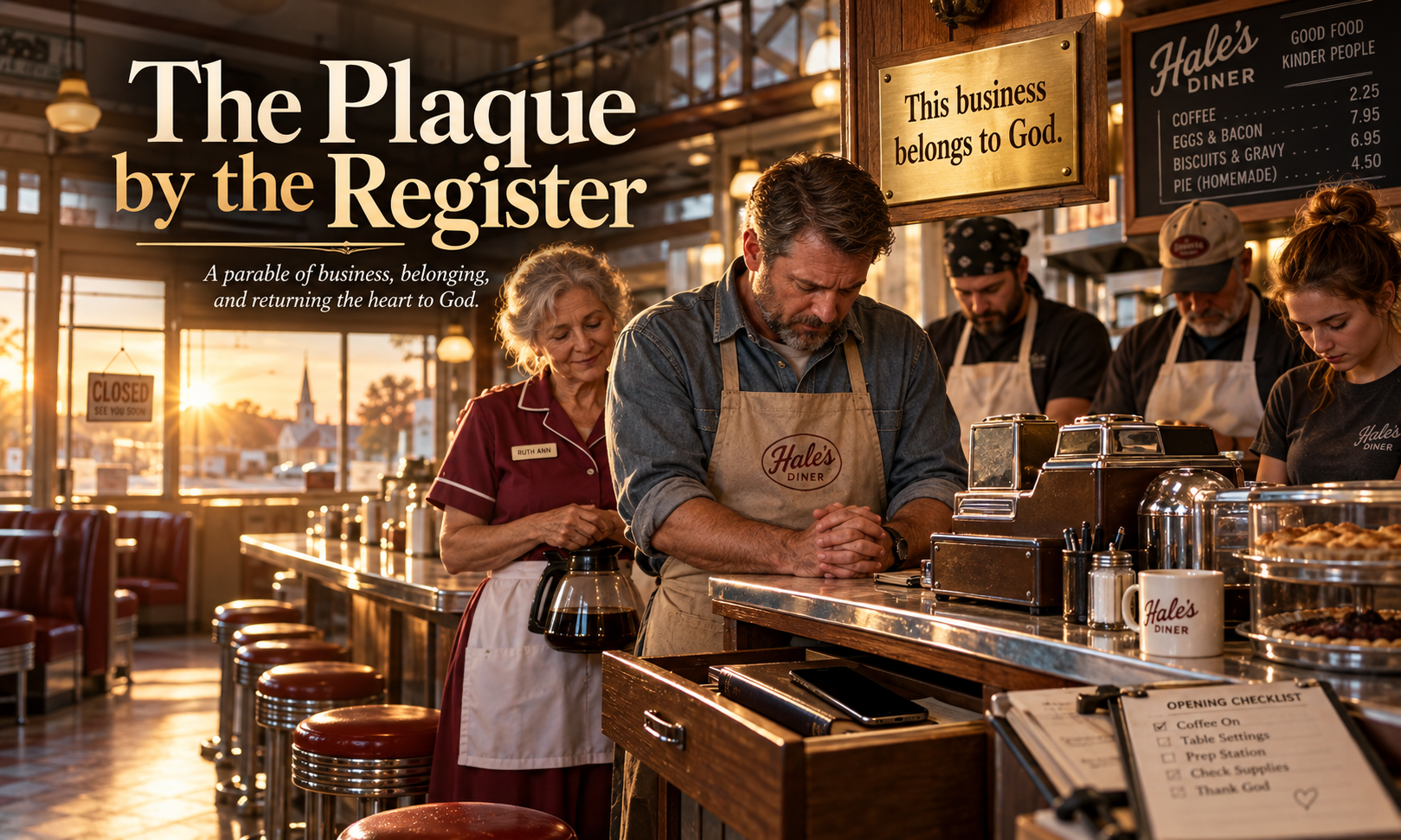
"Walt closed on Sundays. Every Sunday for forty-one years. He opened every morning by praying with whoever was working. Thirty seconds, maybe less. And he kept that by the register." She nodded toward a small brass plaque Marcus had taken down and dropped in a drawer. It read: "This business belongs to God."
"People here loved him for it," she said. "It made the place feel like theirs." She stood up and picked up the coffee pot. "But he didn't close on Sundays for the town. The town just noticed."
Marcus thanked her. That night he made a plan.
The plaque went back up the next morning. The diner closed on Sundays starting that week. At six each morning, before the doors opened, Marcus gathered the staff by the counter and said a short prayer. He was not sure what to say, so he kept it brief.
It worked faster than he expected. The Thursday table filled back up. The after-church families started coming on Saturday nights instead. A new review said the diner was "back to its roots." By August, sales were higher than Walt's best year.
Marcus added the prayer to the opening checklist, right between "start coffee" and "unlock front door."
Nothing else changed.
His dashboard was still the first thing he opened in the morning and the last thing he checked before bed. He looked at it at red lights and at his son's baseball games. When a food influencer with half a million followers said she might come through town, he rebuilt the menu around what would photograph well. He talked about her follower count for weeks. He talked about his staff much less.
He had learned what the town required. He gave it exactly that much.
His daughter Kenzie worked the register on Saturdays.
One evening in October she left her backpack open on the kitchen table, and a printed school assignment slid halfway out. The title at the top read: "What Does Your Family Believe?"
Marcus picked it up. He expected something about church, or the plaque, or the morning prayers.
Kenzie had written one paragraph. Most of it was about the diner. The last line said: "We close on Sundays because the town likes it, and it's good for business."
He read it three times.
He wanted to correct her. He could not think of a single thing she had gotten wrong.
He thought about the plaque. He thought about the checklist. He thought about Ruth Ann standing up from the booth with the coffee pot in her hand, and the thing she had said that he had not paid attention to at the time.
The town just noticed.
On Monday morning Marcus came in at five thirty. He sat down at the office desk, opened the top drawer, and put his phone inside, face down. He closed the drawer.
At six the staff gathered by the counter as usual. Ruth Ann. The two cooks. A college kid on the morning shift.
Marcus stood by the register under the brass plaque. He had a prayer ready, the same short one he always used.
He did not use it.
He was quiet for a moment. Then he prayed something that was not on any checklist. It was not long, and it was not polished. It was the first prayer he had ever prayed in that diner that was meant for God and not for the town.
When he said amen, Ruth Ann did not say anything. She just squeezed his arm on her way to unlock the front door.
The plaque hung where it always had. The phone stayed in the drawer until lunch.
In 2 Kings 17, people worshiped the Lord and served other gods. See what syncretism is and how money, fame and screens become rivals to God today.
Lions in Samaria
In 722 BC the northern kingdom of Israel fell. Assyria besieged Samaria for three years, took the city, and carried the people away (2 Kings 17:5-6).
The writer of Kings stops the story to explain why. It was not bad strategy or bad luck. Israel had rejected the LORD and worshiped other gods, and the prophets' warnings had gone unheard for generations (2 Kings 17:7-23).
Then the chapter takes a strange turn.
Assyria fills the empty towns with people from five nations (2 Kings 17:24). They move into Israelite houses, farm Israelite fields, and bring their own gods with them.
Then the lions come. The newcomers did not honor the LORD, and lions began killing them (2 Kings 17:25).
The king of Assyria treats it as a practical problem. Someone tells him the settlers do not know the local rules. So he gives an order: send back one of the exiled priests to "teach the people what the god of the land requires" (2 Kings 17:27, NIV).
It is a training program. Learn the rituals, keep the lions away, get back to business.
And it almost works. The people learn to worship the LORD. They also keep every god they brought with them.
That is syncretism: blending the worship of the true God with the worship of other gods. It is one of the oldest temptations in Scripture, and one of the most current. Most people who struggle with it would never call it idolatry. They would call it balance.
This chapter asks a hard question. When we worship God and something else, what does God call it?
Lesson One: God Is Not a Local Deity to Appease
Listen to how the report reaches the king of Assyria. The settlers "do not know what the god of that country requires" (2 Kings 17:26, NIV).
To them, the LORD was a regional power. Every land had a god. Babylon had its gods. Hamath had its gods. This land apparently had one too. He was dangerous if ignored, so the wise move was to learn his terms.
That is not worship. That is risk management.
The settlers never asked who the LORD was. They asked what He required. They wanted the minimum that would stop the lions. Once the lions stopped, the question was settled.
Many people relate to God the same way today. He is kept as a kind of insurance policy. We call on Him when the test results come back, when the business is in trouble, when a child is in danger. We give Him enough to feel covered. But the daily devotion, the first thoughts and the real trust go somewhere else.
The problem is that God is not the god of a territory. He is not one power among many, handled by whoever knows the right procedures. He made the land. He owns the land. He owns the people on it.
That is the root of every stewardship principle. Nothing we hold is ours. Our homes, businesses, money, time and influence are entrusted to us by the One who owns them. A steward does not negotiate terms with the Owner. A steward serves Him.
The Assyrian king thought he had a lion problem. He actually had a lordship problem. So do we, whenever we treat God as one more factor to manage.
You cannot manage the One who owns you.
Lesson Two: Instruction Without Surrender
The order is carried out. One exiled priest returns, settles in the land, and "taught them how to worship the LORD" (2 Kings 17:28, NIV).
Notice where he settles. He lives in Bethel. Two centuries earlier, King Jeroboam set up a golden calf at Bethel so his people would not travel to Jerusalem to worship (1 Kings 12:28-29). Bethel had been a center of compromised worship for generations. The instruction came from a place that had already mixed the worship of the LORD with images He had forbidden.
So the settlers learned. They learned the forms, the words and the feasts. Then the very next verse turns on one word: "Nevertheless, each national group made its own gods in the several towns where they settled" (2 Kings 17:29, NIV).
The lessons did not change their loyalty. They added the LORD to the shelf and kept everything else on it.
This is one of the most sobering truths in the chapter. You can learn the forms of worship and never be asked to give anything up. Information is not allegiance.
Isaiah described the same condition in Judah years later: "These people come near to me with their mouth and honor me with their lips, but their hearts are far from me" (Isaiah 29:13, NIV). The verse goes on to say their worship rested on rules they had been taught. That is exactly what happened in Samaria. A priest taught the rules. The hearts stayed where they were.
It is possible to sit in church every Sunday, know the songs by heart, speak the language of faith fluently, and still keep a rival god in first place. Knowing about God and surrendering to God are not the same thing. The settlers had the first without the second.
The question is not whether you know how to worship. It is whether anything else is still standing on the shelf.
Lesson Three: Divided Worship Is No Worship
Here is the center of the chapter. Read these two verses together.
"They worshiped the LORD, but they also served their own gods in accordance with the customs of the nations from which they had been brought" (2 Kings 17:33, NIV).
Then, immediately: "To this day they persist in their former practices. They neither worship the LORD nor adhere to the decrees and regulations" (2 Kings 17:34, NIV).
Verse 33 says they worshiped the LORD. Verse 34 says they did not worship the LORD.
At first it looks like a contradiction. It is not. It is the whole point.
Verse 33 describes what anyone could see from the street. Sacrifices were offered to the LORD. His name was spoken. Priests served at the shrines (2 Kings 17:32). By every outward measure, the LORD was part of their religious life.
Verse 34 is God's verdict on the same people. Divided worship did not count as partial worship. It did not count at all.
God does not accept a share of the heart and call it worship. He is not one name on a list of loyalties. Either He is Lord, or He is being used.
Jesus said the same thing in His own words: "No one can serve two masters. Either you will hate the one and love the other, or you will be devoted to the one and despise the other. You cannot serve both God and money" (Matthew 6:24, NIV).
Notice that Jesus does not say it is unwise to serve both. He says it cannot be done. The attempt itself is the failure.
Elijah pressed the same question on Mount Carmel, when Israel was trying to keep both the LORD and Baal (1 Kings 18:21). How long will you waver? Choose.
This is hard for modern readers, because we are used to balance. We balance work and family, saving and spending, rest and effort. Balance is a virtue in many things. But it does not apply to worship. God is not a priority to balance. He is the One who sets the priorities.
Partial devotion is not partial credit. It is a counterfeit.
Lesson Four: The Covenant Was Always Exclusive
The writer of Kings makes sure no one misses why this matters. He quotes the covenant itself. When the LORD made His covenant with Israel, He commanded them: "Do not worship any other gods or bow down to them, serve them or sacrifice to them" (2 Kings 17:35, NIV).
That command was not new. It is the first of the Ten Commandments (Exodus 20:3). And when God renewed the covenant after the golden calf, He called Himself by the name Jealous (Exodus 34:14).
To many readers, jealousy sounds like a flaw. In people it often is. But God's jealousy is not insecurity. It is covenant love that refuses to share its bride. A husband who did not care whether his wife had other lovers would not be secure. He would be indifferent. God is not indifferent to where your heart goes.
That is why Scripture uses such strong language. When Moses warned Israel about the idols of Canaan, he told them not to keep even the silver and gold on them, "or you will be ensnared by it, for it is detestable to the LORD your God" (Deuteronomy 7:25, NIV).
Notice what Moses called the snare. Not the statue. The gold on it. The danger was what the idol offered.
That is how added gods work. They come with promises. And the writer of Kings gives us the other half of the command: "Rather, worship the LORD your God; it is he who will deliver you from the hand of all your enemies" (2 Kings 17:39, NIV).
Every added god promises a deliverance it cannot give. Money promises security. Fame promises worth. Approval promises belonging. A feed promises connection and leaves us lonelier. Celebrities promise a picture of the life we want, and we follow them into it.
Only one of them has ever actually delivered anyone. The settlers kept their gods because they thought more gods meant more protection. In truth, every god they added was one more thing that could not save them.
The gods we add always promise what only God can deliver.
Lesson Five: You Become What You Worship, and So Do Your Children
Earlier in the chapter, the writer sums up Israel's own slide in one sentence: "They followed worthless idols and themselves became worthless" (2 Kings 17:15, NIV).
That is a law of the spiritual life. We become like what we worship. The psalmist said it of idol makers: "Those who make them will be like them, and so will all who trust in them" (Psalm 115:8, NIV).
Worship is formation. Whatever holds first place in your heart begins to shape your desires, your fears and your character. Worship money, and you grow anxious and grasping. Worship approval, and you grow fragile, always checking how you are seen. Worship celebrity, and you slowly trade your own calling for someone else's image.
The chapter does not end with the settlers. It ends with their children: "Even while these people were worshiping the LORD, they were serving their idols. To this day their children and grandchildren continue to do as their ancestors did" (2 Kings 17:41, NIV).
Divided worship does not stay with the person who starts it. It is inherited. The settlers' gods eventually demanded their children (2 Kings 17:31), and Israel had walked the same road before them (2 Kings 17:17). Today's added gods are quieter, but they still take from our children: their time, their attention, and the example they learn to bow to.
Children rarely inherit what we say we believe. They inherit what we actually bow to. They notice what we check first in the morning. They notice what makes us anxious and what makes us glad. They notice whose opinion we fear.
None of the modern gods named here is evil by itself. Social media is a tool. Money is a resource. Music and movies can be good gifts. Fame is a circumstance. The sin is placement. It is putting any of them before God.
Your children will inherit your real altar.
For Business Leaders: When Revenue Becomes the God of the Land
Many business leaders pray over their companies. They thank God at the year-end meeting and ask His blessing on new ventures. That is good. But it is possible to honor God in the opening prayer and let the numbers make every real decision after it.
That is the Assyrian approach to faith. God is kept as protection against the lions, while revenue, growth and reputation run the business.
The test is simple. When obedience and profit point in different directions, which one usually wins? When cash is tight, what gets cut first: God's portion, or something else?
Scripture puts God's portion at the front, not the end: "Honor the LORD with your wealth, with the firstfruits of all your crops" (Proverbs 3:9, NIV). Firstfruits come off the top, before anyone knows how the rest of the harvest will turn out. That is what it looks like when God is Lord of the business and not its insurance.
Your Obedience Step
Look back at last month's decisions. Name one that money made instead of obedience. This month, set God's portion before any other line in the budget.
For Community Leaders: When the Platform Becomes a Shrine
Community leaders usually start out wanting to serve. Then the platform grows. Followers, recognition and invitations begin to arrive, and without anyone noticing, the audience becomes a second altar.
It shows up in small ways. We choose causes that will be seen. We measure an event by attendance and posts instead of by the people it actually helped. We shape our words for applause rather than truth.
John describes leaders in Jesus' day who believed in Him but would not say so publicly, "for they loved human praise more than praise from God" (John 12:43, NIV). Their faith was real enough to hold in private. It was not strong enough to cost them their standing.
A leader can serve God and still be seen. But a leader cannot serve God and serve being seen. One of them will set the agenda.
Your Obedience Step
This week, do one act of service with no post, no mention and no credit. Notice how it feels to be seen only by God.
For Home Leaders: What Your Children Will Inherit
Verse 41 is written for parents. The children and grandchildren of the settlers did exactly what their parents did. Not what their parents said. What they did.
In many Christian homes the added gods are not statues. They are screens, sports schedules, status and spending. They take the first hour of the day, the best energy of the week and the deepest worries of the night. Worship gets what is left.
Parents rarely intend this. It happens through a thousand small choices that each seemed reasonable. But children read the pattern clearly. They learn what really matters by watching what gets protected when time runs short.
Joshua faced a nation with divided loyalties and made his own household's choice plain: "But as for me and my household, we will serve the LORD" (Joshua 24:15, NIV). He did not wait for the culture to change. He decided what his home would bow to.
Your Obedience Step
Ask your family one question: what gets the first hour of a normal day in our home? Move one thing this week so God gets that place.
For the Everyday Believer: Name the God You Added
You may not lead a company, a community group or a household. But you have a heart, and it has a first place. The question is what sits there.
For most of us it is not a carved image. It is the phone checked before prayer. The bank balance that decides whether the week feels safe. The singer or actor whose life shapes our picture of a good one. The hope of being known, followed or admired.
None of these announce themselves as gods. They arrive as habits, interests and goals. That is exactly why they are dangerous. The settlers in Samaria never thought they had abandoned the LORD. They thought they had added to Him.
John ends his first letter with a single sentence of warning: "Dear children, keep yourselves from idols" (1 John 5:21, NIV). Keeping yourself from idols starts with naming them honestly.
Your Obedience Step
Write down what you check first, trust most, or would hate most to lose. Then give it one concrete demotion this week: a phone left outside the bedroom, an account unfollowed, a gift given before a purchase made.
Not a Place Among Your Priorities
Go back one more time to verses 33 and 34. The settlers believed they had made room for the LORD. They had added Him to the shrines and learned His rituals. By their own measure, they worshiped Him.
God measured it differently. He said they did not worship Him at all.
That verdict is not harsh. It is honest. A God who shared His throne with money, fame and approval would be one more idol on the shelf. He would be no better at delivering us than the rest of them.
The good news is that the LORD has never wanted a place among our priorities. He wants to be the One who orders them. When He holds first place, everything else in our lives finds its right size. Work becomes a calling instead of an identity. Money becomes a tool instead of a refuge. A platform becomes a place to serve. Family becomes a gift instead of a god.
The shrine beside the altar does not have to stay standing. It can be named, demoted and torn down. And the altar that remains can belong to Him alone.
God does not ask for a place among your priorities. He asks to be the One who orders them.
Questions for Reflection
- If I am honest, do I treat God as the Lord of my life, or as protection against the lions?
- What do I check first in the morning, and what do I turn to when I am anxious?
- Where does my money go before God's portion is settled?
- If my children copied my actual devotion, not my words, what would they worship?
Closing Prayer
Father, I confess that I have tried to keep You as one God among several. I have honored You with my words while money, approval, screens and the people I admire have taken first place in my heart. Forgive me for treating You as protection instead of as Lord. Show me every shrine I have built beside Your altar, and give me the courage to tear it down. Make my heart undivided. Let my home, my work and my influence bow to You alone. And let the people who come after me inherit a faith that is whole, not divided. In Jesus' name, Amen.
The Plaque by the Register
Marcus Hale bought the Corner Table Diner in March, two weeks after Walt Hensley's funeral.
The diner had been on Main Street for forty-one years, and Walt had run it the whole time. The booths were cracked vinyl, the coffee was strong, and the pie case had not changed since the eighties. Marcus saw a solid business with room to grow.
He kept the name. He changed nearly everything else. New menu boards. A register system that tracked every sale in real time. Longer hours, including Sundays, the busiest day for any diner in a town that size.
By May, the regulars were gone.
Not all at once. The Thursday men's table thinned out first. Then the after-church families stopped coming. The online reviews turned sour. "Not the same place." "Lost its soul." One just said, "Walt would be sad."
Marcus sat in the back office with his sales dashboard open and could not make the numbers move.
Ruth Ann had waited tables at the Corner Table for twenty-two years. She did not say much, and Marcus had nearly let her go in April. One slow afternoon she refilled his coffee and sat down across from him without asking.
"You want to know why they stopped coming," she said.
He did.
"Walt closed on Sundays. Every Sunday for forty-one years. He opened every morning by praying with whoever was working. Thirty seconds, maybe less. And he kept that by the register." She nodded toward a small brass plaque Marcus had taken down and dropped in a drawer. It read: "This business belongs to God."
"People here loved him for it," she said. "It made the place feel like theirs." She stood up and picked up the coffee pot. "But he didn't close on Sundays for the town. The town just noticed."
Marcus thanked her. That night he made a plan.
The plaque went back up the next morning. The diner closed on Sundays starting that week. At six each morning, before the doors opened, Marcus gathered the staff by the counter and said a short prayer. He was not sure what to say, so he kept it brief.
It worked faster than he expected. The Thursday table filled back up. The after-church families started coming on Saturday nights instead. A new review said the diner was "back to its roots." By August, sales were higher than Walt's best year.
Marcus added the prayer to the opening checklist, right between "start coffee" and "unlock front door."
Nothing else changed.
His dashboard was still the first thing he opened in the morning and the last thing he checked before bed. He looked at it at red lights and at his son's baseball games. When a food influencer with half a million followers said she might come through town, he rebuilt the menu around what would photograph well. He talked about her follower count for weeks. He talked about his staff much less.
He had learned what the town required. He gave it exactly that much.
His daughter Kenzie worked the register on Saturdays.
One evening in October she left her backpack open on the kitchen table, and a printed school assignment slid halfway out. The title at the top read: "What Does Your Family Believe?"
Marcus picked it up. He expected something about church, or the plaque, or the morning prayers.
Kenzie had written one paragraph. Most of it was about the diner. The last line said: "We close on Sundays because the town likes it, and it's good for business."
He read it three times.
He wanted to correct her. He could not think of a single thing she had gotten wrong.
He thought about the plaque. He thought about the checklist. He thought about Ruth Ann standing up from the booth with the coffee pot in her hand, and the thing she had said that he had not paid attention to at the time.
The town just noticed.
On Monday morning Marcus came in at five thirty. He sat down at the office desk, opened the top drawer, and put his phone inside, face down. He closed the drawer.
At six the staff gathered by the counter as usual. Ruth Ann. The two cooks. A college kid on the morning shift.
Marcus stood by the register under the brass plaque. He had a prayer ready, the same short one he always used.
He did not use it.
He was quiet for a moment. Then he prayed something that was not on any checklist. It was not long, and it was not polished. It was the first prayer he had ever prayed in that diner that was meant for God and not for the town.
When he said amen, Ruth Ann did not say anything. She just squeezed his arm on her way to unlock the front door.
The plaque hung where it always had. The phone stayed in the drawer until lunch.
Comments
Keep it kind and on topic. See something that doesn't belong? Tap Report under it and we'll review it.