
Stewardship of Resources · Stewardship of Life
Let Nothing Be Wasted: John 6 on Abundance, Leftovers and the Care God Takes Over Every Piece
Qunetin Robinson

Five thousand people have just eaten their fill, and Jesus sends His disciples back across the grass for the crumbs. Here is what John 6 teaches about abundance, waste and the care God takes over every last piece.
The Sentence After the Miracle
Almost everyone knows the story of the five loaves and two fish. It is the only miracle of Jesus, apart from the resurrection, that all four Gospels record.
Fewer of us remember what happened next. The people were full. The sun was going down. The greatest catering event in history had just ended with no bill. And the One who had just made bread out of almost nothing looked at the mess on the hillside and gave one more instruction.
"When they had all had enough to eat, he said to his disciples, 'Gather the pieces that are left over. Let nothing be wasted.'" (John 6:12, NIV).
The Question Under the Story
We would expect a God of abundance to be careless about crumbs. People with plenty usually are. The rich leave food on the plate, the busy leave hours on the table, and the gifted leave talents in the closet, because there always seems to be more where that came from.
Jesus had more where that came from. He sent His men back anyway.
So abundance and carefulness belong together in the mind of Christ. This chapter shows a Lord who gives as much as people want and then gathers what remains. So the question under this story is a practical one. What is lying on the grass in your life right now, and who is going to pick it up?
Lesson One: He Already Had in Mind What He Was Going to Do
The story opens with a test. "When Jesus looked up and saw a great crowd coming toward him, he said to Philip, 'Where shall we buy bread for these people to eat?'" (John 6:5, NIV).
John immediately lets us in on what Philip cannot see. "He asked this only to test him, for he already had in mind what he was going to do." (John 6:6, NIV).
Philip does what capable people do. He runs the numbers. "Philip answered him, 'It would take more than half a year's wages to buy enough bread for each one to have a bite!'" (John 6:7, NIV).
There is nothing wrong with the arithmetic. Philip counted the crowd, priced the bread and reached a correct answer. His calculation left out one thing, and that one thing was standing next to him asking the question.
Notice that Jesus does not scold him for counting. The rest of the story involves a good deal of counting: five loaves, two fish, five thousand men, twelve baskets. Jesus cares about numbers. He simply refuses to let the numbers be the last word.
Many of us have made our peace with Philip's answer. We look at the budget or the calendar, report what we cannot do, and call that realism. Stewards need realism. Jesus wanted to know whether Philip would look at the need and think of Him.
The test still arrives as a need larger than our resources, from a Lord who already knows what He will do. The stewardship of what is left over starts with a person who has learned to bring the numbers to Jesus.
Lesson Two: How Far Will They Go?
Andrew at least goes looking. "Another of his disciples, Andrew, Simon Peter's brother, spoke up, 'Here is a boy with five small barley loaves and two small fish, but how far will they go among so many?'" (John 6:8-9, NIV).
John alone tells us the loaves were barley, and he alone mentions the boy. Barley was the bread of ordinary and poor people, and the word for fish here points to something small, the kind of dried or salted bit you ate with bread. This was one child's lunch, and a modest one.
Andrew's sentence has two halves, and most of us live in the second. He finds the lunch, and then he apologizes for it. Here is what we have, but it will not go far.
Think about what that boy could have decided. He could have reasoned that his lunch would make no difference and eaten it. Nobody would have blamed him.
That is how waste often happens in the kingdom of God. A thing goes unused because it looked too small to offer. The woman who can only give an hour a week never gives it. The man who can only give twenty dollars keeps it. The young believer who knows only one verse says nothing to a friend in trouble.
We tend to measure a gift by comparing it with the need, and by that measure every gift fails. Jesus measures it by whose hands it is in. He never asks how far a thing will go. He asks to have it. The barley loaves were never enough, and that was never the point, because they were about to pass through hands that had made the world.
Lesson Three: As Much as They Wanted
What comes next is unhurried. "Jesus said, 'Have the people sit down.' There was plenty of grass in that place, and they sat down (about five thousand men were there)." (John 6:10, NIV).
He gives an order before He gives any food. People told to sit before anything has appeared on the table are being asked to trust. John mentions the grass, and earlier that the Passover was near (John 6:4), which helps explain why the hills were green. Readers of the Psalms may think of a Shepherd and green pastures.
Then come the actions. "Jesus then took the loaves, gave thanks, and distributed to those who were seated as much as they wanted. He did the same with the fish." (John 6:11, NIV).
Look at that phrase, as much as they wanted. Philip had hoped for a bite each. Jesus gives until nobody wants more. There is no rationing in this story and no suspicion. Nobody is asked whether they deserve it, and nobody is told to make it last.
Stewardship teaching often sounds like a call to tighten the belt. This story begins with a God who is generous past what anyone asked for. If you lose that, carefulness turns sour and becomes a fear of running out. The person who saves every crumb because he is afraid is not doing what the disciples did on that hillside. He is doing what Israel did with the manna when they tried to keep it overnight (Exodus 16:19-20), and that hoard went bad by morning.
Notice too that He gave thanks over a lunch that was obviously too small. A grateful steward thanks God for the barley loaf in hand and does not wait for the banquet.
Lesson Four: Let Nothing Be Wasted
Now we arrive at the sentence this post is about. "When they had all had enough to eat, he said to his disciples, 'Gather the pieces that are left over. Let nothing be wasted.'" (John 6:12, NIV).
The timing matters. He says this after everyone is full. Scarcity did not drive this order, because there was no scarcity. Jesus gave the command at the very moment when waste would have seemed most harmless.
This is the opposite of how we usually think. We are careful when we are short and careless when we have plenty. The end of a lean month gets our full attention. A good year gets very little. Jesus teaches that plenty does not change the rule, because what is on the grass still came from the Father's hand.
"So they gathered them and filled twelve baskets with the pieces of the five barley loaves left over by those who had eaten." (John 6:13, NIV).
There was far more at the end than there had been at the start. Twelve is the number of the tribes of Israel and of the men holding the baskets, though readers differ on how much to make of that. What is plain is that twelve men who had just served a crowd were sent back to stoop and pick up scraps, and they came back with their arms full.
The crowd saw the bread arrive. The disciples saw how much remained after a meal they had thought impossible. Sometimes God teaches His servants more in the cleanup than in the miracle.
John does not tell us who ate those baskets. We know only that nothing the Lord had made was left to rot.
Lesson Five: What Is Lying on the Grass
Bread is the subject of the passage, and it is right to start there. An enormous share of the food produced in wealthy countries ends up in the trash, and a Christian who hears this verse should look in the refrigerator before anywhere else.
But the principle reaches further. Everything you have has come from the same hand, and nearly everyone has some of it lying around.
There is the money that leaks away without a decision: the subscription nobody uses, the interest on a balance, the purchases that nobody remembers a month later. There are the pieces of time between the large blocks, the twenty minutes that vanish into a phone. There are the skills you used for years and then put away. There is the spare room, the extra car, the tools in the garage, the coat in the closet that has not been worn in three winters.
The word for pieces here is a word for fragments, things broken off. That should give hope to anyone who feels their life has come apart. Some of what is lying on your grass is broken: a failed business and the lessons it taught, a long illness and the compassion it left in you, a divorce, a bankruptcy, a child you lost. We are inclined to throw those years away and try to forget them. Jesus tells His people to go and gather the pieces.
Nothing you have suffered needs to go to waste in the hands of Christ. The person who has walked through a broken season often becomes the one best able to feed someone else in it. Those baskets were filled with broken bread, and it was still good bread.
So walk your own hillside with a basket. Ask what God has already given you that is simply lying there.
Lesson Six: Food That Spoils and Food That Endures
The crowd drew the wrong conclusion. "After the people saw the sign Jesus performed, they began to say, 'Surely this is the Prophet who is to come into the world.'" (John 6:14, NIV).
"Jesus, knowing that they intended to come and make him king by force, withdrew again to a mountain by himself." (John 6:15, NIV).
A king who could produce free bread would solve a great many problems, and they were prepared to use force to keep it coming. When they caught up with Him the next day, He told them so. "Jesus answered, 'Very truly I tell you, you are looking for me, not because you saw the signs I performed but because you ate the loaves and had your fill. Do not work for food that spoils, but for food that endures to eternal life, which the Son of Man will give you. For on him God the Father has placed his seal of approval.'" (John 6:26-27, NIV).
Here is something an English reader cannot easily see. The word translated wasted in verse 12 and the word translated spoils in verse 27 are the same Greek verb, and it means to perish or be lost. Jesus has just had His men save bread from perishing. Now He tells the crowd that all such bread perishes in the end, and that there is another kind.
Those twelve baskets would be gone within days. We are careful with things that will not last, and we should be, but they cannot be what we live for. A person can manage every dollar and minute well and still be working only for food that spoils.
Then Jesus says who the lasting bread is. "Then Jesus declared, 'I am the bread of life. Whoever comes to me will never go hungry, and whoever believes in me will never be thirsty.'" (John 6:35, NIV).
The steward's first act is to come and eat. Everything else follows from that.
For Business Leaders: Audit the Grass
Every company leaks. Some of it shows up on a report: unused licenses, excess inventory, overtime that exists only because of a bad process. Much of it does not: the talented employee doing work far below her ability, the customer who was never called back, the idea from the warehouse floor that nobody asked about.
Waste in a business is seldom dramatic. It sits in the small things after the sale is made and everybody has moved on. A leader who goes back over the hillside after a big win is honoring what God gave, and is teaching the team that success never excuses carelessness.
"The lazy do not roast any game, but the diligent feed on the riches of the hunt." (Proverbs 12:27, NIV).
Your Obedience Step
After your next win, schedule one hour to go back over it with your team. Ask what was left on the table, what was thrown away, and who did good work that nobody noticed. Pick one item and do something about it within the week.
For Community Leaders: Find What Is Going Unused
Most churches and nonprofits describe themselves as short of resources. Many of them sit on buildings that stand empty six days a week, kitchens used twice a year, and retired members with forty years of experience who are never asked for anything.
The surplus in one part of a community is often the exact answer to the need in another. Someone has to walk the ground and connect the two. Leaders who do this help people see that their leftovers have a place to go.
"She opens her arms to the poor and extends her hands to the needy." (Proverbs 31:20, NIV).
Your Obedience Step
Walk through your building or your member list this month with one question: what have we got that nobody is using? Choose one thing and match it to one real need in your neighborhood before the month ends.
For Home Leaders: Teach It at the Table
Children learn what things are worth by how a home treats them. A family that throws out half of what it buys is teaching something, whether it means to or not. So is a family that thanks God before a meal, eats what it has, and makes something good out of Tuesday's chicken.
This need not become a grim lesson about cleaning your plate. The point is gratitude. Everything on the table came from God's open hand, and a home that remembers that will treat a loaf of bread differently, and will also tend to notice who has none.
"You open your hand and satisfy the desires of every living thing." (Psalm 145:16, NIV).
Your Obedience Step
This week, plan one meal from what is already in the house, and let the children help make it. Before you eat, thank God together. Then pick one thing you have more of than you need and give it to someone who could use it.
For the Everyday Believer: Pick Up the Pieces of Your Day
You may not have a budget, a building or a team. You have a hillside all the same. You have the fifteen minutes before work, the small skill nobody pays you for, the phone call you keep meaning to make, and the hard thing you lived through that somebody near you is going through now.
None of it looks like much. It did not look like much in a boy's hands either. God has a long history of using what we were about to throw away.
"Whatever your hand finds to do, do it with all your might, for in the realm of the dead, where you are going, there is neither working nor planning nor knowledge nor wisdom." (Ecclesiastes 9:10, NIV).
Your Obedience Step
Tonight, write down three leftovers from your week: some time, some money and one broken experience. Give one of them to God in prayer, and use it for someone else before next Sunday.
Not One Piece Lost
Later in the same conversation, Jesus takes this subject far beyond food. "And this is the will of him who sent me, that I shall lose none of all those he has given me, but raise them up at the last day." (John 6:39, NIV).
There is that word again, the same verb. Let nothing be lost, He told the disciples about the bread. I shall lose none, He says about His people. The same care that sent twelve men across the grass is the care He has for you.
If you have felt like a crumb, overlooked and left behind after the meal, this chapter speaks to you. He does not leave pieces on the hillside. His own body would be broken so that nothing the Father gave Him would be lost.
Go and gather what you have been given. You were gathered first.
Questions for Reflection
- Where am I careful when I am short and careless when I have plenty?
- What need am I measuring by the numbers without bringing it to Jesus?
- What small thing have I held back because it did not seem worth offering?
- What in my life is simply lying on the grass, unused, right now?
- Which broken season might God want me to gather up and use for someone else?
- Am I working mainly for food that spoils, or have I come to the bread that endures?
Closing Prayer
Lord Jesus, you fed a hungry crowd with a boy's lunch and then sent your friends back for the crumbs. I confess that I have been careless with much of what you gave me. I have let money slip away, and hours, and gifts you placed in my hands. I have held back what looked too small, and I have tried to bury what was broken. Forgive me. Teach me to bring my numbers to you. Make me grateful before I see the provision, and generous with what I have. Open my eyes to what is lying unused around me, and show me who needs it. Keep me from working only for food that spoils. You are the bread of life. Thank you that your body was broken for me, and thank you that you will lose none of those the Father gave you. I come to you to eat. In Jesus' name, Amen.
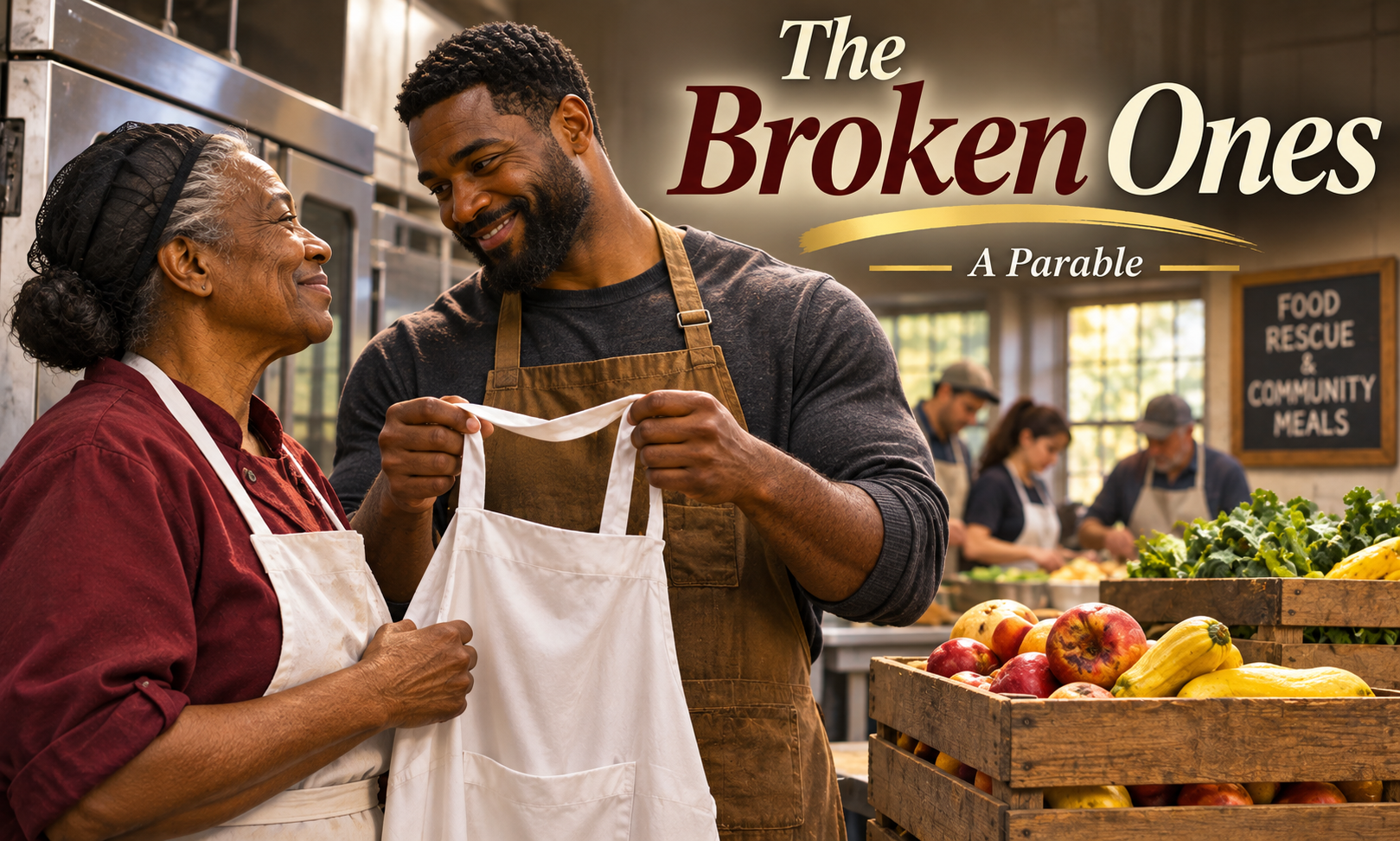
The Broken Ones
Hattie Okafor ran the kitchen at Bishop Road Elementary for thirty-one years. She knew every child by their tray.
She also knew Teddy Lund, who came through last every day, in a coat whose sleeves stopped well short of his wrists. He would slide up to the steam table after the line had gone and look over the sheet pan of dinner rolls.
"Any broken ones, Mrs. Okafor?"
The rolls that tore on the way out of the pan could not be served. The rule said so. They went in the can with everything else that came back: the unopened milks, the whole apples, a hundred and forty pounds of food on a bad day. Hattie had complained about that can for years. Nobody had ever answered her.
"Plenty of broken ones," she said, and he folded four of them into a napkin and put them in his coat.
It took her until November to understand they were not for him. There were two little sisters at home, and a mother working nights.
That was the end of the can. Hattie stayed late and read the regulations until she found what the state allowed. She built a share table by the door, for anything sealed or whole. She froze what could be frozen. She talked the bus garage into a freezer and the Baptists on the corner into a van. On Fridays, forty-one families on Bishop Road received a box, and nobody at the school needed to know which ones.
"Mrs. Okafor," a woman from the district said one spring, looking over the logs, "this is a great deal of work for leftovers."
"Yes, ma'am," Hattie said, and went on wrapping.
Teddy Lund finished school and moved away, the way they do. A hundred children came through after him, and then a thousand.
When Hattie was sixty-four, the district signed with a vendor. The food would now arrive heated and portioned from a plant two counties over, and the kitchen would need one attendant at half her pay. They gave her a plaque and a sheet cake. She carried a box of pans out to her car, and on the way she passed the can, full to the top.
She sat in the driveway for a long while that day. Her husband was gone. Her knee was bad. For a month she got up at five o'clock with nowhere to be, and she stood at the counter holding her coffee and tried to think what she was for.
The call came in March.
"Mrs. Okafor? It's Teddy. Teddy Lund. I need you to come see something."
He met her at the old grange hall at the far end of Bishop Road. He was thirty-three and broad across the shoulders, and his sleeves fit. Behind him stood two new ovens, a walk-in cooler and eleven volunteers who did not know how to hold a knife.
"The stores give me whatever they cannot sell," he said. "Bruised peaches, day-old bread, chicken a day from its date. I can get four thousand pounds a week. I can feed six hundred people. But I don't know what I'm doing, and it's going bad back there faster than I can cook it."
Hattie walked slowly along the shelves. She picked up a split squash and turned it in her hand. She looked at the volunteers, at the crates, at the young man in front of her.
"Teddy," she said, "that's a kind thought. But I'm sixty-four with a bad knee, and they just finished telling me they don't need me. Look at me, child. I'm what was left over."
Teddy reached behind the door and took down a clean white apron. He held it out to her in both hands, the way he used to hold the napkin.
"Yes, ma'am," he said. "Who do you think taught me what to do with that?"
Five thousand people have just eaten their fill, and Jesus sends His disciples back across the grass for the crumbs. Here is what John 6 teaches about abundance, waste and the care God takes over every last piece.
The Sentence After the Miracle
Almost everyone knows the story of the five loaves and two fish. It is the only miracle of Jesus, apart from the resurrection, that all four Gospels record.
Fewer of us remember what happened next. The people were full. The sun was going down. The greatest catering event in history had just ended with no bill. And the One who had just made bread out of almost nothing looked at the mess on the hillside and gave one more instruction.
"When they had all had enough to eat, he said to his disciples, 'Gather the pieces that are left over. Let nothing be wasted.'" (John 6:12, NIV).
The Question Under the Story
We would expect a God of abundance to be careless about crumbs. People with plenty usually are. The rich leave food on the plate, the busy leave hours on the table, and the gifted leave talents in the closet, because there always seems to be more where that came from.
Jesus had more where that came from. He sent His men back anyway.
So abundance and carefulness belong together in the mind of Christ. This chapter shows a Lord who gives as much as people want and then gathers what remains. So the question under this story is a practical one. What is lying on the grass in your life right now, and who is going to pick it up?
Lesson One: He Already Had in Mind What He Was Going to Do
The story opens with a test. "When Jesus looked up and saw a great crowd coming toward him, he said to Philip, 'Where shall we buy bread for these people to eat?'" (John 6:5, NIV).
John immediately lets us in on what Philip cannot see. "He asked this only to test him, for he already had in mind what he was going to do." (John 6:6, NIV).
Philip does what capable people do. He runs the numbers. "Philip answered him, 'It would take more than half a year's wages to buy enough bread for each one to have a bite!'" (John 6:7, NIV).
There is nothing wrong with the arithmetic. Philip counted the crowd, priced the bread and reached a correct answer. His calculation left out one thing, and that one thing was standing next to him asking the question.
Notice that Jesus does not scold him for counting. The rest of the story involves a good deal of counting: five loaves, two fish, five thousand men, twelve baskets. Jesus cares about numbers. He simply refuses to let the numbers be the last word.
Many of us have made our peace with Philip's answer. We look at the budget or the calendar, report what we cannot do, and call that realism. Stewards need realism. Jesus wanted to know whether Philip would look at the need and think of Him.
The test still arrives as a need larger than our resources, from a Lord who already knows what He will do. The stewardship of what is left over starts with a person who has learned to bring the numbers to Jesus.
Lesson Two: How Far Will They Go?
Andrew at least goes looking. "Another of his disciples, Andrew, Simon Peter's brother, spoke up, 'Here is a boy with five small barley loaves and two small fish, but how far will they go among so many?'" (John 6:8-9, NIV).
John alone tells us the loaves were barley, and he alone mentions the boy. Barley was the bread of ordinary and poor people, and the word for fish here points to something small, the kind of dried or salted bit you ate with bread. This was one child's lunch, and a modest one.
Andrew's sentence has two halves, and most of us live in the second. He finds the lunch, and then he apologizes for it. Here is what we have, but it will not go far.
Think about what that boy could have decided. He could have reasoned that his lunch would make no difference and eaten it. Nobody would have blamed him.
That is how waste often happens in the kingdom of God. A thing goes unused because it looked too small to offer. The woman who can only give an hour a week never gives it. The man who can only give twenty dollars keeps it. The young believer who knows only one verse says nothing to a friend in trouble.
We tend to measure a gift by comparing it with the need, and by that measure every gift fails. Jesus measures it by whose hands it is in. He never asks how far a thing will go. He asks to have it. The barley loaves were never enough, and that was never the point, because they were about to pass through hands that had made the world.
Lesson Three: As Much as They Wanted
What comes next is unhurried. "Jesus said, 'Have the people sit down.' There was plenty of grass in that place, and they sat down (about five thousand men were there)." (John 6:10, NIV).
He gives an order before He gives any food. People told to sit before anything has appeared on the table are being asked to trust. John mentions the grass, and earlier that the Passover was near (John 6:4), which helps explain why the hills were green. Readers of the Psalms may think of a Shepherd and green pastures.
Then come the actions. "Jesus then took the loaves, gave thanks, and distributed to those who were seated as much as they wanted. He did the same with the fish." (John 6:11, NIV).
Look at that phrase, as much as they wanted. Philip had hoped for a bite each. Jesus gives until nobody wants more. There is no rationing in this story and no suspicion. Nobody is asked whether they deserve it, and nobody is told to make it last.
Stewardship teaching often sounds like a call to tighten the belt. This story begins with a God who is generous past what anyone asked for. If you lose that, carefulness turns sour and becomes a fear of running out. The person who saves every crumb because he is afraid is not doing what the disciples did on that hillside. He is doing what Israel did with the manna when they tried to keep it overnight (Exodus 16:19-20), and that hoard went bad by morning.
Notice too that He gave thanks over a lunch that was obviously too small. A grateful steward thanks God for the barley loaf in hand and does not wait for the banquet.
Lesson Four: Let Nothing Be Wasted
Now we arrive at the sentence this post is about. "When they had all had enough to eat, he said to his disciples, 'Gather the pieces that are left over. Let nothing be wasted.'" (John 6:12, NIV).
The timing matters. He says this after everyone is full. Scarcity did not drive this order, because there was no scarcity. Jesus gave the command at the very moment when waste would have seemed most harmless.
This is the opposite of how we usually think. We are careful when we are short and careless when we have plenty. The end of a lean month gets our full attention. A good year gets very little. Jesus teaches that plenty does not change the rule, because what is on the grass still came from the Father's hand.
"So they gathered them and filled twelve baskets with the pieces of the five barley loaves left over by those who had eaten." (John 6:13, NIV).
There was far more at the end than there had been at the start. Twelve is the number of the tribes of Israel and of the men holding the baskets, though readers differ on how much to make of that. What is plain is that twelve men who had just served a crowd were sent back to stoop and pick up scraps, and they came back with their arms full.
The crowd saw the bread arrive. The disciples saw how much remained after a meal they had thought impossible. Sometimes God teaches His servants more in the cleanup than in the miracle.
John does not tell us who ate those baskets. We know only that nothing the Lord had made was left to rot.
Lesson Five: What Is Lying on the Grass
Bread is the subject of the passage, and it is right to start there. An enormous share of the food produced in wealthy countries ends up in the trash, and a Christian who hears this verse should look in the refrigerator before anywhere else.
But the principle reaches further. Everything you have has come from the same hand, and nearly everyone has some of it lying around.
There is the money that leaks away without a decision: the subscription nobody uses, the interest on a balance, the purchases that nobody remembers a month later. There are the pieces of time between the large blocks, the twenty minutes that vanish into a phone. There are the skills you used for years and then put away. There is the spare room, the extra car, the tools in the garage, the coat in the closet that has not been worn in three winters.
The word for pieces here is a word for fragments, things broken off. That should give hope to anyone who feels their life has come apart. Some of what is lying on your grass is broken: a failed business and the lessons it taught, a long illness and the compassion it left in you, a divorce, a bankruptcy, a child you lost. We are inclined to throw those years away and try to forget them. Jesus tells His people to go and gather the pieces.
Nothing you have suffered needs to go to waste in the hands of Christ. The person who has walked through a broken season often becomes the one best able to feed someone else in it. Those baskets were filled with broken bread, and it was still good bread.
So walk your own hillside with a basket. Ask what God has already given you that is simply lying there.
Lesson Six: Food That Spoils and Food That Endures
The crowd drew the wrong conclusion. "After the people saw the sign Jesus performed, they began to say, 'Surely this is the Prophet who is to come into the world.'" (John 6:14, NIV).
"Jesus, knowing that they intended to come and make him king by force, withdrew again to a mountain by himself." (John 6:15, NIV).
A king who could produce free bread would solve a great many problems, and they were prepared to use force to keep it coming. When they caught up with Him the next day, He told them so. "Jesus answered, 'Very truly I tell you, you are looking for me, not because you saw the signs I performed but because you ate the loaves and had your fill. Do not work for food that spoils, but for food that endures to eternal life, which the Son of Man will give you. For on him God the Father has placed his seal of approval.'" (John 6:26-27, NIV).
Here is something an English reader cannot easily see. The word translated wasted in verse 12 and the word translated spoils in verse 27 are the same Greek verb, and it means to perish or be lost. Jesus has just had His men save bread from perishing. Now He tells the crowd that all such bread perishes in the end, and that there is another kind.
Those twelve baskets would be gone within days. We are careful with things that will not last, and we should be, but they cannot be what we live for. A person can manage every dollar and minute well and still be working only for food that spoils.
Then Jesus says who the lasting bread is. "Then Jesus declared, 'I am the bread of life. Whoever comes to me will never go hungry, and whoever believes in me will never be thirsty.'" (John 6:35, NIV).
The steward's first act is to come and eat. Everything else follows from that.
For Business Leaders: Audit the Grass
Every company leaks. Some of it shows up on a report: unused licenses, excess inventory, overtime that exists only because of a bad process. Much of it does not: the talented employee doing work far below her ability, the customer who was never called back, the idea from the warehouse floor that nobody asked about.
Waste in a business is seldom dramatic. It sits in the small things after the sale is made and everybody has moved on. A leader who goes back over the hillside after a big win is honoring what God gave, and is teaching the team that success never excuses carelessness.
"The lazy do not roast any game, but the diligent feed on the riches of the hunt." (Proverbs 12:27, NIV).
Your Obedience Step
After your next win, schedule one hour to go back over it with your team. Ask what was left on the table, what was thrown away, and who did good work that nobody noticed. Pick one item and do something about it within the week.
For Community Leaders: Find What Is Going Unused
Most churches and nonprofits describe themselves as short of resources. Many of them sit on buildings that stand empty six days a week, kitchens used twice a year, and retired members with forty years of experience who are never asked for anything.
The surplus in one part of a community is often the exact answer to the need in another. Someone has to walk the ground and connect the two. Leaders who do this help people see that their leftovers have a place to go.
"She opens her arms to the poor and extends her hands to the needy." (Proverbs 31:20, NIV).
Your Obedience Step
Walk through your building or your member list this month with one question: what have we got that nobody is using? Choose one thing and match it to one real need in your neighborhood before the month ends.
For Home Leaders: Teach It at the Table
Children learn what things are worth by how a home treats them. A family that throws out half of what it buys is teaching something, whether it means to or not. So is a family that thanks God before a meal, eats what it has, and makes something good out of Tuesday's chicken.
This need not become a grim lesson about cleaning your plate. The point is gratitude. Everything on the table came from God's open hand, and a home that remembers that will treat a loaf of bread differently, and will also tend to notice who has none.
"You open your hand and satisfy the desires of every living thing." (Psalm 145:16, NIV).
Your Obedience Step
This week, plan one meal from what is already in the house, and let the children help make it. Before you eat, thank God together. Then pick one thing you have more of than you need and give it to someone who could use it.
For the Everyday Believer: Pick Up the Pieces of Your Day
You may not have a budget, a building or a team. You have a hillside all the same. You have the fifteen minutes before work, the small skill nobody pays you for, the phone call you keep meaning to make, and the hard thing you lived through that somebody near you is going through now.
None of it looks like much. It did not look like much in a boy's hands either. God has a long history of using what we were about to throw away.
"Whatever your hand finds to do, do it with all your might, for in the realm of the dead, where you are going, there is neither working nor planning nor knowledge nor wisdom." (Ecclesiastes 9:10, NIV).
Your Obedience Step
Tonight, write down three leftovers from your week: some time, some money and one broken experience. Give one of them to God in prayer, and use it for someone else before next Sunday.
Not One Piece Lost
Later in the same conversation, Jesus takes this subject far beyond food. "And this is the will of him who sent me, that I shall lose none of all those he has given me, but raise them up at the last day." (John 6:39, NIV).
There is that word again, the same verb. Let nothing be lost, He told the disciples about the bread. I shall lose none, He says about His people. The same care that sent twelve men across the grass is the care He has for you.
If you have felt like a crumb, overlooked and left behind after the meal, this chapter speaks to you. He does not leave pieces on the hillside. His own body would be broken so that nothing the Father gave Him would be lost.
Go and gather what you have been given. You were gathered first.
Questions for Reflection
- Where am I careful when I am short and careless when I have plenty?
- What need am I measuring by the numbers without bringing it to Jesus?
- What small thing have I held back because it did not seem worth offering?
- What in my life is simply lying on the grass, unused, right now?
- Which broken season might God want me to gather up and use for someone else?
- Am I working mainly for food that spoils, or have I come to the bread that endures?
Closing Prayer
Lord Jesus, you fed a hungry crowd with a boy's lunch and then sent your friends back for the crumbs. I confess that I have been careless with much of what you gave me. I have let money slip away, and hours, and gifts you placed in my hands. I have held back what looked too small, and I have tried to bury what was broken. Forgive me. Teach me to bring my numbers to you. Make me grateful before I see the provision, and generous with what I have. Open my eyes to what is lying unused around me, and show me who needs it. Keep me from working only for food that spoils. You are the bread of life. Thank you that your body was broken for me, and thank you that you will lose none of those the Father gave you. I come to you to eat. In Jesus' name, Amen.
The Broken Ones
Hattie Okafor ran the kitchen at Bishop Road Elementary for thirty-one years. She knew every child by their tray.
She also knew Teddy Lund, who came through last every day, in a coat whose sleeves stopped well short of his wrists. He would slide up to the steam table after the line had gone and look over the sheet pan of dinner rolls.
"Any broken ones, Mrs. Okafor?"
The rolls that tore on the way out of the pan could not be served. The rule said so. They went in the can with everything else that came back: the unopened milks, the whole apples, a hundred and forty pounds of food on a bad day. Hattie had complained about that can for years. Nobody had ever answered her.
"Plenty of broken ones," she said, and he folded four of them into a napkin and put them in his coat.
It took her until November to understand they were not for him. There were two little sisters at home, and a mother working nights.
That was the end of the can. Hattie stayed late and read the regulations until she found what the state allowed. She built a share table by the door, for anything sealed or whole. She froze what could be frozen. She talked the bus garage into a freezer and the Baptists on the corner into a van. On Fridays, forty-one families on Bishop Road received a box, and nobody at the school needed to know which ones.
"Mrs. Okafor," a woman from the district said one spring, looking over the logs, "this is a great deal of work for leftovers."
"Yes, ma'am," Hattie said, and went on wrapping.
Teddy Lund finished school and moved away, the way they do. A hundred children came through after him, and then a thousand.
When Hattie was sixty-four, the district signed with a vendor. The food would now arrive heated and portioned from a plant two counties over, and the kitchen would need one attendant at half her pay. They gave her a plaque and a sheet cake. She carried a box of pans out to her car, and on the way she passed the can, full to the top.
She sat in the driveway for a long while that day. Her husband was gone. Her knee was bad. For a month she got up at five o'clock with nowhere to be, and she stood at the counter holding her coffee and tried to think what she was for.
The call came in March.
"Mrs. Okafor? It's Teddy. Teddy Lund. I need you to come see something."
He met her at the old grange hall at the far end of Bishop Road. He was thirty-three and broad across the shoulders, and his sleeves fit. Behind him stood two new ovens, a walk-in cooler and eleven volunteers who did not know how to hold a knife.
"The stores give me whatever they cannot sell," he said. "Bruised peaches, day-old bread, chicken a day from its date. I can get four thousand pounds a week. I can feed six hundred people. But I don't know what I'm doing, and it's going bad back there faster than I can cook it."
Hattie walked slowly along the shelves. She picked up a split squash and turned it in her hand. She looked at the volunteers, at the crates, at the young man in front of her.
"Teddy," she said, "that's a kind thought. But I'm sixty-four with a bad knee, and they just finished telling me they don't need me. Look at me, child. I'm what was left over."
Teddy reached behind the door and took down a clean white apron. He held it out to her in both hands, the way he used to hold the napkin.
"Yes, ma'am," he said. "Who do you think taught me what to do with that?"
Comments
Keep it kind and on topic. See something that doesn't belong? Tap Report under it and we'll review it.