
Stewardship of Resources · Stewardship Faith-Spiritual Growth
Here and Now: Luke 19 on Zacchaeus and the Restitution That Follows Grace
Qunetin Robinson

A rich man climbs a tree, Jesus invites Himself to dinner, and a chief tax collector starts paying people back. Here is what Luke 19 teaches about the grace that comes first and the restitution that follows it.
The Man Nobody Invited
Jericho had plenty of reasons to hate Zacchaeus. He collected taxes for Rome from his own people, he ran other collectors under him, and he had grown rich doing it. Everyone in town could point to his house and guess how it was paid for. Decent people did not eat there.
By the end of one afternoon, that man was on his feet in his own home, announcing that half of what he owned was going to the poor and that anyone he had cheated would be repaid four times over. Nobody had preached at him. Nobody had told him what to do. Jesus had walked up to a tree, called him by name and asked to come over.
The Question Under the Story
Most of us have something in our past that still has a dollar amount on it. It might be an overcharge, a debt we let die, or a corner we cut that cost someone else without their ever knowing. We confess it to God, we feel forgiven, and we leave the money where it is.
Zacchaeus would not do that. His story puts a plain question to any steward who has met Christ. Forgiveness is free, and this passage insists on it. So what do you do with what you took?
Lesson One: The Money Had a History
Luke sets the scene in two short lines. "Jesus entered Jericho and was passing through." (Luke 19:1, NIV). "A man was there by the name of Zacchaeus; he was a chief tax collector and was wealthy." (Luke 19:2, NIV).
Jericho sat on a main trade road, which made it a rich post for a customs man. Rome contracted the work out, and a collector's profit came from whatever he could raise above what was owed. Chief tax collector is a title found nowhere else in the New Testament. It suggests a man at the top of a local system, with others working below him.
When tax collectors asked John the Baptist what repentance required, his answer set a low bar. "Even tax collectors came to be baptized. 'Teacher,' they asked, 'what should we do?' 'Don't collect any more than you are required to,' he told them." (Luke 3:12-13, NIV). The fact that he had to say it tells you how the job usually worked.
Luke places this man in a telling spot. One chapter earlier, a rich ruler walked away from Jesus very sad (Luke 18:18-23), and the crowd asked who could possibly be saved. "Jesus replied, 'What is impossible with man is possible with God.'" (Luke 18:27, NIV). Turn the page and here is another rich man, and now we get to watch the impossible happen.
Notice that Luke says wealthy and adds no comment. He does not need one. Money has a history, and the people of Jericho knew this history by heart. Much of what you hold may be clean, earned by honest labor. Some of it may not be. Stewardship starts with being honest about how the money reached you.
Lesson Two: Up in the Sycamore-Fig
"He wanted to see who Jesus was, but because he was short he could not see over the crowd. So he ran ahead and climbed a sycamore-fig tree to see him, since Jesus was coming that way." (Luke 19:3-4, NIV).
Think about what that cost him. Men of standing in that world did not run, and they did not climb trees in their robes. A man this rich could hire out almost anything, but nobody could do this for him. Luke says only that he was short, but it is hard to imagine anyone in that crowd stepping aside to give Zacchaeus a better view.
He wanted to see who Jesus was. Luke does not tell us why. He may have heard that Jesus had called a tax collector named Levi and eaten at his table (Luke 5:27-29). Whatever the reason, something in the richest man in town was still hungry. Money had bought him a fine house and, it seems, cost him the town.
That matters to a steward. Wealth can leave a person surrounded and alone. It can also keep a person so busy protecting what they have that they stop wanting anything else. Zacchaeus still wanted something, and he was willing to look foolish to get it.
Plenty of people never reach the question of money because they will not risk their dignity. They will write a check to the church, but they will not be seen needing anything from it. Before this man ever reached for his purse, he was up a tree in front of people who despised him.
It is a small, funny picture of a serious truth. He thought he was the one looking for Jesus. The next verse shows he had it backward.
Lesson Three: I Must Stay at Your House
"When Jesus reached the spot, he looked up and said to him, 'Zacchaeus, come down immediately. I must stay at your house today.'" (Luke 19:5, NIV).
Everything turns here. Jesus stops, looks up and calls him by name, and nobody in the story has told Him who this is. Then He says must, the same word He used when He said He must proclaim the kingdom (Luke 4:43) and must suffer (Luke 9:22). This visit was part of His errand.
Look at the order. Jesus did not say to come down, repent, pay everyone back, and then He would consider a visit. He invited Himself in first, with no conditions at all. "So he came down at once and welcomed him gladly." (Luke 19:6, NIV). That word gladly is our first look at what grace does to a person. Joy got there before the money did.
The reaction was just as quick. "All the people saw this and began to mutter, 'He has gone to be the guest of a sinner.'" (Luke 19:7, NIV). We have heard that sound earlier in Luke. "But the Pharisees and the teachers of the law muttered, 'This man welcomes sinners and eats with them.'" (Luke 15:2, NIV). In Jericho the complaint had spread. Now all the people were saying it.
They had the facts right. Zacchaeus was a sinner, and some of them had paid for it. What they could not see was that the guest walking into that house was the only person who could get their money back. No lawsuit or boycott had ever moved Zacchaeus to return a coin. A dinner invitation did it. The town wanted justice from a distance, and Jesus went inside to get it.
Lesson Four: Here and Now
"But Zacchaeus stood up and said to the Lord, 'Look, Lord! Here and now I give half of my possessions to the poor, and if I have cheated anybody out of anything, I will pay back four times the amount.'" (Luke 19:8, NIV).
Some careful readers take the verbs as describing a habit, as if he were defending himself by saying this is what he already does. The NIV's here and now reads it as a fresh decision, and that fits the story, since Jesus answers by saying salvation has come today.
He names two things. The first is generosity: half of everything, to the poor, and nobody asked. The second is repayment, and the number is worth a close look. "Whoever steals an ox or a sheep and slaughters it or sells it must pay back five head of cattle for the ox and four sheep for the sheep." (Exodus 22:1, NIV). For an ordinary wrong, the law asked for the full amount plus a fifth (Numbers 5:7). Zacchaeus passed over the lighter rule and reached for the penalty on a thief. He judged himself by it.
The word for cheated is the one John used with soldiers (Luke 3:14), and it means getting money through pressure and false claims. His if does not express doubt. He knew.
Do the math. Half is gone, and then four times the damages come out of the half that remains. That could take nearly everything he had. No one set those terms. Jesus told the rich ruler to sell it all, and He gave Zacchaeus no instruction whatever. There is no formula here, because Jesus goes to where each person's idol lives.
Then notice the first words of his promise. Here and now. Delay is how most of us stay comfortable with what we owe. We mean to get to it someday. He stood up at the table and started.
Lesson Five: Fruit, Not a Fee
"Jesus said to him, 'Today salvation has come to this house, because this man, too, is a son of Abraham.'" (Luke 19:9, NIV).
It would be easy to read this wrongly, as though he paid and so he was saved. The order of events rules that out. Jesus chose this house before a single coin moved. Zacchaeus did not buy his welcome. He answered it. Salvation is a gift of grace (Ephesians 2:8-9), and what he did at that table was its fruit.
Fruit is the word John the Baptist used. "Produce fruit in keeping with repentance. And do not begin to say to yourselves, 'We have Abraham as our father.' For I tell you that out of these stones God can raise up children for Abraham." (Luke 3:8, NIV). Zacchaeus made no claim about Abraham. Jesus gave him that name himself, in front of a town that had written him out of the family.
Two things in this verse correct us. The first is that giving is not the same as restitution. You cannot write a large check to a good cause and settle what you owe a particular person. Zacchaeus kept the two apart. Half went to the poor, and the man he cheated still got paid.
The second is that restitution does not earn forgiveness, which is exactly why it can be done gladly. You are not paying God. That account was settled by someone else. Because you are already forgiven, you are free to go and pay your neighbor.
A person who thinks forgiveness leaves the books untouched has misread this story. So has a person who thinks the books can buy forgiveness. Grace comes first, and it reaches the wallet.
Lesson Six: Why He Went There
"For the Son of Man came to seek and to save the lost." (Luke 19:10, NIV).
This is Jesus' answer to the muttering. Everyone wanted to know why He would go to that house. He told them, and in one sentence He gave the reason for His whole coming.
Israel had heard God promise this. "I will search for the lost and bring back the strays. I will bind up the injured and strengthen the weak, but the sleek and the strong I will destroy. I will shepherd the flock with justice." (Ezekiel 34:16, NIV). God spoke those words against shepherds who fed themselves on the flock (Ezekiel 34:2). Then Jesus stands in a rich man's house in Jericho and claims that work as His own. Lost is the same word Luke used of the sheep, the coin and the son (Luke 15:4-32).
Zacchaeus was a lost man who looked found. He had a title, a staff and a full treasury. A strong balance sheet can sit on top of a lost life for years, and nothing on the statement will show it.
This verse changes how a steward sees two groups of people. The first group is us. We were the ones being looked for. Every good thing we have done with money began with Someone stopping under our tree. That leaves no room for pride about our giving.
The second group is the people we have written off. Think of the person you have decided is too far gone, too greedy, too compromised. It might be someone who cheated you. Jesus may be on His way to that house right now, and the crowd may be muttering. Make sure you are not among them.
For Business Leaders: Pay Back What the System Let You Keep
Zacchaeus worked inside a system that allowed what he did. Much of his overcharging was probably normal for his trade. He still called it cheating.
Your industry has its own version: the fee nobody reads, the overbilled hour, the customer who never noticed. Legal is not the same as clean. If a matter has real legal weight, take wise counsel, but do not let counsel turn into a place to hide. Silence about it costs more than you think.
"Whoever conceals their sins does not prosper, but the one who confesses and renounces them finds mercy." (Proverbs 28:13, NIV).
Your Obedience Step
Ask yourself who has paid more than they should have because of how you do business. Pick one name or account. This month, repay it with something added, in writing, and change the practice that caused it.
For Community Leaders: Settle It Before You Stand Up
Leaders of churches and nonprofits collect trust the way Zacchaeus collected taxes, and we can take more than we were owed. A volunteer gets used and dropped. A staff member takes the blame for our mistake. A donor gift gets moved without a word to the donor.
It is tempting to make up for such things with public service. Jesus told us to go to the person first, and He put that ahead of worship itself.
"Therefore, if you are offering your gift at the altar and there remember that your brother or sister has something against you, leave your gift there in front of the altar. First go and be reconciled to them; then come and offer your gift." (Matthew 5:23-24, NIV).
Your Obedience Step
Before you next stand up to lead, name the person who has something against you. Go to them, say plainly what you did without explaining it, and ask what would make it right.
For Home Leaders: Say the Whole Thing at Your Own Table
Jesus said salvation had come to this house. Whoever was under that roof watched the man of the house stand up, tell the truth about himself and start giving things back. Imagine what that did for the people who lived there.
Children rarely see an adult make something right. They see us defend ourselves. A home changes when a parent can say, "I was wrong, I took something that was not mine to take, and here is how I am going to repair it." It may be money. It may be time, or a promise, or a reputation you damaged in an argument.
"Then I acknowledged my sin to you and did not cover up my iniquity. I said, 'I will confess my transgressions to the Lord.' And you forgave the guilt of my sin." (Psalm 32:5, NIV).
Your Obedience Step
Choose one wrong you have done to someone in your home that was never named. Tell them this week, in plain words, and ask what repair would look like. Then do it where the family can see.
For the Everyday Believer: Go Back for the Joy
You may not be a chief anything, and your list may be short: a borrowed tool, an unpaid loan from a friend, a hotel towel, a false claim on a form, money from a job where you padded your hours. Small debts have a way of sitting on the soul.
Think about going back as the road to joy, and leave the shame behind. Zacchaeus does not sound crushed in this story. He sounds like a man whose chains have come off. If going back to someone would hurt them or put you at risk, talk to a pastor first about the right way to do it.
"Restore to me the joy of your salvation and grant me a willing spirit, to sustain me." (Psalm 51:12, NIV).
Your Obedience Step
Sit quietly and ask God to bring one name to mind. Write it down, with what you owe. Take the first step within seven days, and add something to it.
Come Down Immediately
Luke does not tell us how it went from there. He never says who came to the door or how much was paid out. The story simply moves on, and before long Jesus is going up to Jerusalem (Luke 19:28).
He went there to deal with a debt no fourfold repayment could touch. Zacchaeus could make things right with his neighbors, but he could not pay what he owed God. Neither can we. The one person in Jericho who owed nothing went to a cross and paid it all. Every act of restitution in this story stands on that.
So the call is the same as it was under the tree. Come down, today, and let Him into the house. The books can follow.
Questions for Reflection
- What in my past still has a dollar amount on it?
- How did the money I hold reach me, and is any of it not really mine?
- What am I too dignified to do to get closer to Jesus?
- Have I ever tried to cover a specific wrong with general giving?
- Who have I written off as too far gone for Jesus to visit?
- What would it look like for me to obey here and now, and not someday?
Closing Prayer
Lord Jesus, you stopped under my tree before I ever knew you were looking for me. You called me by name, and you came in while the house was still a mess. Thank you for paying what I could never pay. I do not want to treat your grace as a way to keep what is not mine. Show me what I have taken and who has paid for it. Give me the courage to go to them, the honesty to say it plainly, and a glad heart as I make it right. Keep me from covering a wrong with a good deed. Keep me from despising anyone you are on your way to find. Let salvation be plain in my house, and let the people closest to me see it. In Jesus' name, Amen.
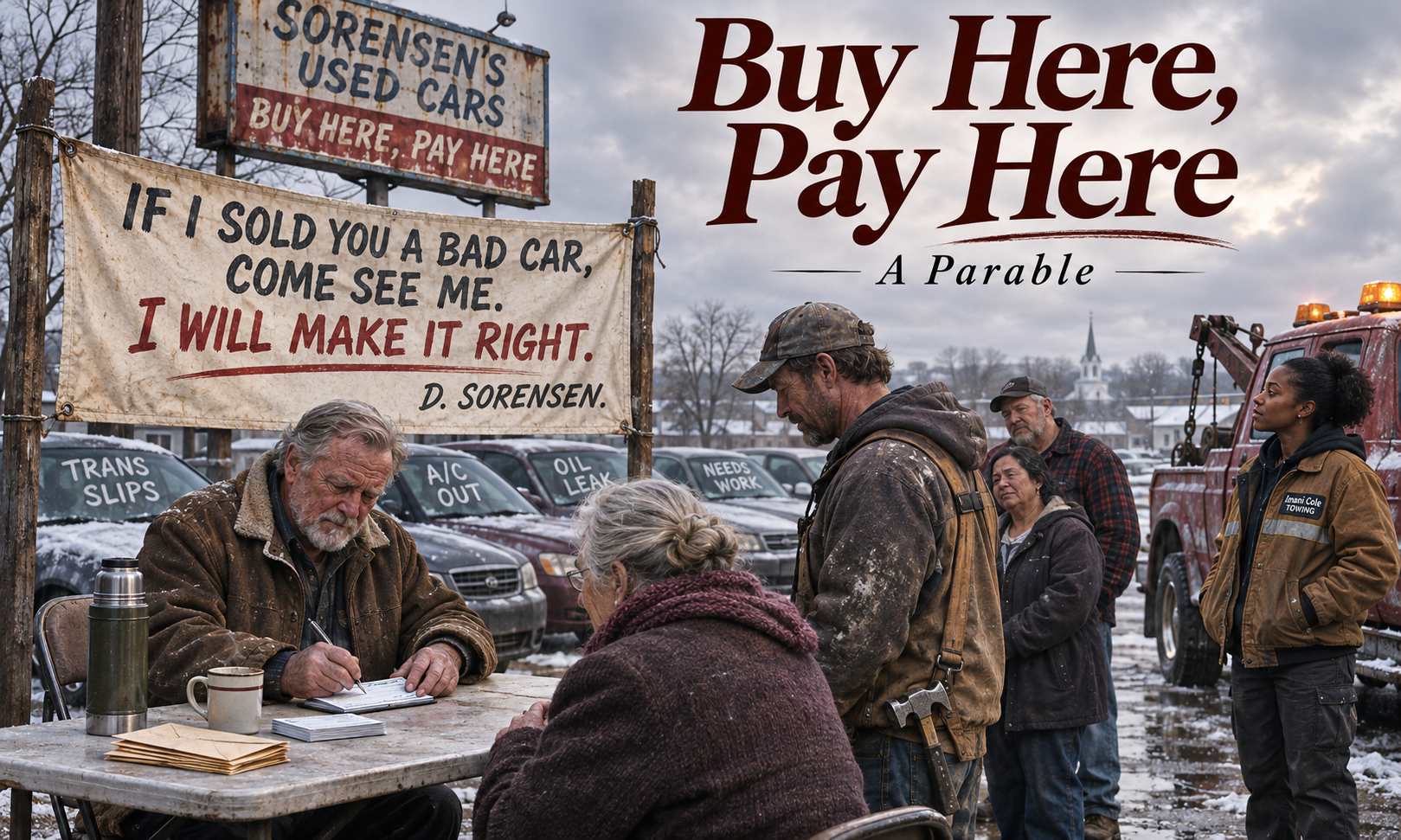
Buy Here, Pay Here
For thirty-four years, the sign over Sorensen Auto on Mercer Street read BUY HERE, PAY HERE. Dwight Sorensen sold cars to people the banks would not touch. He knew which ones had been under water, which ones burned oil, and which ones would make it just past ninety days. He had a big house on the lake side of town and a table at the club, where he mostly ate alone.
He was driving home from that table one night in November when his truck quit on County Road 9. It was sleeting. The tow driver was a young woman in a canvas coat, who hooked up the truck without a word, put him in the cab and turned the heater up.
"You're Dwight Sorensen," she said, after a mile or so.
"Do I know you?"
"Imani Cole. A silver Malibu, about fifteen years back." She kept her eyes on the road. "I was nineteen. It had a cracked head gasket and you knew it. It quit on me in my second month of nursing school, and I was still paying you for it a year after it went to the crusher. I never did go back to school."
Dwight looked for something to say. In all his years on the lot, he had never once failed to find it.
She pulled into the yard and dropped the truck. The shop would not open until morning. She looked at him standing there in the sleet in his club shoes.
"My mother has soup on," she said. "Come on."
"You know who I am," he said. "You just told me."
"I know exactly who you are, Mr. Sorensen. Get in."
Her mother's kitchen was about the size of his closet. A bowl was set in front of him without anyone asking, and then a second one. The old woman said the blessing and put his name in it. Nobody mentioned the Malibu. They asked if he was warm enough. He had eaten at the club for twenty years, and he could not remember anyone there ever asking him that.
He did not sleep. At six the next morning he stood on the lot in the cold and looked down the rows, and he knew, the way he had always known, exactly what was wrong with every car.
By noon the sign man had come. Vince, his sales manager, walked out with his coffee, read the new banner and went pale.
IF I SOLD YOU A BAD CAR, COME SEE ME. I WILL MAKE IT RIGHT. D. SORENSEN.
"Dwight, you'll have half the county out here. Do you know what that's going to cost?"
"I have a fair idea," Dwight said. "I remember every one of them."
They came. A roofer came with a transmission story. A grandmother came who had walked to church for a year. Some came to shout, and he let them. Around town they said he was dying, or under indictment. He sat at a folding table under the banner and wrote checks, four times the damage wherever he could figure it. The lake house went on the market in January. The club stopped sending a bill. In March he sold off the last eleven cars with every fault written on the windshield in grease pencil.
On the last afternoon, a tow truck pulled in. Imani Cole got out and stood reading the banner while the wind worked at it. She had not come all winter.
He took an envelope out of his shirt pocket. It had been there since November, and the corners had gone soft. She opened it and looked at the check for a long time.
"I didn't feed you for this," she said.
"I know you didn't," Dwight said. "That's how I was able to write it."
Go Deeper
Ready to put this teaching into practice? Here and Now is a guided workbook drawn from Luke 19, Nehemiah 5 and Acts 4 and 5. Work through four movements at your own pace and finish with one page you build for yourself: Your Restitution List.
A rich man climbs a tree, Jesus invites Himself to dinner, and a chief tax collector starts paying people back. Here is what Luke 19 teaches about the grace that comes first and the restitution that follows it.
The Man Nobody Invited
Jericho had plenty of reasons to hate Zacchaeus. He collected taxes for Rome from his own people, he ran other collectors under him, and he had grown rich doing it. Everyone in town could point to his house and guess how it was paid for. Decent people did not eat there.
By the end of one afternoon, that man was on his feet in his own home, announcing that half of what he owned was going to the poor and that anyone he had cheated would be repaid four times over. Nobody had preached at him. Nobody had told him what to do. Jesus had walked up to a tree, called him by name and asked to come over.
The Question Under the Story
Most of us have something in our past that still has a dollar amount on it. It might be an overcharge, a debt we let die, or a corner we cut that cost someone else without their ever knowing. We confess it to God, we feel forgiven, and we leave the money where it is.
Zacchaeus would not do that. His story puts a plain question to any steward who has met Christ. Forgiveness is free, and this passage insists on it. So what do you do with what you took?
Lesson One: The Money Had a History
Luke sets the scene in two short lines. "Jesus entered Jericho and was passing through." (Luke 19:1, NIV). "A man was there by the name of Zacchaeus; he was a chief tax collector and was wealthy." (Luke 19:2, NIV).
Jericho sat on a main trade road, which made it a rich post for a customs man. Rome contracted the work out, and a collector's profit came from whatever he could raise above what was owed. Chief tax collector is a title found nowhere else in the New Testament. It suggests a man at the top of a local system, with others working below him.
When tax collectors asked John the Baptist what repentance required, his answer set a low bar. "Even tax collectors came to be baptized. 'Teacher,' they asked, 'what should we do?' 'Don't collect any more than you are required to,' he told them." (Luke 3:12-13, NIV). The fact that he had to say it tells you how the job usually worked.
Luke places this man in a telling spot. One chapter earlier, a rich ruler walked away from Jesus very sad (Luke 18:18-23), and the crowd asked who could possibly be saved. "Jesus replied, 'What is impossible with man is possible with God.'" (Luke 18:27, NIV). Turn the page and here is another rich man, and now we get to watch the impossible happen.
Notice that Luke says wealthy and adds no comment. He does not need one. Money has a history, and the people of Jericho knew this history by heart. Much of what you hold may be clean, earned by honest labor. Some of it may not be. Stewardship starts with being honest about how the money reached you.
Lesson Two: Up in the Sycamore-Fig
"He wanted to see who Jesus was, but because he was short he could not see over the crowd. So he ran ahead and climbed a sycamore-fig tree to see him, since Jesus was coming that way." (Luke 19:3-4, NIV).
Think about what that cost him. Men of standing in that world did not run, and they did not climb trees in their robes. A man this rich could hire out almost anything, but nobody could do this for him. Luke says only that he was short, but it is hard to imagine anyone in that crowd stepping aside to give Zacchaeus a better view.
He wanted to see who Jesus was. Luke does not tell us why. He may have heard that Jesus had called a tax collector named Levi and eaten at his table (Luke 5:27-29). Whatever the reason, something in the richest man in town was still hungry. Money had bought him a fine house and, it seems, cost him the town.
That matters to a steward. Wealth can leave a person surrounded and alone. It can also keep a person so busy protecting what they have that they stop wanting anything else. Zacchaeus still wanted something, and he was willing to look foolish to get it.
Plenty of people never reach the question of money because they will not risk their dignity. They will write a check to the church, but they will not be seen needing anything from it. Before this man ever reached for his purse, he was up a tree in front of people who despised him.
It is a small, funny picture of a serious truth. He thought he was the one looking for Jesus. The next verse shows he had it backward.
Lesson Three: I Must Stay at Your House
"When Jesus reached the spot, he looked up and said to him, 'Zacchaeus, come down immediately. I must stay at your house today.'" (Luke 19:5, NIV).
Everything turns here. Jesus stops, looks up and calls him by name, and nobody in the story has told Him who this is. Then He says must, the same word He used when He said He must proclaim the kingdom (Luke 4:43) and must suffer (Luke 9:22). This visit was part of His errand.
Look at the order. Jesus did not say to come down, repent, pay everyone back, and then He would consider a visit. He invited Himself in first, with no conditions at all. "So he came down at once and welcomed him gladly." (Luke 19:6, NIV). That word gladly is our first look at what grace does to a person. Joy got there before the money did.
The reaction was just as quick. "All the people saw this and began to mutter, 'He has gone to be the guest of a sinner.'" (Luke 19:7, NIV). We have heard that sound earlier in Luke. "But the Pharisees and the teachers of the law muttered, 'This man welcomes sinners and eats with them.'" (Luke 15:2, NIV). In Jericho the complaint had spread. Now all the people were saying it.
They had the facts right. Zacchaeus was a sinner, and some of them had paid for it. What they could not see was that the guest walking into that house was the only person who could get their money back. No lawsuit or boycott had ever moved Zacchaeus to return a coin. A dinner invitation did it. The town wanted justice from a distance, and Jesus went inside to get it.
Lesson Four: Here and Now
"But Zacchaeus stood up and said to the Lord, 'Look, Lord! Here and now I give half of my possessions to the poor, and if I have cheated anybody out of anything, I will pay back four times the amount.'" (Luke 19:8, NIV).
Some careful readers take the verbs as describing a habit, as if he were defending himself by saying this is what he already does. The NIV's here and now reads it as a fresh decision, and that fits the story, since Jesus answers by saying salvation has come today.
He names two things. The first is generosity: half of everything, to the poor, and nobody asked. The second is repayment, and the number is worth a close look. "Whoever steals an ox or a sheep and slaughters it or sells it must pay back five head of cattle for the ox and four sheep for the sheep." (Exodus 22:1, NIV). For an ordinary wrong, the law asked for the full amount plus a fifth (Numbers 5:7). Zacchaeus passed over the lighter rule and reached for the penalty on a thief. He judged himself by it.
The word for cheated is the one John used with soldiers (Luke 3:14), and it means getting money through pressure and false claims. His if does not express doubt. He knew.
Do the math. Half is gone, and then four times the damages come out of the half that remains. That could take nearly everything he had. No one set those terms. Jesus told the rich ruler to sell it all, and He gave Zacchaeus no instruction whatever. There is no formula here, because Jesus goes to where each person's idol lives.
Then notice the first words of his promise. Here and now. Delay is how most of us stay comfortable with what we owe. We mean to get to it someday. He stood up at the table and started.
Lesson Five: Fruit, Not a Fee
"Jesus said to him, 'Today salvation has come to this house, because this man, too, is a son of Abraham.'" (Luke 19:9, NIV).
It would be easy to read this wrongly, as though he paid and so he was saved. The order of events rules that out. Jesus chose this house before a single coin moved. Zacchaeus did not buy his welcome. He answered it. Salvation is a gift of grace (Ephesians 2:8-9), and what he did at that table was its fruit.
Fruit is the word John the Baptist used. "Produce fruit in keeping with repentance. And do not begin to say to yourselves, 'We have Abraham as our father.' For I tell you that out of these stones God can raise up children for Abraham." (Luke 3:8, NIV). Zacchaeus made no claim about Abraham. Jesus gave him that name himself, in front of a town that had written him out of the family.
Two things in this verse correct us. The first is that giving is not the same as restitution. You cannot write a large check to a good cause and settle what you owe a particular person. Zacchaeus kept the two apart. Half went to the poor, and the man he cheated still got paid.
The second is that restitution does not earn forgiveness, which is exactly why it can be done gladly. You are not paying God. That account was settled by someone else. Because you are already forgiven, you are free to go and pay your neighbor.
A person who thinks forgiveness leaves the books untouched has misread this story. So has a person who thinks the books can buy forgiveness. Grace comes first, and it reaches the wallet.
Lesson Six: Why He Went There
"For the Son of Man came to seek and to save the lost." (Luke 19:10, NIV).
This is Jesus' answer to the muttering. Everyone wanted to know why He would go to that house. He told them, and in one sentence He gave the reason for His whole coming.
Israel had heard God promise this. "I will search for the lost and bring back the strays. I will bind up the injured and strengthen the weak, but the sleek and the strong I will destroy. I will shepherd the flock with justice." (Ezekiel 34:16, NIV). God spoke those words against shepherds who fed themselves on the flock (Ezekiel 34:2). Then Jesus stands in a rich man's house in Jericho and claims that work as His own. Lost is the same word Luke used of the sheep, the coin and the son (Luke 15:4-32).
Zacchaeus was a lost man who looked found. He had a title, a staff and a full treasury. A strong balance sheet can sit on top of a lost life for years, and nothing on the statement will show it.
This verse changes how a steward sees two groups of people. The first group is us. We were the ones being looked for. Every good thing we have done with money began with Someone stopping under our tree. That leaves no room for pride about our giving.
The second group is the people we have written off. Think of the person you have decided is too far gone, too greedy, too compromised. It might be someone who cheated you. Jesus may be on His way to that house right now, and the crowd may be muttering. Make sure you are not among them.
For Business Leaders: Pay Back What the System Let You Keep
Zacchaeus worked inside a system that allowed what he did. Much of his overcharging was probably normal for his trade. He still called it cheating.
Your industry has its own version: the fee nobody reads, the overbilled hour, the customer who never noticed. Legal is not the same as clean. If a matter has real legal weight, take wise counsel, but do not let counsel turn into a place to hide. Silence about it costs more than you think.
"Whoever conceals their sins does not prosper, but the one who confesses and renounces them finds mercy." (Proverbs 28:13, NIV).
Your Obedience Step
Ask yourself who has paid more than they should have because of how you do business. Pick one name or account. This month, repay it with something added, in writing, and change the practice that caused it.
For Community Leaders: Settle It Before You Stand Up
Leaders of churches and nonprofits collect trust the way Zacchaeus collected taxes, and we can take more than we were owed. A volunteer gets used and dropped. A staff member takes the blame for our mistake. A donor gift gets moved without a word to the donor.
It is tempting to make up for such things with public service. Jesus told us to go to the person first, and He put that ahead of worship itself.
"Therefore, if you are offering your gift at the altar and there remember that your brother or sister has something against you, leave your gift there in front of the altar. First go and be reconciled to them; then come and offer your gift." (Matthew 5:23-24, NIV).
Your Obedience Step
Before you next stand up to lead, name the person who has something against you. Go to them, say plainly what you did without explaining it, and ask what would make it right.
For Home Leaders: Say the Whole Thing at Your Own Table
Jesus said salvation had come to this house. Whoever was under that roof watched the man of the house stand up, tell the truth about himself and start giving things back. Imagine what that did for the people who lived there.
Children rarely see an adult make something right. They see us defend ourselves. A home changes when a parent can say, "I was wrong, I took something that was not mine to take, and here is how I am going to repair it." It may be money. It may be time, or a promise, or a reputation you damaged in an argument.
"Then I acknowledged my sin to you and did not cover up my iniquity. I said, 'I will confess my transgressions to the Lord.' And you forgave the guilt of my sin." (Psalm 32:5, NIV).
Your Obedience Step
Choose one wrong you have done to someone in your home that was never named. Tell them this week, in plain words, and ask what repair would look like. Then do it where the family can see.
For the Everyday Believer: Go Back for the Joy
You may not be a chief anything, and your list may be short: a borrowed tool, an unpaid loan from a friend, a hotel towel, a false claim on a form, money from a job where you padded your hours. Small debts have a way of sitting on the soul.
Think about going back as the road to joy, and leave the shame behind. Zacchaeus does not sound crushed in this story. He sounds like a man whose chains have come off. If going back to someone would hurt them or put you at risk, talk to a pastor first about the right way to do it.
"Restore to me the joy of your salvation and grant me a willing spirit, to sustain me." (Psalm 51:12, NIV).
Your Obedience Step
Sit quietly and ask God to bring one name to mind. Write it down, with what you owe. Take the first step within seven days, and add something to it.
Come Down Immediately
Luke does not tell us how it went from there. He never says who came to the door or how much was paid out. The story simply moves on, and before long Jesus is going up to Jerusalem (Luke 19:28).
He went there to deal with a debt no fourfold repayment could touch. Zacchaeus could make things right with his neighbors, but he could not pay what he owed God. Neither can we. The one person in Jericho who owed nothing went to a cross and paid it all. Every act of restitution in this story stands on that.
So the call is the same as it was under the tree. Come down, today, and let Him into the house. The books can follow.
Questions for Reflection
- What in my past still has a dollar amount on it?
- How did the money I hold reach me, and is any of it not really mine?
- What am I too dignified to do to get closer to Jesus?
- Have I ever tried to cover a specific wrong with general giving?
- Who have I written off as too far gone for Jesus to visit?
- What would it look like for me to obey here and now, and not someday?
Closing Prayer
Lord Jesus, you stopped under my tree before I ever knew you were looking for me. You called me by name, and you came in while the house was still a mess. Thank you for paying what I could never pay. I do not want to treat your grace as a way to keep what is not mine. Show me what I have taken and who has paid for it. Give me the courage to go to them, the honesty to say it plainly, and a glad heart as I make it right. Keep me from covering a wrong with a good deed. Keep me from despising anyone you are on your way to find. Let salvation be plain in my house, and let the people closest to me see it. In Jesus' name, Amen.
Buy Here, Pay Here
For thirty-four years, the sign over Sorensen Auto on Mercer Street read BUY HERE, PAY HERE. Dwight Sorensen sold cars to people the banks would not touch. He knew which ones had been under water, which ones burned oil, and which ones would make it just past ninety days. He had a big house on the lake side of town and a table at the club, where he mostly ate alone.
He was driving home from that table one night in November when his truck quit on County Road 9. It was sleeting. The tow driver was a young woman in a canvas coat, who hooked up the truck without a word, put him in the cab and turned the heater up.
"You're Dwight Sorensen," she said, after a mile or so.
"Do I know you?"
"Imani Cole. A silver Malibu, about fifteen years back." She kept her eyes on the road. "I was nineteen. It had a cracked head gasket and you knew it. It quit on me in my second month of nursing school, and I was still paying you for it a year after it went to the crusher. I never did go back to school."
Dwight looked for something to say. In all his years on the lot, he had never once failed to find it.
She pulled into the yard and dropped the truck. The shop would not open until morning. She looked at him standing there in the sleet in his club shoes.
"My mother has soup on," she said. "Come on."
"You know who I am," he said. "You just told me."
"I know exactly who you are, Mr. Sorensen. Get in."
Her mother's kitchen was about the size of his closet. A bowl was set in front of him without anyone asking, and then a second one. The old woman said the blessing and put his name in it. Nobody mentioned the Malibu. They asked if he was warm enough. He had eaten at the club for twenty years, and he could not remember anyone there ever asking him that.
He did not sleep. At six the next morning he stood on the lot in the cold and looked down the rows, and he knew, the way he had always known, exactly what was wrong with every car.
By noon the sign man had come. Vince, his sales manager, walked out with his coffee, read the new banner and went pale.
IF I SOLD YOU A BAD CAR, COME SEE ME. I WILL MAKE IT RIGHT. D. SORENSEN.
"Dwight, you'll have half the county out here. Do you know what that's going to cost?"
"I have a fair idea," Dwight said. "I remember every one of them."
They came. A roofer came with a transmission story. A grandmother came who had walked to church for a year. Some came to shout, and he let them. Around town they said he was dying, or under indictment. He sat at a folding table under the banner and wrote checks, four times the damage wherever he could figure it. The lake house went on the market in January. The club stopped sending a bill. In March he sold off the last eleven cars with every fault written on the windshield in grease pencil.
On the last afternoon, a tow truck pulled in. Imani Cole got out and stood reading the banner while the wind worked at it. She had not come all winter.
He took an envelope out of his shirt pocket. It had been there since November, and the corners had gone soft. She opened it and looked at the check for a long time.
"I didn't feed you for this," she said.
"I know you didn't," Dwight said. "That's how I was able to write it."
Go Deeper
Ready to put this teaching into practice? Here and Now is a guided workbook drawn from Luke 19, Nehemiah 5 and Acts 4 and 5. Work through four movements at your own pace and finish with one page you build for yourself: Your Restitution List.
Comments
Keep it kind and on topic. See something that doesn't belong? Tap Report under it and we'll review it.