
Stewardship of Resources · Stewardship Faith-Spiritual Growth
Fifty Shekels of Silver: 2 Samuel 24 and the Offering That Costs Something
Qunetin Robinson

David was offered everything he needed for free, and he refused it. In 2 Samuel 24 a king who had counted his own strength learns to pay full price for worship, and the threshing floor he bought becomes the place where the temple would stand.
A Gift on the Threshing Floor
It was the worst week of David's reign. A plague was sweeping through Israel, and seventy thousand people had died. When the angel of judgment reached Jerusalem, God said, enough. The angel stopped at a threshing floor on the hill above the city, a flat stone place where a man named Araunah beat his grain.
The prophet Gad brought David instructions. Go up. Build an altar there.
So the king climbed the hill with his officials. Araunah saw them coming and bowed to the ground. When he heard what David wanted, he did what a loyal subject would do. He offered everything. The floor, the oxen for the sacrifice, the wooden sledges and yokes for the fire. Take it all, he said. It is yours.
It was a generous gift, and David was in a hurry. People were dying. Nobody would have blamed him for accepting.
He said no.
The Cost Behind the Story
The last scene of 2 Samuel is a story about money, but it begins with a story about numbers. David's crisis started when he decided to count his fighting men. It ended when he insisted on paying for an altar.
Between those two moments is one of the clearest lessons in Scripture about the difference between trusting what we have and offering what we have. David counted his strength, and it brought judgment. Then he paid a price for worship, and it brought mercy.
The line David spoke on that threshing floor has echoed through the centuries: he would not offer the Lord something that cost him nothing. It is a line about giving, but it is also about repentance, leadership and the kind of worship God receives. It asks a question every steward has to answer. Does what I give to God actually cost me anything?
Lesson One: Counting What Was Never Yours
The chapter opens with David giving an order to his army commander. "Go throughout the tribes of Israel from Dan to Beersheba and enroll the fighting men, so that I may know how many there are." (2 Samuel 24:2, NIV).
The text tells us that God's anger was already burning against Israel, and that David was moved to take this census in that setting (2 Samuel 24:1; compare 1 Chronicles 21:1). The details are mysterious, but the heart of David's sin is not. He wanted to know how strong he was. He wanted a number he could lean on.
Joab, who was not a particularly godly man, saw the problem immediately. "May the Lord your God multiply the troops a hundred times over, and may the eyes of my lord the king see it. But why does my lord the king want to do such a thing?" (2 Samuel 24:3, NIV).
Joab's point was simple. The troops were the Lord's to multiply. Israel's strength had never come from counting soldiers. It came from God. David himself had once faced a giant with a sling and five stones. Now, late in his reign, he wanted the reassurance of a spreadsheet.
There is nothing wrong with counting. Good stewards know their numbers. Businesses need budgets, churches need membership rolls, families need to know what is in the bank. The problem comes when the count becomes the source of our confidence. When we know exactly how much we have and start to feel safe because of it, we have shifted our trust from the Giver to the gift.
The census took almost ten months. That is a long time to keep counting. It is worth asking what we are counting, and why. Are we measuring so we can be faithful, or so we can feel secure without God?
Lesson Two: Conscience-Stricken
When the counting was done, the numbers came back large. Eight hundred thousand in Israel, five hundred thousand in Judah. And David felt sick.
"David was conscience-stricken after he had counted the fighting men, and he said to the Lord, 'I have sinned greatly in what I have done. Now, Lord, I beg you, take away the guilt of your servant. I have done a very foolish thing.'" (2 Samuel 24:10, NIV).
This is one of the reasons David is called a man after God's own heart. Not because he never sinned, but because he knew what to do when he did. He did not explain or excuse. He did not blame Joab or the circumstances. He said, I have sinned greatly. I have done a very foolish thing.
Notice the timing. David's conscience struck him after the count, when he finally held the number in his hands. Often that is how it works. The thing we thought would make us feel secure leaves us feeling empty, and in that emptiness the Spirit gets our attention. The bigger house does not bring peace. The larger savings account does not end the fear. The success we chased does not satisfy, and we realize we were trusting the wrong thing.
A conscience that still works is a gift. It is God's warning light. The danger is not that we feel conviction. The danger is that we learn to ignore it.
If your conscience has been troubling you about where you have placed your trust, listen to it. It is not your enemy. It is the beginning of your way back.
Lesson Three: I, the Shepherd, Have Done Wrong
God gave David three options for the consequence of his sin, and David's choice reveals his heart. "I am in deep distress. Let us fall into the hands of the Lord, for his mercy is great; but do not let me fall into human hands." (2 Samuel 24:14, NIV).
Even in judgment, David trusted God's character. He would rather face the discipline of a merciful God than the cruelty of people.
Then, as the plague swept through the land, David saw the angel and said something every leader should hear. "I have sinned; I, the shepherd, have done wrong. These are but sheep. What have they done? Let your hand fall on me and my family." (2 Samuel 24:17, NIV).
This is leadership at its best, even in failure. David did not hide behind his people. He stepped in front of them. He took responsibility for a decision that had hurt them and asked God to let the cost fall on him.
Many leaders do the opposite. When things go wrong, the blame flows downhill. The team failed. The market changed. The staff did not follow through. David knew that the shepherd is responsible for the sheep. The people had not ordered the census. He had.
And the Lord's mercy came quickly. Even before David spoke, God had already said to the angel, "Enough! Withdraw your hand." (2 Samuel 24:16, NIV). Judgment was real, but mercy had the last word.
If you lead anyone, there will be times when your decisions hurt the people under you. The godly response is not self-defense. It is to say, I, the shepherd, have done wrong, and to place yourself between your mistake and the people who are paying for it.
Lesson Four: Take Whatever He Wishes
Araunah's offer was generous and sincere. "Let my lord the king take whatever he wishes and offer it up." (2 Samuel 24:22, NIV). He pointed to his oxen, his threshing sledges, his ox yokes. Everything David needed was right there, and it would not cost the king a single shekel.
This is a subtle temptation, and it is a temptation precisely because it looks like a blessing. Someone else will pay. Someone else will provide. You get the credit for the offering without the cost of it.
We face versions of this all the time. The church project funded by someone else while we give what is left over. The company donation that costs the business leader nothing personally. The volunteer role we take as long as it does not interfere with anything we actually want to do. The prayer we offer when it is convenient. The generosity that is really just giving away what we no longer need.
None of this is evil in itself. Receiving help is not a sin, and God often provides through the generosity of others. But David saw something important. If he accepted Araunah's gift, the sacrifice on that altar would really be Araunah's. David would be offering God another man's oxen.
Worship that costs us nothing is often worship that means little to us. When the gift is free, it is easy to give. When it costs us, it tells the truth about what we value.
Lesson Five: Offerings That Cost Me Nothing
David's answer to Araunah is one of the great sentences of the Old Testament. "No, I insist on paying you for it. I will not sacrifice to the Lord my God burnt offerings that cost me nothing." (2 Samuel 24:24, NIV).
And then the text tells us exactly what he paid. "So David bought the threshing floor and the oxen and paid fifty shekels of silver for them." (2 Samuel 24:24, NIV).
The king who had started this story by counting his strength ended it by counting out silver. He moved from measuring what he had to giving what he had. That is the turn every steward needs to make.
There is a deep connection here between repentance and generosity. David's sin was trusting in his resources. His repentance was offering them. Real repentance is rarely only words. It often shows up in what we are willing to give up.
David's principle is simple, and it searches every heart. Does my giving cost me anything? Not, how much do I give, but what does it cost me? A wealthy person can give a large amount that costs them very little. A poor person can give a small amount that costs them a great deal. God measures the cost, not just the total.
This applies to more than money. It applies to time, comfort, reputation and convenience. Does my service to God cost me anything? Does my obedience ever require me to give up something I want? Or have I arranged my faith so that it never interferes with the rest of my life?
The altar David built was paid for with his own silver. That is the kind of offering God was pleased to receive.
For Business Leaders: Count the Cost Before You Commit
Business leaders are trained to estimate costs before they start a project. Jesus used that very picture to describe what it means to follow Him. Before you commit to something for God, sit down and count what it will actually cost you, then pay it gladly.
That might mean personal generosity, not just corporate giving. It might mean paying full price to a supplier who would happily cut you a deal because they owe you. It might mean taking the hit yourself instead of passing it to your team.
"Suppose one of you wants to build a tower. Won't you first sit down and estimate the cost to see if you have enough money to complete it?" (Luke 14:28, NIV).
Your Obedience Step
Look at your giving and your company's giving side by side this week. Choose one gift you will make from your own resources, not the business's, that will actually cost you something.
For Community Leaders: The Sacrifices God Is Pleased With
Churches and ministries can slip into Araunah's offer without noticing. A few generous people carry the budget, a handful of volunteers do most of the work, and everyone else attends. Community leaders can help people discover the joy of costly giving and serving.
That starts with leaders who model it. When people see you give your time, your comfort and your resources, it invites them to do the same.
"And do not forget to do good and to share with others, for with such sacrifices God is pleased." (Hebrews 13:16, NIV).
Your Obedience Step
Identify one need in your community that will require real sacrifice to meet. Commit to it personally first, then invite others to join you, telling them honestly what it will cost.
For Home Leaders: Say It First at Home
The hardest place to say, I, the shepherd, have done wrong, is often at home. Parents and spouses can be quick to defend their decisions and slow to admit when those decisions have hurt their families.
The most costly offering a home leader can bring is a broken and humble heart. Children and spouses learn more from one honest apology than from a hundred lectures about responsibility.
"My sacrifice, O God, is a broken spirit; a broken and contrite heart you, God, will not despise." (Psalm 51:17, NIV).
Your Obedience Step
Think of a decision you made that cost your family something. This week, name it to them, take responsibility without excuses, and ask what you can do to make it right.
For the Everyday Believer: What Shall I Return?
Every believer has received far more from God than they can repay. Salvation, provision, forgiveness and grace were all given at great cost. David's question on the threshing floor is really a question of gratitude.
Look at what you give to God. Is it the first and best, or the leftovers? Does it ever cost you something you would rather keep? Costly giving is not a burden. It is a response to costly grace.
"What shall I return to the Lord for all his goodness to me?" (Psalm 116:12, NIV).
Your Obedience Step
Choose one offering this week that will cost you something real: a gift, an hour, a comfort you give up. Offer it to God privately, without telling anyone, as an act of thanks.
The Place Where the Plague Stopped
The story ends quietly. "David built an altar to the Lord there and sacrificed burnt offerings and fellowship offerings. Then the Lord answered his prayer in behalf of the land, and the plague on Israel was stopped." (2 Samuel 24:25, NIV).
But the threshing floor's story was not over. Years later, David's son chose that exact spot for something far greater. "Then Solomon began to build the temple of the Lord in Jerusalem on Mount Moriah, where the Lord had appeared to his father David. It was on the threshing floor of Araunah the Jebusite, the place provided by David." (2 Chronicles 3:1, NIV).
The place David paid for became the place where Israel would worship for generations. The fifty shekels of silver bought more than an altar. They bought the ground for the house of God.
And Mount Moriah was where Abraham had once offered Isaac, believing God would provide (Genesis 22:2). That hill would always be a place of costly offering. Centuries later, on a hill outside the same city, God Himself would make the costliest offering of all. He did not give us something that cost Him nothing. He gave His Son.
That is why our giving can never be cheap. We are responding to a love that paid full price.
Questions for Reflection
- What am I counting in my life, and is it the source of my confidence?
- When was the last time my conscience troubled me about where I place my trust?
- Where do I need to say, I, the shepherd, have done wrong?
- Is there an Araunah's offer in my life, where someone else is paying for my worship?
- What would it look like for my giving this month to actually cost me something?
Closing Prayer
Lord, everything I have comes from you. Forgive me for the times I have counted my resources and trusted them more than you. Forgive me for the times I have offered you what was left over, what was convenient, or what someone else paid for. Give me a conscience that stays tender, and the courage to say I have done wrong when my choices hurt the people I lead. Teach me to give in a way that costs me something, not to earn your favor, but because you gave everything for me. Let my offerings of money, time and obedience be real and wholehearted. Thank you that your mercy is great and that you said enough to judgment through the sacrifice of your Son. In Jesus' name, Amen.
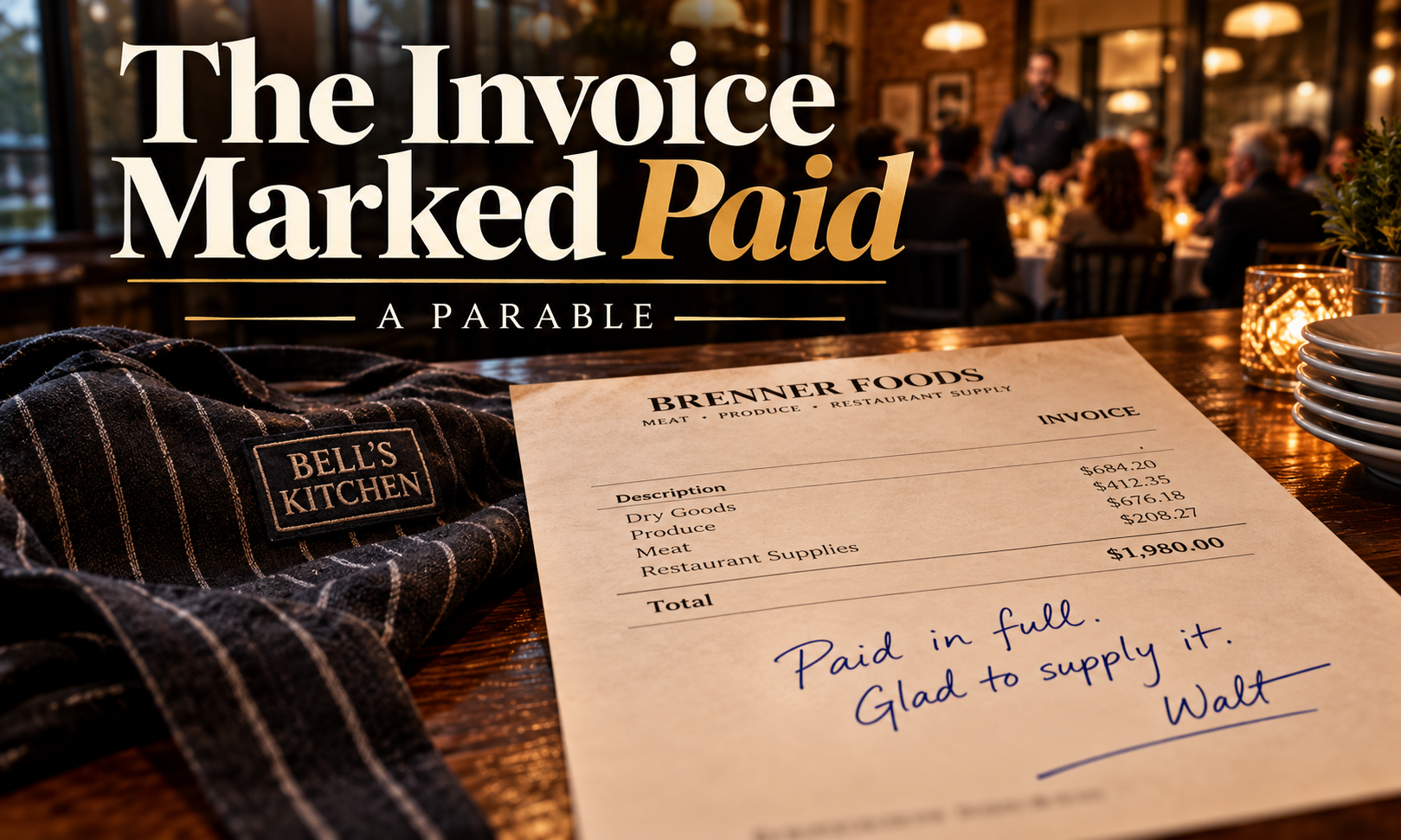
The Invoice Marked Paid
Marcus Bell had owned Bell's Kitchen on Fourth Street for eleven years when he decided it was time to open a second location.
He did not really need a second location. The first one was full most nights and paid its bills. But he liked the sound of it. Bell's Kitchen, two locations. He liked the way his banker smiled when he said it, and he liked the way it looked on the sign he ordered before the lease was signed.
His wife asked him twice if he was sure. His head cook, Denise, asked once, and then let it go.
The second location lasted fourteen months.
When it closed, it took more than itself down. Marcus had moved some of his best people from Fourth Street to run the new place, and he had borrowed against the old restaurant to keep the new one alive. When the money ran out, he had to let nine people go, including two who had been with him since the first year.
He did it in one afternoon, in the back booth, one at a time. Denise was the last. She did not cry. She just said, "I told you once," and handed him her apron.
Marcus did not sleep much that winter.
In March, he sat in his truck in the church parking lot after a Sunday service and wrote out a list. Nine names. Next to each one, what he owed them. Not what the law required. What he actually owed them, as best he could reckon it.
The total was more than he had.
So he sold the boat he had bought the summer the second location opened. He cashed out a retirement account his accountant begged him not to touch. It still was not enough, so he decided to do one more thing.
He would host a dinner at Fourth Street for the nine of them and their families. He would tell them the truth about what happened, apologize properly, give each of them an envelope, and have three restaurant owners there who were hiring.
He called Walt Brenner to order the food. Walt had supplied Bell's Kitchen with meat and produce for a decade, and he had heard about everything.
"How many people?" Walt asked.
"About forty."
Walt was quiet for a second. "Marcus, don't worry about it. It's on me. All of it. You've been a good customer, and you've had a hard year."
Marcus almost said yes. It would have saved him close to two thousand dollars, and he needed every one of them.
"No," he said. "Send me the invoice. Full price."
"Marcus, come on."
"Walt, if it's free, it's your dinner. I need it to be mine."
There was a long pause on the line. Then Walt said, "All right. Full price."
The dinner was on a Thursday. Marcus stood in front of his own dining room and told nine families the truth. That he had wanted a bigger name. That he had not listened. That they had paid for his pride, and he was sorry. Then he walked from table to table with the envelopes.
Two of the restaurant owners hired people that night. Denise did not take any of the job offers. She stayed after everyone left, helped him stack the chairs, and asked if the head cook position at Fourth Street was still open.
It was.
The invoice from Brenner Foods came the next week. At the bottom, in Walt's blocky handwriting, under the total Marcus had already paid, it said: "Paid in full. Glad to supply it."
Marcus framed it. It hangs in the little office behind the kitchen, next to the schedule.
When new managers ask about it, he tells them the whole story. The second sign, the nine names, the boat, the dinner. Then he points to the frame.
"That," he says, "is the most expensive meal I ever served. And the only one I'm proud of."
David was offered everything he needed for free, and he refused it. In 2 Samuel 24 a king who had counted his own strength learns to pay full price for worship, and the threshing floor he bought becomes the place where the temple would stand.
A Gift on the Threshing Floor
It was the worst week of David's reign. A plague was sweeping through Israel, and seventy thousand people had died. When the angel of judgment reached Jerusalem, God said, enough. The angel stopped at a threshing floor on the hill above the city, a flat stone place where a man named Araunah beat his grain.
The prophet Gad brought David instructions. Go up. Build an altar there.
So the king climbed the hill with his officials. Araunah saw them coming and bowed to the ground. When he heard what David wanted, he did what a loyal subject would do. He offered everything. The floor, the oxen for the sacrifice, the wooden sledges and yokes for the fire. Take it all, he said. It is yours.
It was a generous gift, and David was in a hurry. People were dying. Nobody would have blamed him for accepting.
He said no.
The Cost Behind the Story
The last scene of 2 Samuel is a story about money, but it begins with a story about numbers. David's crisis started when he decided to count his fighting men. It ended when he insisted on paying for an altar.
Between those two moments is one of the clearest lessons in Scripture about the difference between trusting what we have and offering what we have. David counted his strength, and it brought judgment. Then he paid a price for worship, and it brought mercy.
The line David spoke on that threshing floor has echoed through the centuries: he would not offer the Lord something that cost him nothing. It is a line about giving, but it is also about repentance, leadership and the kind of worship God receives. It asks a question every steward has to answer. Does what I give to God actually cost me anything?
Lesson One: Counting What Was Never Yours
The chapter opens with David giving an order to his army commander. "Go throughout the tribes of Israel from Dan to Beersheba and enroll the fighting men, so that I may know how many there are." (2 Samuel 24:2, NIV).
The text tells us that God's anger was already burning against Israel, and that David was moved to take this census in that setting (2 Samuel 24:1; compare 1 Chronicles 21:1). The details are mysterious, but the heart of David's sin is not. He wanted to know how strong he was. He wanted a number he could lean on.
Joab, who was not a particularly godly man, saw the problem immediately. "May the Lord your God multiply the troops a hundred times over, and may the eyes of my lord the king see it. But why does my lord the king want to do such a thing?" (2 Samuel 24:3, NIV).
Joab's point was simple. The troops were the Lord's to multiply. Israel's strength had never come from counting soldiers. It came from God. David himself had once faced a giant with a sling and five stones. Now, late in his reign, he wanted the reassurance of a spreadsheet.
There is nothing wrong with counting. Good stewards know their numbers. Businesses need budgets, churches need membership rolls, families need to know what is in the bank. The problem comes when the count becomes the source of our confidence. When we know exactly how much we have and start to feel safe because of it, we have shifted our trust from the Giver to the gift.
The census took almost ten months. That is a long time to keep counting. It is worth asking what we are counting, and why. Are we measuring so we can be faithful, or so we can feel secure without God?
Lesson Two: Conscience-Stricken
When the counting was done, the numbers came back large. Eight hundred thousand in Israel, five hundred thousand in Judah. And David felt sick.
"David was conscience-stricken after he had counted the fighting men, and he said to the Lord, 'I have sinned greatly in what I have done. Now, Lord, I beg you, take away the guilt of your servant. I have done a very foolish thing.'" (2 Samuel 24:10, NIV).
This is one of the reasons David is called a man after God's own heart. Not because he never sinned, but because he knew what to do when he did. He did not explain or excuse. He did not blame Joab or the circumstances. He said, I have sinned greatly. I have done a very foolish thing.
Notice the timing. David's conscience struck him after the count, when he finally held the number in his hands. Often that is how it works. The thing we thought would make us feel secure leaves us feeling empty, and in that emptiness the Spirit gets our attention. The bigger house does not bring peace. The larger savings account does not end the fear. The success we chased does not satisfy, and we realize we were trusting the wrong thing.
A conscience that still works is a gift. It is God's warning light. The danger is not that we feel conviction. The danger is that we learn to ignore it.
If your conscience has been troubling you about where you have placed your trust, listen to it. It is not your enemy. It is the beginning of your way back.
Lesson Three: I, the Shepherd, Have Done Wrong
God gave David three options for the consequence of his sin, and David's choice reveals his heart. "I am in deep distress. Let us fall into the hands of the Lord, for his mercy is great; but do not let me fall into human hands." (2 Samuel 24:14, NIV).
Even in judgment, David trusted God's character. He would rather face the discipline of a merciful God than the cruelty of people.
Then, as the plague swept through the land, David saw the angel and said something every leader should hear. "I have sinned; I, the shepherd, have done wrong. These are but sheep. What have they done? Let your hand fall on me and my family." (2 Samuel 24:17, NIV).
This is leadership at its best, even in failure. David did not hide behind his people. He stepped in front of them. He took responsibility for a decision that had hurt them and asked God to let the cost fall on him.
Many leaders do the opposite. When things go wrong, the blame flows downhill. The team failed. The market changed. The staff did not follow through. David knew that the shepherd is responsible for the sheep. The people had not ordered the census. He had.
And the Lord's mercy came quickly. Even before David spoke, God had already said to the angel, "Enough! Withdraw your hand." (2 Samuel 24:16, NIV). Judgment was real, but mercy had the last word.
If you lead anyone, there will be times when your decisions hurt the people under you. The godly response is not self-defense. It is to say, I, the shepherd, have done wrong, and to place yourself between your mistake and the people who are paying for it.
Lesson Four: Take Whatever He Wishes
Araunah's offer was generous and sincere. "Let my lord the king take whatever he wishes and offer it up." (2 Samuel 24:22, NIV). He pointed to his oxen, his threshing sledges, his ox yokes. Everything David needed was right there, and it would not cost the king a single shekel.
This is a subtle temptation, and it is a temptation precisely because it looks like a blessing. Someone else will pay. Someone else will provide. You get the credit for the offering without the cost of it.
We face versions of this all the time. The church project funded by someone else while we give what is left over. The company donation that costs the business leader nothing personally. The volunteer role we take as long as it does not interfere with anything we actually want to do. The prayer we offer when it is convenient. The generosity that is really just giving away what we no longer need.
None of this is evil in itself. Receiving help is not a sin, and God often provides through the generosity of others. But David saw something important. If he accepted Araunah's gift, the sacrifice on that altar would really be Araunah's. David would be offering God another man's oxen.
Worship that costs us nothing is often worship that means little to us. When the gift is free, it is easy to give. When it costs us, it tells the truth about what we value.
Lesson Five: Offerings That Cost Me Nothing
David's answer to Araunah is one of the great sentences of the Old Testament. "No, I insist on paying you for it. I will not sacrifice to the Lord my God burnt offerings that cost me nothing." (2 Samuel 24:24, NIV).
And then the text tells us exactly what he paid. "So David bought the threshing floor and the oxen and paid fifty shekels of silver for them." (2 Samuel 24:24, NIV).
The king who had started this story by counting his strength ended it by counting out silver. He moved from measuring what he had to giving what he had. That is the turn every steward needs to make.
There is a deep connection here between repentance and generosity. David's sin was trusting in his resources. His repentance was offering them. Real repentance is rarely only words. It often shows up in what we are willing to give up.
David's principle is simple, and it searches every heart. Does my giving cost me anything? Not, how much do I give, but what does it cost me? A wealthy person can give a large amount that costs them very little. A poor person can give a small amount that costs them a great deal. God measures the cost, not just the total.
This applies to more than money. It applies to time, comfort, reputation and convenience. Does my service to God cost me anything? Does my obedience ever require me to give up something I want? Or have I arranged my faith so that it never interferes with the rest of my life?
The altar David built was paid for with his own silver. That is the kind of offering God was pleased to receive.
For Business Leaders: Count the Cost Before You Commit
Business leaders are trained to estimate costs before they start a project. Jesus used that very picture to describe what it means to follow Him. Before you commit to something for God, sit down and count what it will actually cost you, then pay it gladly.
That might mean personal generosity, not just corporate giving. It might mean paying full price to a supplier who would happily cut you a deal because they owe you. It might mean taking the hit yourself instead of passing it to your team.
"Suppose one of you wants to build a tower. Won't you first sit down and estimate the cost to see if you have enough money to complete it?" (Luke 14:28, NIV).
Your Obedience Step
Look at your giving and your company's giving side by side this week. Choose one gift you will make from your own resources, not the business's, that will actually cost you something.
For Community Leaders: The Sacrifices God Is Pleased With
Churches and ministries can slip into Araunah's offer without noticing. A few generous people carry the budget, a handful of volunteers do most of the work, and everyone else attends. Community leaders can help people discover the joy of costly giving and serving.
That starts with leaders who model it. When people see you give your time, your comfort and your resources, it invites them to do the same.
"And do not forget to do good and to share with others, for with such sacrifices God is pleased." (Hebrews 13:16, NIV).
Your Obedience Step
Identify one need in your community that will require real sacrifice to meet. Commit to it personally first, then invite others to join you, telling them honestly what it will cost.
For Home Leaders: Say It First at Home
The hardest place to say, I, the shepherd, have done wrong, is often at home. Parents and spouses can be quick to defend their decisions and slow to admit when those decisions have hurt their families.
The most costly offering a home leader can bring is a broken and humble heart. Children and spouses learn more from one honest apology than from a hundred lectures about responsibility.
"My sacrifice, O God, is a broken spirit; a broken and contrite heart you, God, will not despise." (Psalm 51:17, NIV).
Your Obedience Step
Think of a decision you made that cost your family something. This week, name it to them, take responsibility without excuses, and ask what you can do to make it right.
For the Everyday Believer: What Shall I Return?
Every believer has received far more from God than they can repay. Salvation, provision, forgiveness and grace were all given at great cost. David's question on the threshing floor is really a question of gratitude.
Look at what you give to God. Is it the first and best, or the leftovers? Does it ever cost you something you would rather keep? Costly giving is not a burden. It is a response to costly grace.
"What shall I return to the Lord for all his goodness to me?" (Psalm 116:12, NIV).
Your Obedience Step
Choose one offering this week that will cost you something real: a gift, an hour, a comfort you give up. Offer it to God privately, without telling anyone, as an act of thanks.
The Place Where the Plague Stopped
The story ends quietly. "David built an altar to the Lord there and sacrificed burnt offerings and fellowship offerings. Then the Lord answered his prayer in behalf of the land, and the plague on Israel was stopped." (2 Samuel 24:25, NIV).
But the threshing floor's story was not over. Years later, David's son chose that exact spot for something far greater. "Then Solomon began to build the temple of the Lord in Jerusalem on Mount Moriah, where the Lord had appeared to his father David. It was on the threshing floor of Araunah the Jebusite, the place provided by David." (2 Chronicles 3:1, NIV).
The place David paid for became the place where Israel would worship for generations. The fifty shekels of silver bought more than an altar. They bought the ground for the house of God.
And Mount Moriah was where Abraham had once offered Isaac, believing God would provide (Genesis 22:2). That hill would always be a place of costly offering. Centuries later, on a hill outside the same city, God Himself would make the costliest offering of all. He did not give us something that cost Him nothing. He gave His Son.
That is why our giving can never be cheap. We are responding to a love that paid full price.
Questions for Reflection
- What am I counting in my life, and is it the source of my confidence?
- When was the last time my conscience troubled me about where I place my trust?
- Where do I need to say, I, the shepherd, have done wrong?
- Is there an Araunah's offer in my life, where someone else is paying for my worship?
- What would it look like for my giving this month to actually cost me something?
Closing Prayer
Lord, everything I have comes from you. Forgive me for the times I have counted my resources and trusted them more than you. Forgive me for the times I have offered you what was left over, what was convenient, or what someone else paid for. Give me a conscience that stays tender, and the courage to say I have done wrong when my choices hurt the people I lead. Teach me to give in a way that costs me something, not to earn your favor, but because you gave everything for me. Let my offerings of money, time and obedience be real and wholehearted. Thank you that your mercy is great and that you said enough to judgment through the sacrifice of your Son. In Jesus' name, Amen.
The Invoice Marked Paid
Marcus Bell had owned Bell's Kitchen on Fourth Street for eleven years when he decided it was time to open a second location.
He did not really need a second location. The first one was full most nights and paid its bills. But he liked the sound of it. Bell's Kitchen, two locations. He liked the way his banker smiled when he said it, and he liked the way it looked on the sign he ordered before the lease was signed.
His wife asked him twice if he was sure. His head cook, Denise, asked once, and then let it go.
The second location lasted fourteen months.
When it closed, it took more than itself down. Marcus had moved some of his best people from Fourth Street to run the new place, and he had borrowed against the old restaurant to keep the new one alive. When the money ran out, he had to let nine people go, including two who had been with him since the first year.
He did it in one afternoon, in the back booth, one at a time. Denise was the last. She did not cry. She just said, "I told you once," and handed him her apron.
Marcus did not sleep much that winter.
In March, he sat in his truck in the church parking lot after a Sunday service and wrote out a list. Nine names. Next to each one, what he owed them. Not what the law required. What he actually owed them, as best he could reckon it.
The total was more than he had.
So he sold the boat he had bought the summer the second location opened. He cashed out a retirement account his accountant begged him not to touch. It still was not enough, so he decided to do one more thing.
He would host a dinner at Fourth Street for the nine of them and their families. He would tell them the truth about what happened, apologize properly, give each of them an envelope, and have three restaurant owners there who were hiring.
He called Walt Brenner to order the food. Walt had supplied Bell's Kitchen with meat and produce for a decade, and he had heard about everything.
"How many people?" Walt asked.
"About forty."
Walt was quiet for a second. "Marcus, don't worry about it. It's on me. All of it. You've been a good customer, and you've had a hard year."
Marcus almost said yes. It would have saved him close to two thousand dollars, and he needed every one of them.
"No," he said. "Send me the invoice. Full price."
"Marcus, come on."
"Walt, if it's free, it's your dinner. I need it to be mine."
There was a long pause on the line. Then Walt said, "All right. Full price."
The dinner was on a Thursday. Marcus stood in front of his own dining room and told nine families the truth. That he had wanted a bigger name. That he had not listened. That they had paid for his pride, and he was sorry. Then he walked from table to table with the envelopes.
Two of the restaurant owners hired people that night. Denise did not take any of the job offers. She stayed after everyone left, helped him stack the chairs, and asked if the head cook position at Fourth Street was still open.
It was.
The invoice from Brenner Foods came the next week. At the bottom, in Walt's blocky handwriting, under the total Marcus had already paid, it said: "Paid in full. Glad to supply it."
Marcus framed it. It hangs in the little office behind the kitchen, next to the schedule.
When new managers ask about it, he tells them the whole story. The second sign, the nine names, the boat, the dinner. Then he points to the frame.
"That," he says, "is the most expensive meal I ever served. And the only one I'm proud of."
Comments
Keep it kind and on topic. See something that doesn't belong? Tap Report under it and we'll review it.