
Stewardship of Resources · Stewardship of Leadership
Silver as Common as Stones: 1 Kings 10 and 11 on Wealth and the Slow Drift of the Heart
Qunetin Robinson
Solomon did not fall in a day. Deuteronomy 17 gave Israel's kings three simple limits, and 1 Kings 10 and 11 show the wisest man who ever lived breaking every one of them, slowly, in plain sight, while the money poured in. Here is how to keep wealth from turning your heart.
The Richest Chapter in the Bible
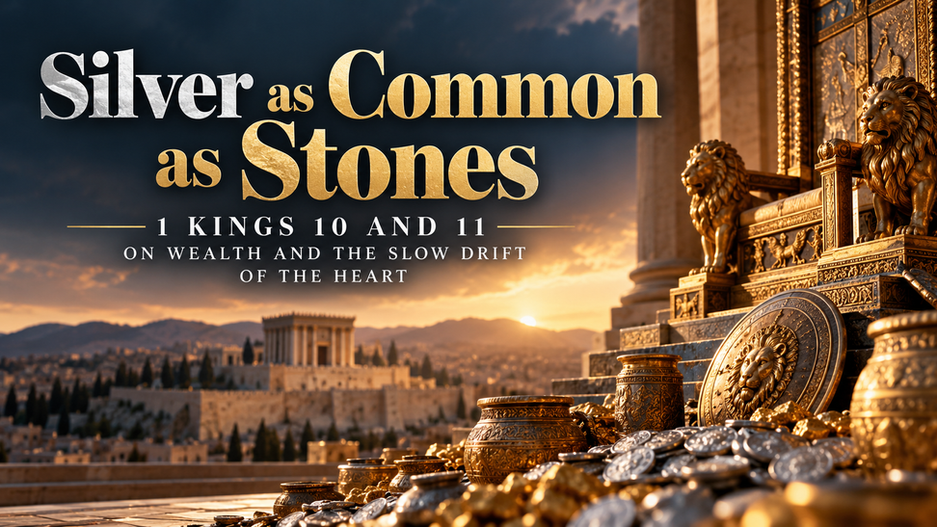
If you wanted to describe success, you could hardly do better than 1 Kings 10. A foreign queen travels across the desert to test Solomon with hard questions and leaves overwhelmed. Gold arrives by the ton. Shields are hammered out of it. The king's throne is ivory covered in gold, with lions on every step. His ships come home every three years loaded with silver, ivory and exotic animals. Kings from every nation send gifts year after year.
The chapter reads like a celebration, and in many ways it is. God had promised Solomon wisdom, wealth and honor, and He kept His word.
Then comes chapter 11, and its first sentence turns on the word "however." Solomon loved many foreign women. As he grew old, they turned his heart after other gods. The man who built the temple built shrines on the hill across from it. God tore most of the kingdom away from his son.
How does a man go from chapter 10 to chapter 11? The answer was written down centuries before Solomon was born.
A Warning Written in Advance
Long before Israel had a king, Moses told the people that one day they would want one. When that day came, he said, the king God chose would have to live within certain limits. Deuteronomy 17 lists them. Not too many horses, and none brought from Egypt. Not too many wives. Not too much silver and gold. And every day, the king was to read God's law.
Read 1 Kings 10 and 11 with Deuteronomy 17 open beside it, and the story becomes painfully clear. Solomon did not stumble into sin he had never been warned about. He crossed lines that had been drawn in advance, one by one, while everyone around him applauded.
This is not only a story about kings. It is a story about anyone God blesses with resources, influence or success. Solomon's drift is the drift of the successful. And the safeguard God gave him is still the one we need.
Lesson One: Three Limits Written Before There Was a King
Moses' instructions for Israel's future kings were specific. "The king, moreover, must not acquire great numbers of horses for himself or make the people return to Egypt to get more of them." (Deuteronomy 17:16, NIV). And then: "He must not take many wives, or his heart will be led astray. He must not accumulate large amounts of silver and gold." (Deuteronomy 17:17, NIV).
Horses were military power, the tanks of the ancient world. Wives in a royal court usually meant political alliances with other nations. Silver and gold were wealth. Military strength, political alliances and money: the three things every king in the world relied on.
God was not against strength, partnerships or prosperity. He was against His king trusting them. Israel was supposed to be different. Their security was the Lord. Their king was supposed to be the first person in the nation to live like it.
Notice the reason given for one of the limits: or his heart will be led astray. The issue was never just the horses or the gold. It was what they would do to the heart.
Every person who handles resources needs limits like these. Not because money is evil, but because it pulls on the heart in ways we rarely notice. Wise people decide their limits before the money arrives. They decide how much is enough, what they will not do to get more, and which partnerships they will not enter. Limits set in advance protect us in moments when our judgment is clouded by success.
If you have never written down your own limits, Deuteronomy 17 is an invitation. Decide now, while your heart is clear, what you will not do when the gold starts coming in.
Lesson Two: The Wisdom God Had Put in His Heart
Solomon's story did not start with gold. It started with a humble prayer. When God offered to give him whatever he asked, the young king asked for one thing. "So give your servant a discerning heart to govern your people and to distinguish between right and wrong." (1 Kings 3:9, NIV).
God was so pleased with that request that He gave Solomon wisdom, and then He added more: "Moreover, I will give you what you have not asked for—both wealth and honor—so that in your lifetime you will have no equal among kings." (1 Kings 3:13, NIV). By chapter 10, both gifts had come to full bloom. "King Solomon was greater in riches and wisdom than all the other kings of the earth. The whole world sought audience with Solomon to hear the wisdom God had put in his heart." (1 Kings 10:23-24, NIV).
Notice that phrase: the wisdom God had put in his heart. The Queen of Sheba saw it too. She praised Solomon's God, saying the Lord had made him king "to maintain justice and righteousness." (1 Kings 10:9, NIV).
Everything Solomon had was a gift, and its purpose was clear. The wisdom was for governing God's people well. The kingdom was for justice and righteousness. Even a foreign queen could see it.
This is the first thing successful people forget. We start to believe our wisdom is ours, our wealth is ours, our reputation is ours. We forget who put it in our hearts and why. And once we forget the Giver and the purpose, we start using the gifts for ourselves.
Every talent you have was put in your heart by God. Every resource you manage was entrusted for a purpose beyond your own comfort. Remembering that is the beginning of staying faithful with it.
Lesson Three: Silver Was Considered of Little Value
The chapter opens with a royal visitor. "Arriving at Jerusalem with a very great caravan—with camels carrying spices, large quantities of gold, and precious stones—she came to Solomon and talked with him about all that she had on her mind." (1 Kings 10:2, NIV). From there the chapter piles up numbers until they almost stop meaning anything. "The weight of the gold that Solomon received yearly was 666 talents" (1 Kings 10:14, NIV), not counting taxes and trade. Two hundred large shields of gold. Three hundred small ones. A throne overlaid with gold.
Then comes a remarkable line. "All King Solomon's goblets were gold, and all the household articles in the Palace of the Forest of Lebanon were pure gold. Nothing was made of silver, because silver was considered of little value in Solomon's days." (1 Kings 10:21, NIV).
And again: "The king made silver as common in Jerusalem as stones, and cedar as plentiful as sycamore-fig trees in the foothills." (1 Kings 10:27, NIV).
That is what abundance does. It changes what we value. Things that once seemed precious become ordinary. A generation before, silver would have been treasure. Now it was not worth making a cup from.
This is one of the quiet dangers of wealth. Abundance does not only tempt us to want more. It dulls our sense of gratitude for what we have. What was once a gift becomes an expectation. What was once enough becomes too little. We stop noticing God's provision because it is everywhere.
It also pushes the limits outward. When silver is as common as stones, a little more gold does not seem like much. When you already have more than you need, adding a bit more hardly feels like crossing a line. That is exactly how Deuteronomy's third limit fell. Not in a single dramatic choice, but in a thousand ordinary days when there was simply more coming in.
If you find yourself less grateful than you used to be, that may be the first sign of Solomon's drift. Gratitude is what keeps silver valuable.
Lesson Four: Imported From Egypt
The end of 1 Kings 10 reads almost like an inventory. "Solomon accumulated chariots and horses; he had fourteen hundred chariots and twelve thousand horses, which he kept in the chariot cities and also with him in Jerusalem." (1 Kings 10:26, NIV). Then the source: "Solomon's horses were imported from Egypt and from Kue—the royal merchants purchased them from Kue at the current price." (1 Kings 10:28, NIV).
Put that next to Deuteronomy 17. Not great numbers of horses. Not from Egypt. Solomon did exactly what the law told the king not to do, and the writer of Kings records it without a word of comment, as if it were simply part of the success story.
That silence is part of the lesson. Nobody seems to have objected. The horses were good for national defense. The trade was good for the economy. Egypt was a respectable partner, and Solomon had even married Pharaoh's daughter. Every step made sense.
Then chapter 11 names the second limit. "King Solomon, however, loved many foreign women besides Pharaoh's daughter—Moabites, Ammonites, Edomites, Sidonians and Hittites." (1 Kings 11:1, NIV). "He had seven hundred wives of royal birth and three hundred concubines, and his wives led him astray." (1 Kings 11:3, NIV). Many of those marriages were treaties with neighboring kingdoms. They made Israel safer and more connected. They also brought foreign gods into the palace.
Horses, wives, gold. All three limits broken. None of them in secret.
This is how compromise often works for successful people. It is not hidden. It is celebrated. The decision that crosses God's line looks like smart strategy, good business, a wise alliance. Everyone around you nods. And because the results are good, no one asks whether the choice was right.
Faithful stewards check their decisions against God's word, not just against results. The question is not only, does this work? It is, did God say not to do this?
Lesson Five: As Solomon Grew Old
The tragedy of Solomon is not that he was wicked from the start. It is that he drifted. "As Solomon grew old, his wives turned his heart after other gods, and his heart was not fully devoted to the Lord his God, as the heart of David his father had been." (1 Kings 11:4, NIV).
As he grew old. Solomon's fall did not happen in his youth, when he prayed for wisdom. It happened gradually, over decades, as the horses multiplied, the alliances piled up and the gold kept coming.
Notice the words: not fully devoted. Solomon did not abandon the Lord overnight. He kept worshiping at the temple. But his heart was divided. He made room for other gods alongside the true one, and then built them altars on the hill east of Jerusalem.
God's response was sober. "The Lord became angry with Solomon because his heart had turned away from the Lord, the God of Israel, who had appeared to him twice." (1 Kings 11:9, NIV).
Who had appeared to him twice. Solomon had more spiritual experience than almost anyone in history. He had met God personally, received astonishing gifts and written much of the wisdom literature in the Bible. None of that protected him from a slow drift.
That should humble every one of us. Spiritual experience in the past is not protection in the present. Wisdom is not the same as faithfulness. And the danger is often greatest later in life, when success has piled up and the habits of devotion have worn thin.
The way to finish well is to keep watch over the heart every day, especially when life is going well. Drift is quiet. It rarely announces itself. But it can be caught early by someone who is paying attention.
For Business Leaders: Enough Is a Decision
Success makes it easy to keep raising the target. More revenue, more locations, more partnerships, more of everything. Solomon's story warns that without a clear sense of enough, abundance quietly becomes its own goal.
Wise business leaders decide in advance how much is enough for themselves and what they will do with anything beyond it. They also decide which deals they will not make, no matter how profitable.
"Keep falsehood and lies far from me; give me neither poverty nor riches, but give me only my daily bread." (Proverbs 30:8, NIV).
Your Obedience Step
Write down your own three limits for your business: how much is enough for you personally, one kind of deal you will not make, and one partnership you will not enter. Share them with someone who will hold you to them.
For Community Leaders: Guard the Heart Behind the Influence
Solomon's marriages were political alliances that made Israel stronger and more connected. They also brought idols into the center of the nation. Community leaders face the same temptation: partnerships, platforms and alliances that bring influence at the cost of faithfulness.
Before you join a coalition, accept a sponsorship or form a partnership, ask what it will bring into the heart of what you lead.
"Above all else, guard your heart, for everything you do flows from it." (Proverbs 4:23, NIV).
Your Obedience Step
Review the partnerships and alliances your group or ministry has formed in the last few years. Ask honestly whether any of them have shifted your values, and take one step to correct it.
For Home Leaders: Keep the Copy Close
God's safeguard for the king was not a stronger army or a better advisor. It was a copy of His word that the king would read every day of his life. Homes need the same thing. Families drift when Scripture becomes something they visit on Sundays.
Home leaders can make God's word a daily presence. Not a heavy program, just a steady habit that keeps the family's heart anchored as life gets busier and fuller.
"I have hidden your word in my heart that I might not sin against you." (Psalm 119:11, NIV).
Your Obedience Step
Choose a time each day this week to read a short passage of Scripture with your household, even five minutes at breakfast or bedtime. Keep a Bible where everyone can see it.
For the Everyday Believer: When Riches Increase
You may never have silver as common as stones. But most of us have more than we once did, and that is when Solomon's drift begins. A raise, a bigger house, a comfortable season. Each one is a blessing, and each one is a test.
The question is not whether God will bless you. It is whether your heart will stay with Him when He does.
"Do not trust in extortion or put vain hope in stolen goods; though your riches increase, do not set your heart on them." (Psalm 62:10, NIV).
Your Obedience Step
Think of the last increase God gave you, in money, comfort or opportunity. This week, give a meaningful part of it away, and thank God by name for the rest.
A Copy of the Law on the King's Desk
Deuteronomy 17 did not only give the king limits. It gave him a daily habit. "When he takes the throne of his kingdom, he is to write for himself on a scroll a copy of this law, taken from that of the Levitical priests." (Deuteronomy 17:18, NIV).
The purpose was clear. The king was to "read it all the days of his life so that he may learn to revere the Lord his God" (Deuteronomy 17:19, NIV) and "not consider himself better than his fellow Israelites" (Deuteronomy 17:20, NIV).
All the days of his life. Not only in his youth, when he was humble and new to the throne. Every day, especially when the gold came in.
We are never told that Solomon wrote that copy. We are only told that, as he grew old, his heart turned. Perhaps the scroll sat unread while the treasury filled.
The answer to Solomon's drift is not to fear blessing. It is to stay close to God's word while you are blessed. Read it every day. Let it set your limits. Let it remind you who put the wisdom in your heart, and why. A heart that stays in God's word can handle silver as common as stones. A heart that leaves it will be turned by far less.
Questions for Reflection
- Have I set limits for my money, partnerships and ambitions before success arrives?
- Do I remember that my wisdom and resources were put in my heart by God, and for His purposes?
- What has abundance made ordinary to me that I used to be grateful for?
- Are there decisions in my life that look smart but cross a line God has drawn?
- Is my heart fully devoted to the Lord, or am I slowly making room for other things?
Closing Prayer
Lord, every good thing I have was put in my heart and placed in my hands by you. Thank you for your generosity. Forgive me for the times I have forgotten the Giver and used the gifts for myself. Keep me from Solomon's drift. Help me set limits before success arrives and keep them when it does. Give me the courage to check my decisions against your word and not only against results. When my riches increase, keep my heart from being set on them. Draw me back to your word every day of my life, so that I may learn to revere you and never think of myself as better than others. Make my heart fully devoted to you, now and as I grow old. In Jesus' name, Amen.
Three Rules in the Top Drawer
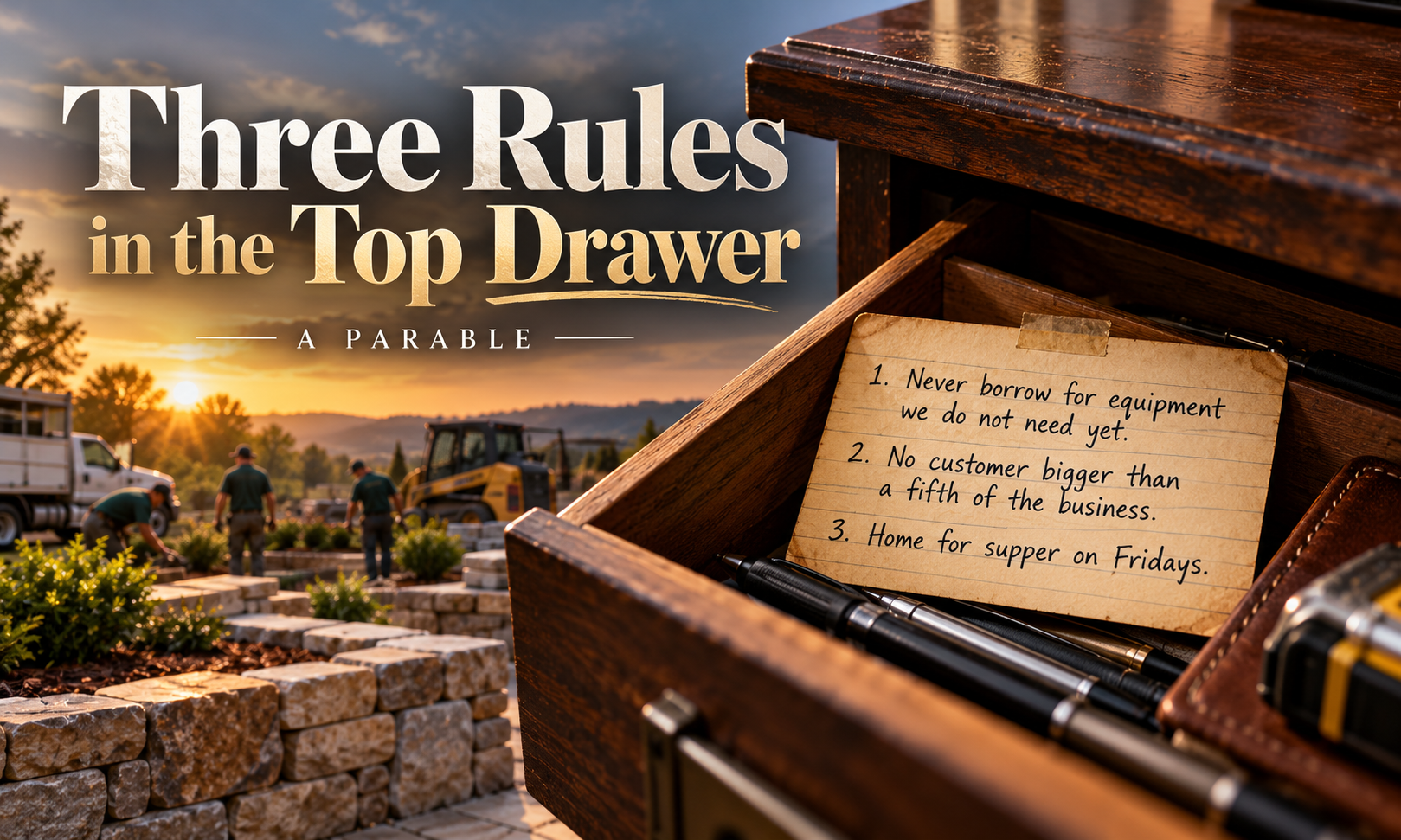
When Nathan Price started Price Landscape and Stone, he had one truck, two mowers and a borrowed trailer. He also had an index card.
He wrote it the night before the first job, at the kitchen table, with his wife reading over his shoulder. Three rules.
Never borrow for equipment we do not need yet.
No customer bigger than a fifth of the business.
Home for supper on Fridays.
He taped the card to the inside of his desk drawer, the top one, where he kept his pens. For the first few years he saw it every morning.
The business grew faster than anyone expected. By year five he had six crews. By year ten he had twenty, a stone yard, and a contract with the biggest developer in the county.
The first rule went in year seven. A dealer offered him a fleet of new excavators at a price he would never see again. The bank was happy to lend. The machines sat in the yard for most of a season, but the next year they paid for themselves, and everybody said it was a smart move.
The second rule went in year nine. The developer, Harlan Group, offered him every subdivision they were building for the next three years. It would be almost half his revenue. His controller ran the numbers twice and said it was the best deal in the company's history. Nathan signed it at a dinner downtown.
The third rule went quietly. There was always a bid due on Friday, or a site visit, or a client who could only meet late. His daughter stopped asking what time he would be home.
He had not opened the top drawer in years. He kept his pens in a cup now.
In year fourteen, Harlan Group pushed its payment terms from thirty days to ninety. Nathan could not afford to say no. Then they asked him to use a cheaper stone on two subdivisions than the plans called for and keep the invoice the same. It was not his name on the plans, they said. Nobody would know.
He sat in his office until ten that night trying to decide. He had forty families who depended on payroll, a stone yard full of loans, and one customer who could sink him with a phone call.
Looking for a pen, he opened the top drawer for the first time in a long time. The card was still taped there, yellow now, the tape gone brittle at the corners.
Three rules. He had broken every one, and each time it had seemed like the wise thing to do.
He did not use the cheaper stone. He called Harlan the next morning and told them so, and within a month they had moved most of their work to another contractor.
It was the worst year the company had ever had. He sold the excavators that had been sitting idle. He laid off two crews and found most of the men new jobs with friends in the trade. He spent a long Saturday at the kitchen table with his wife and a legal pad, going through everything they owned.
It took three years to rebuild. When it was done, Price Landscape and Stone was smaller, with no customer bigger than a fifth of the work.
Nathan still has the original card. It is framed now, on the wall by the door, where every foreman sees it on the way out.
But he also wrote a new one, in his own hand, the same three rules. He keeps it in the top drawer, and he reads it every Monday before he opens his email.
His daughter is in college now. On Fridays she calls him at six, just to check.
He always picks up at home.
Go Deeper
Ready to put this teaching into practice? Silver as Common as Stones is a guided workbook drawn from 1 Kings 10 and 11, Joshua 7 and Luke 16. Work through four movements at your own pace and finish with one page you build for yourself: Your Guardrails.
Solomon did not fall in a day. Deuteronomy 17 gave Israel's kings three simple limits, and 1 Kings 10 and 11 show the wisest man who ever lived breaking every one of them, slowly, in plain sight, while the money poured in. Here is how to keep wealth from turning your heart.
The Richest Chapter in the Bible
If you wanted to describe success, you could hardly do better than 1 Kings 10. A foreign queen travels across the desert to test Solomon with hard questions and leaves overwhelmed. Gold arrives by the ton. Shields are hammered out of it. The king's throne is ivory covered in gold, with lions on every step. His ships come home every three years loaded with silver, ivory and exotic animals. Kings from every nation send gifts year after year.
The chapter reads like a celebration, and in many ways it is. God had promised Solomon wisdom, wealth and honor, and He kept His word.
Then comes chapter 11, and its first sentence turns on the word "however." Solomon loved many foreign women. As he grew old, they turned his heart after other gods. The man who built the temple built shrines on the hill across from it. God tore most of the kingdom away from his son.
How does a man go from chapter 10 to chapter 11? The answer was written down centuries before Solomon was born.
A Warning Written in Advance
Long before Israel had a king, Moses told the people that one day they would want one. When that day came, he said, the king God chose would have to live within certain limits. Deuteronomy 17 lists them. Not too many horses, and none brought from Egypt. Not too many wives. Not too much silver and gold. And every day, the king was to read God's law.
Read 1 Kings 10 and 11 with Deuteronomy 17 open beside it, and the story becomes painfully clear. Solomon did not stumble into sin he had never been warned about. He crossed lines that had been drawn in advance, one by one, while everyone around him applauded.
This is not only a story about kings. It is a story about anyone God blesses with resources, influence or success. Solomon's drift is the drift of the successful. And the safeguard God gave him is still the one we need.
Lesson One: Three Limits Written Before There Was a King
Moses' instructions for Israel's future kings were specific. "The king, moreover, must not acquire great numbers of horses for himself or make the people return to Egypt to get more of them." (Deuteronomy 17:16, NIV). And then: "He must not take many wives, or his heart will be led astray. He must not accumulate large amounts of silver and gold." (Deuteronomy 17:17, NIV).
Horses were military power, the tanks of the ancient world. Wives in a royal court usually meant political alliances with other nations. Silver and gold were wealth. Military strength, political alliances and money: the three things every king in the world relied on.
God was not against strength, partnerships or prosperity. He was against His king trusting them. Israel was supposed to be different. Their security was the Lord. Their king was supposed to be the first person in the nation to live like it.
Notice the reason given for one of the limits: or his heart will be led astray. The issue was never just the horses or the gold. It was what they would do to the heart.
Every person who handles resources needs limits like these. Not because money is evil, but because it pulls on the heart in ways we rarely notice. Wise people decide their limits before the money arrives. They decide how much is enough, what they will not do to get more, and which partnerships they will not enter. Limits set in advance protect us in moments when our judgment is clouded by success.
If you have never written down your own limits, Deuteronomy 17 is an invitation. Decide now, while your heart is clear, what you will not do when the gold starts coming in.
Lesson Two: The Wisdom God Had Put in His Heart
Solomon's story did not start with gold. It started with a humble prayer. When God offered to give him whatever he asked, the young king asked for one thing. "So give your servant a discerning heart to govern your people and to distinguish between right and wrong." (1 Kings 3:9, NIV).
God was so pleased with that request that He gave Solomon wisdom, and then He added more: "Moreover, I will give you what you have not asked for—both wealth and honor—so that in your lifetime you will have no equal among kings." (1 Kings 3:13, NIV). By chapter 10, both gifts had come to full bloom. "King Solomon was greater in riches and wisdom than all the other kings of the earth. The whole world sought audience with Solomon to hear the wisdom God had put in his heart." (1 Kings 10:23-24, NIV).
Notice that phrase: the wisdom God had put in his heart. The Queen of Sheba saw it too. She praised Solomon's God, saying the Lord had made him king "to maintain justice and righteousness." (1 Kings 10:9, NIV).
Everything Solomon had was a gift, and its purpose was clear. The wisdom was for governing God's people well. The kingdom was for justice and righteousness. Even a foreign queen could see it.
This is the first thing successful people forget. We start to believe our wisdom is ours, our wealth is ours, our reputation is ours. We forget who put it in our hearts and why. And once we forget the Giver and the purpose, we start using the gifts for ourselves.
Every talent you have was put in your heart by God. Every resource you manage was entrusted for a purpose beyond your own comfort. Remembering that is the beginning of staying faithful with it.
Lesson Three: Silver Was Considered of Little Value
The chapter opens with a royal visitor. "Arriving at Jerusalem with a very great caravan—with camels carrying spices, large quantities of gold, and precious stones—she came to Solomon and talked with him about all that she had on her mind." (1 Kings 10:2, NIV). From there the chapter piles up numbers until they almost stop meaning anything. "The weight of the gold that Solomon received yearly was 666 talents" (1 Kings 10:14, NIV), not counting taxes and trade. Two hundred large shields of gold. Three hundred small ones. A throne overlaid with gold.
Then comes a remarkable line. "All King Solomon's goblets were gold, and all the household articles in the Palace of the Forest of Lebanon were pure gold. Nothing was made of silver, because silver was considered of little value in Solomon's days." (1 Kings 10:21, NIV).
And again: "The king made silver as common in Jerusalem as stones, and cedar as plentiful as sycamore-fig trees in the foothills." (1 Kings 10:27, NIV).
That is what abundance does. It changes what we value. Things that once seemed precious become ordinary. A generation before, silver would have been treasure. Now it was not worth making a cup from.
This is one of the quiet dangers of wealth. Abundance does not only tempt us to want more. It dulls our sense of gratitude for what we have. What was once a gift becomes an expectation. What was once enough becomes too little. We stop noticing God's provision because it is everywhere.
It also pushes the limits outward. When silver is as common as stones, a little more gold does not seem like much. When you already have more than you need, adding a bit more hardly feels like crossing a line. That is exactly how Deuteronomy's third limit fell. Not in a single dramatic choice, but in a thousand ordinary days when there was simply more coming in.
If you find yourself less grateful than you used to be, that may be the first sign of Solomon's drift. Gratitude is what keeps silver valuable.
Lesson Four: Imported From Egypt
The end of 1 Kings 10 reads almost like an inventory. "Solomon accumulated chariots and horses; he had fourteen hundred chariots and twelve thousand horses, which he kept in the chariot cities and also with him in Jerusalem." (1 Kings 10:26, NIV). Then the source: "Solomon's horses were imported from Egypt and from Kue—the royal merchants purchased them from Kue at the current price." (1 Kings 10:28, NIV).
Put that next to Deuteronomy 17. Not great numbers of horses. Not from Egypt. Solomon did exactly what the law told the king not to do, and the writer of Kings records it without a word of comment, as if it were simply part of the success story.
That silence is part of the lesson. Nobody seems to have objected. The horses were good for national defense. The trade was good for the economy. Egypt was a respectable partner, and Solomon had even married Pharaoh's daughter. Every step made sense.
Then chapter 11 names the second limit. "King Solomon, however, loved many foreign women besides Pharaoh's daughter—Moabites, Ammonites, Edomites, Sidonians and Hittites." (1 Kings 11:1, NIV). "He had seven hundred wives of royal birth and three hundred concubines, and his wives led him astray." (1 Kings 11:3, NIV). Many of those marriages were treaties with neighboring kingdoms. They made Israel safer and more connected. They also brought foreign gods into the palace.
Horses, wives, gold. All three limits broken. None of them in secret.
This is how compromise often works for successful people. It is not hidden. It is celebrated. The decision that crosses God's line looks like smart strategy, good business, a wise alliance. Everyone around you nods. And because the results are good, no one asks whether the choice was right.
Faithful stewards check their decisions against God's word, not just against results. The question is not only, does this work? It is, did God say not to do this?
Lesson Five: As Solomon Grew Old
The tragedy of Solomon is not that he was wicked from the start. It is that he drifted. "As Solomon grew old, his wives turned his heart after other gods, and his heart was not fully devoted to the Lord his God, as the heart of David his father had been." (1 Kings 11:4, NIV).
As he grew old. Solomon's fall did not happen in his youth, when he prayed for wisdom. It happened gradually, over decades, as the horses multiplied, the alliances piled up and the gold kept coming.
Notice the words: not fully devoted. Solomon did not abandon the Lord overnight. He kept worshiping at the temple. But his heart was divided. He made room for other gods alongside the true one, and then built them altars on the hill east of Jerusalem.
God's response was sober. "The Lord became angry with Solomon because his heart had turned away from the Lord, the God of Israel, who had appeared to him twice." (1 Kings 11:9, NIV).
Who had appeared to him twice. Solomon had more spiritual experience than almost anyone in history. He had met God personally, received astonishing gifts and written much of the wisdom literature in the Bible. None of that protected him from a slow drift.
That should humble every one of us. Spiritual experience in the past is not protection in the present. Wisdom is not the same as faithfulness. And the danger is often greatest later in life, when success has piled up and the habits of devotion have worn thin.
The way to finish well is to keep watch over the heart every day, especially when life is going well. Drift is quiet. It rarely announces itself. But it can be caught early by someone who is paying attention.
For Business Leaders: Enough Is a Decision
Success makes it easy to keep raising the target. More revenue, more locations, more partnerships, more of everything. Solomon's story warns that without a clear sense of enough, abundance quietly becomes its own goal.
Wise business leaders decide in advance how much is enough for themselves and what they will do with anything beyond it. They also decide which deals they will not make, no matter how profitable.
"Keep falsehood and lies far from me; give me neither poverty nor riches, but give me only my daily bread." (Proverbs 30:8, NIV).
Your Obedience Step
Write down your own three limits for your business: how much is enough for you personally, one kind of deal you will not make, and one partnership you will not enter. Share them with someone who will hold you to them.
For Community Leaders: Guard the Heart Behind the Influence
Solomon's marriages were political alliances that made Israel stronger and more connected. They also brought idols into the center of the nation. Community leaders face the same temptation: partnerships, platforms and alliances that bring influence at the cost of faithfulness.
Before you join a coalition, accept a sponsorship or form a partnership, ask what it will bring into the heart of what you lead.
"Above all else, guard your heart, for everything you do flows from it." (Proverbs 4:23, NIV).
Your Obedience Step
Review the partnerships and alliances your group or ministry has formed in the last few years. Ask honestly whether any of them have shifted your values, and take one step to correct it.
For Home Leaders: Keep the Copy Close
God's safeguard for the king was not a stronger army or a better advisor. It was a copy of His word that the king would read every day of his life. Homes need the same thing. Families drift when Scripture becomes something they visit on Sundays.
Home leaders can make God's word a daily presence. Not a heavy program, just a steady habit that keeps the family's heart anchored as life gets busier and fuller.
"I have hidden your word in my heart that I might not sin against you." (Psalm 119:11, NIV).
Your Obedience Step
Choose a time each day this week to read a short passage of Scripture with your household, even five minutes at breakfast or bedtime. Keep a Bible where everyone can see it.
For the Everyday Believer: When Riches Increase
You may never have silver as common as stones. But most of us have more than we once did, and that is when Solomon's drift begins. A raise, a bigger house, a comfortable season. Each one is a blessing, and each one is a test.
The question is not whether God will bless you. It is whether your heart will stay with Him when He does.
"Do not trust in extortion or put vain hope in stolen goods; though your riches increase, do not set your heart on them." (Psalm 62:10, NIV).
Your Obedience Step
Think of the last increase God gave you, in money, comfort or opportunity. This week, give a meaningful part of it away, and thank God by name for the rest.
A Copy of the Law on the King's Desk
Deuteronomy 17 did not only give the king limits. It gave him a daily habit. "When he takes the throne of his kingdom, he is to write for himself on a scroll a copy of this law, taken from that of the Levitical priests." (Deuteronomy 17:18, NIV).
The purpose was clear. The king was to "read it all the days of his life so that he may learn to revere the Lord his God" (Deuteronomy 17:19, NIV) and "not consider himself better than his fellow Israelites" (Deuteronomy 17:20, NIV).
All the days of his life. Not only in his youth, when he was humble and new to the throne. Every day, especially when the gold came in.
We are never told that Solomon wrote that copy. We are only told that, as he grew old, his heart turned. Perhaps the scroll sat unread while the treasury filled.
The answer to Solomon's drift is not to fear blessing. It is to stay close to God's word while you are blessed. Read it every day. Let it set your limits. Let it remind you who put the wisdom in your heart, and why. A heart that stays in God's word can handle silver as common as stones. A heart that leaves it will be turned by far less.
Questions for Reflection
- Have I set limits for my money, partnerships and ambitions before success arrives?
- Do I remember that my wisdom and resources were put in my heart by God, and for His purposes?
- What has abundance made ordinary to me that I used to be grateful for?
- Are there decisions in my life that look smart but cross a line God has drawn?
- Is my heart fully devoted to the Lord, or am I slowly making room for other things?
Closing Prayer
Lord, every good thing I have was put in my heart and placed in my hands by you. Thank you for your generosity. Forgive me for the times I have forgotten the Giver and used the gifts for myself. Keep me from Solomon's drift. Help me set limits before success arrives and keep them when it does. Give me the courage to check my decisions against your word and not only against results. When my riches increase, keep my heart from being set on them. Draw me back to your word every day of my life, so that I may learn to revere you and never think of myself as better than others. Make my heart fully devoted to you, now and as I grow old. In Jesus' name, Amen.
Three Rules in the Top Drawer
When Nathan Price started Price Landscape and Stone, he had one truck, two mowers and a borrowed trailer. He also had an index card.
He wrote it the night before the first job, at the kitchen table, with his wife reading over his shoulder. Three rules.
Never borrow for equipment we do not need yet.
No customer bigger than a fifth of the business.
Home for supper on Fridays.
He taped the card to the inside of his desk drawer, the top one, where he kept his pens. For the first few years he saw it every morning.
The business grew faster than anyone expected. By year five he had six crews. By year ten he had twenty, a stone yard, and a contract with the biggest developer in the county.
The first rule went in year seven. A dealer offered him a fleet of new excavators at a price he would never see again. The bank was happy to lend. The machines sat in the yard for most of a season, but the next year they paid for themselves, and everybody said it was a smart move.
The second rule went in year nine. The developer, Harlan Group, offered him every subdivision they were building for the next three years. It would be almost half his revenue. His controller ran the numbers twice and said it was the best deal in the company's history. Nathan signed it at a dinner downtown.
The third rule went quietly. There was always a bid due on Friday, or a site visit, or a client who could only meet late. His daughter stopped asking what time he would be home.
He had not opened the top drawer in years. He kept his pens in a cup now.
In year fourteen, Harlan Group pushed its payment terms from thirty days to ninety. Nathan could not afford to say no. Then they asked him to use a cheaper stone on two subdivisions than the plans called for and keep the invoice the same. It was not his name on the plans, they said. Nobody would know.
He sat in his office until ten that night trying to decide. He had forty families who depended on payroll, a stone yard full of loans, and one customer who could sink him with a phone call.
Looking for a pen, he opened the top drawer for the first time in a long time. The card was still taped there, yellow now, the tape gone brittle at the corners.
Three rules. He had broken every one, and each time it had seemed like the wise thing to do.
He did not use the cheaper stone. He called Harlan the next morning and told them so, and within a month they had moved most of their work to another contractor.
It was the worst year the company had ever had. He sold the excavators that had been sitting idle. He laid off two crews and found most of the men new jobs with friends in the trade. He spent a long Saturday at the kitchen table with his wife and a legal pad, going through everything they owned.
It took three years to rebuild. When it was done, Price Landscape and Stone was smaller, with no customer bigger than a fifth of the work.
Nathan still has the original card. It is framed now, on the wall by the door, where every foreman sees it on the way out.
But he also wrote a new one, in his own hand, the same three rules. He keeps it in the top drawer, and he reads it every Monday before he opens his email.
His daughter is in college now. On Fridays she calls him at six, just to check.
He always picks up at home.
Go Deeper
Ready to put this teaching into practice? Silver as Common as Stones is a guided workbook drawn from 1 Kings 10 and 11, Joshua 7 and Luke 16. Work through four movements at your own pace and finish with one page you build for yourself: Your Guardrails.
Comments
Keep it kind and on topic. See something that doesn't belong? Tap Report under it and we'll review it.