
Stewardship of Resources · Stewardship of Leadership
Only What Comes From Your Hand: 1 Chronicles 29 and the Leader Who Gives It All Back
Qunetin Robinson

David gave his personal treasure for a temple he would never see, and then he prayed the most honest sentence a giver can pray: everything comes from you, and we have given you only what comes from your hand. Here is what 1 Chronicles 29 teaches about owning nothing and giving freely.
A Temple He Would Never See
David wanted to build God a house more than he wanted almost anything else. He had the plans. He had the materials. He had the will. And God told him no.
David repeated that answer to the leaders of Israel without hiding it. God had said to him, "You are not to build a house for my Name, because you are a warrior and have shed blood." (1 Chronicles 28:3, NIV). The honor of building would go to his son Solomon, who was still young and untested.
Most of us would have stepped back at that point and let someone else pay for it. David did the opposite. He spent the last season of his life gathering materials for a building he would never see. Then he reached past the royal stores and into his own treasure.
1 Chronicles 29 records that final gift, the response it drew and the prayer David prayed when it was over.
The Prayer After the Offering
What makes this chapter different from other giving stories is what happens after the gold is counted. David does not make a speech about sacrifice. He does not thank the donors or praise his own generosity. He turns to God and gives the whole thing back.
His prayer is a confession of ownership. Everything belongs to God. The people standing before Him are strangers passing through. Even the offering they just gave came out of His hand first.
That prayer changes how we read every number in the chapter. The talents of gold were never really David's. The silver was never really the leaders'. They were stewards handing back what they had been holding for a little while. And the joy that filled Jerusalem that day was the joy of people who finally understood that.
Lesson One: Give Toward What You Will Never See
David knew exactly what he was funding and exactly what he would miss. He told the assembly that Solomon was "young and inexperienced" (1 Chronicles 29:1, NIV) and that "The task is great, because this palatial structure is not for man but for the Lord God." (1 Chronicles 29:1, NIV).
Then he described what he had already set aside from the kingdom's resources. "With all my resources I have provided for the temple of my God—gold for the gold work, silver for the silver, bronze for the bronze, iron for the iron and wood for the wood, as well as onyx for the settings, turquoise, stones of various colors, and all kinds of fine stone and marble—all of these in large quantities." (1 Chronicles 29:2, NIV). And then he went further. "Besides, in my devotion to the temple of my God I now give my personal treasures of gold and silver for the temple of my God, over and above everything I have provided for this holy temple" (1 Chronicles 29:3, NIV).
Notice the phrase over and above. David had already done his duty as king. This gift came from his own treasure and his own devotion. It was not required. It was love.
And it was love aimed at a future he would not share. David would be in the grave before the first stone was laid. He gave anyway, because the temple was not for David. It was for God, and for worshipers he would never meet.
That is a rare kind of stewardship. Most of our giving has a return built into it: results we can see, a name remembered, a benefit we enjoy. But some of the most important gifts God asks of us are for harvests we will never gather.
Parents, mentors and founders who build something to outlast them do this. So does every believer who gives to a ministry that will flourish after they are gone.
The question this lesson asks is simple. Is any of your giving aimed beyond your own lifetime? If every gift you make has to come back to you in some visible way, David's last offering invites you to give toward something you will never see.
Lesson Two: Leaders Go First, and Joy Follows
David did not ask anyone to give until he had given. Only after he named his own gift did he turn to the assembly with a question. "Now, who is willing to consecrate themselves to the Lord today?" (1 Chronicles 29:5, NIV).
He did not ask who would give money. He asked who would consecrate themselves to the Lord. The gold was the outward sign of an inward decision.
The leaders answered first. "Then the leaders of families, the officers of the tribes of Israel, the commanders of thousands and commanders of hundreds, and the officials in charge of the king's work gave willingly." (1 Chronicles 29:6, NIV).
Then something happened in the crowd. "The people rejoiced at the willing response of their leaders, for they had given freely and wholeheartedly to the Lord. David the king also rejoiced greatly." (1 Chronicles 29:9, NIV).
The people rejoiced at the willing response of their leaders. Generosity at the top did not create pressure. It created joy. When the people watched the most powerful men in the nation give freely, they did not feel squeezed. They felt glad.
Generosity flows downhill. Parents who give cheerfully raise children who think giving is normal. A church whose leaders give first, without grumbling or display, frees the people to give from joy instead of guilt.
When leaders ask others to give what they will not give themselves, people may comply, but they will not rejoice.
If you lead anything, your giving is never only private. Someone is watching how willingly you open your hand. The most effective appeal you will ever make is the one you make with your own example first.
Lesson Three: Everything Comes From You
When the giving was done, David stood before the whole assembly and prayed. He began with praise. "Yours, Lord, is the greatness and the power and the glory and the majesty and the splendor, for everything in heaven and earth is yours. Yours, Lord, is the kingdom; you are exalted as head over all." (1 Chronicles 29:11, NIV).
He went on. "Wealth and honor come from you; you are the ruler of all things. In your hands are strength and power to exalt and give strength to all." (1 Chronicles 29:12, NIV).
Then came the line at the heart of the chapter. "But who am I, and who are my people, that we should be able to give as generously as this? Everything comes from you, and we have given you only what comes from your hand." (1 Chronicles 29:14, NIV).
That sentence turns giving inside out. We usually think of giving as moving something from our account to God's. David saw that nothing started in his account. The gold, the ability to earn it, the years of life and the very desire to give all came from God. When David handed it back, he was not making God richer. He was returning what had always been His.
That truth humbles the giver, because he has only passed along what he was given. It also frees him. If everything already belongs to God, we lose nothing when we give. We are moving God's resources from one place in His kingdom to another.
Notice also David's question: who am I? He had just given more gold than most people would see in a lifetime, and his response was wonder that God would let him take part at all.
The steward who prays this prayer stops calling money mine and starts calling it His, in my care for now. It is hard to cling to something you have finally admitted you do not own.
Lesson Four: Strangers With a Short Lease
David's prayer took a surprising turn. In the middle of a celebration, with gold piled high and the people rejoicing, he spoke about how temporary everything was. "We are foreigners and strangers in your sight, as were all our ancestors. Our days on earth are like a shadow, without hope." (1 Chronicles 29:15, NIV).
David was the king of Israel, living in his own palace. Yet before God he saw himself as a resident alien, passing through land that belonged to another. Abraham had wandered. Jacob had sojourned. Even in the land of promise, Israel lived as tenants.
And their days were like a shadow, real but brief, gone when the light moves. David was old when he prayed this. He knew his shadow was growing long.
He followed that with a reminder of where the offering came from. "Lord our God, all this abundance that we have provided for building you a temple for your Holy Name comes from your hand, and all of it belongs to you." (1 Chronicles 29:16, NIV).
Put those two thoughts together and you have the stewardship mindset. We are here briefly. What we hold is not ours. Both truths point the same direction. If my days are short and my possessions are borrowed, then the wisest thing I can do with them is put them to work for what lasts.
This is not a gloomy thought. It is a clarifying one. People who believe they own everything, forever, hoard. A stranger with a short lease holds things lightly. He enjoys them, cares for them, and lets them go when the time comes.
David's honesty about his own mortality did not dampen his generosity. It fueled it. He gave like a man who knew his time was short and his treasure was borrowed. That is the freedom of knowing who you are and whose you are.
Lesson Five: God Tests the Heart, and David Prayed for Theirs
David's prayer ends with the heart. "I know, my God, that you test the heart and are pleased with integrity. All these things I have given willingly and with honest intent." (1 Chronicles 29:17, NIV).
God was not impressed by the size of the offering. He was looking at what was behind it. Integrity means wholeness, a life where the inside matches the outside. David's gift carried no hidden motive and no performance for the crowd.
God sees whether we give to be seen, to ease guilt or to earn influence. He also sees when we give simply because we love Him. The amount matters far less than the honesty.
Then David turned his prayer toward others. He asked God to "keep these desires and thoughts in the hearts of your people forever, and keep their hearts loyal to you." (1 Chronicles 29:18, NIV). He knew that a single day of joyful giving would not be enough. Hearts drift. Generosity fades. What the people felt that day needed God's keeping to last.
And he prayed for his son. "And give my son Solomon the wholehearted devotion to keep your commands, statutes and decrees" (1 Chronicles 29:19, NIV). David had already charged Solomon to serve God "with wholehearted devotion and with a willing mind" (1 Chronicles 28:9, NIV). Now he asked God to give him that devotion.
Every parent and leader must learn this. You can provide the materials, draw the plans and set the example, but you cannot give someone else a devoted heart. Only God can. So the last thing David did with his treasure was give it away, and the last thing he did for his son was pray.
The best inheritance is not the gold. It is a heart that stays loyal to God after the gold is gone.
For Business Leaders: Your Margin Came From His Hand
Every business owner is tempted to see profit as a personal achievement. You took the risks and worked the hours. David's prayer does not deny the work, but it names the source: strength, wisdom and opportunity came from God's hand.
When a leader sees profit that way, generosity stops feeling like a loss. Giving from the margin becomes a way of returning God's resources to His purposes, and the team learns what really matters by watching where the money goes.
"What do you have that you did not receive? And if you did receive it, why do you boast as though you did not?" (1 Corinthians 4:7, NIV).
Your Obedience Step
Before your next budget or year-end review, list three things in your business you did not create: a gift, a door that opened, a person who came at the right time. Then set a fixed share of this year's profit to give away, and tell your leadership team why.
For Community Leaders: Give First, Then Ask
David named his own gift before he asked anyone else for theirs. The leaders of Israel gave next, and the people rejoiced. That order matters in every church, nonprofit and civic group. People follow what leaders do far more than what leaders say.
If you are asking others to give time, money or energy to a cause, let them see you go first. Do it quietly and gladly. Your willingness will do more to lift the room than any presentation.
"A generous person will prosper; whoever refreshes others will be refreshed." (Proverbs 11:25, NIV).
Your Obedience Step
Before your group's next appeal for volunteers or funds, make your own commitment first and share it plainly, without fanfare. Then ask the other leaders on your team to settle theirs before anyone else is asked.
For Home Leaders: Pray for the Heart You Cannot Give
David could leave Solomon gold, plans and a kingdom. He could not leave him a devoted heart. So he prayed for one. Parents face the same limit. We can provide, protect, teach and model, but we cannot make our children love God.
That means our work must be soaked in prayer. Let your children hear you thank God, see you give, and overhear you asking Him for a heart in them that stays loyal to Him.
"Every good and perfect gift is from above, coming down from the Father of the heavenly lights, who does not change like shifting shadows." (James 1:17, NIV).
Your Obedience Step
This week, pray out loud with your family for each child by name, asking God for a heart fully devoted to Him. Then choose one family gift together and let the children help decide where it goes.
For the Everyday Believer: Hold It Like a Stranger
You may never give talents of gold. But you hold something: a paycheck, a home, time, skills, a few good years. David's prayer invites you to see that all of it came from God's hand, belongs to Him, and is yours only for a shadow's length of days.
That is not a reason for fear. It is a reason for freedom. When you stop treating your possessions as permanent and personal, you can enjoy them without clinging and share them without anxiety.
"Command those who are rich in this present world not to be arrogant nor to put their hope in wealth, which is so uncertain, but to put their hope in God, who richly provides us with everything for our enjoyment." (1 Timothy 6:17, NIV).
Your Obedience Step
Walk through your home or your bank statement and pray David's words over what you see: everything comes from you. Then pick one thing you have been holding tightly and give it, or a portion of it, to someone who needs it this week.
They Ate and Drank With Great Joy
The chapter does not end with a balance sheet. It ends with a feast. "They ate and drank with great joy in the presence of the Lord that day." (1 Chronicles 29:22, NIV). The giving was over, the prayer was prayed, and Jerusalem celebrated.
Then the people acknowledged Solomon as king, and the young man David had worried about took the throne with the temple materials already gathered. David had stewarded his last years so that his son could begin well.
The chapter closes on David's own life. "He ruled over Israel forty years—seven in Hebron and thirty-three in Jerusalem." (1 Chronicles 29:27, NIV). "He died at a good old age, having enjoyed long life, wealth and honor." (1 Chronicles 29:28, NIV). Long life, wealth and honor: the very things David had confessed came from God's hand. He received them, enjoyed them, and gave them back.
That is stewardship at the end of a life: not a tight fist around what we gathered, but an open hand, a prayer of thanks and a table full of joy. Everything comes from Him, and those who learn that find that giving it back is cause for celebration.
Questions for Reflection
- Is any of my giving aimed at something I will never see or benefit from?
- If I lead others, have I gone first in the generosity I am asking of them?
- What do I treat as mine that I need to confess as God's?
- How would my spending and giving change if I truly saw my days as a shadow?
- Who am I praying for, by name, to have a heart fully devoted to God?
Closing Prayer
Lord, yours is the greatness and the power and the glory. Everything in heaven and earth is yours, and everything I have came from your hand. Forgive me for the times I have held your gifts as if they were mine. Thank you for every good thing you have placed in my care. Teach me to give willingly and with honest intent, toward what I may never see, and to go first when I ask others to give. Remind me that my days are like a shadow, so that I hold what I have lightly and put it to work for what lasts. Test my heart and find integrity there. Keep my heart loyal to you, and give the people I love a wholehearted devotion that outlives me. In Jesus' name, Amen.
The Second Column
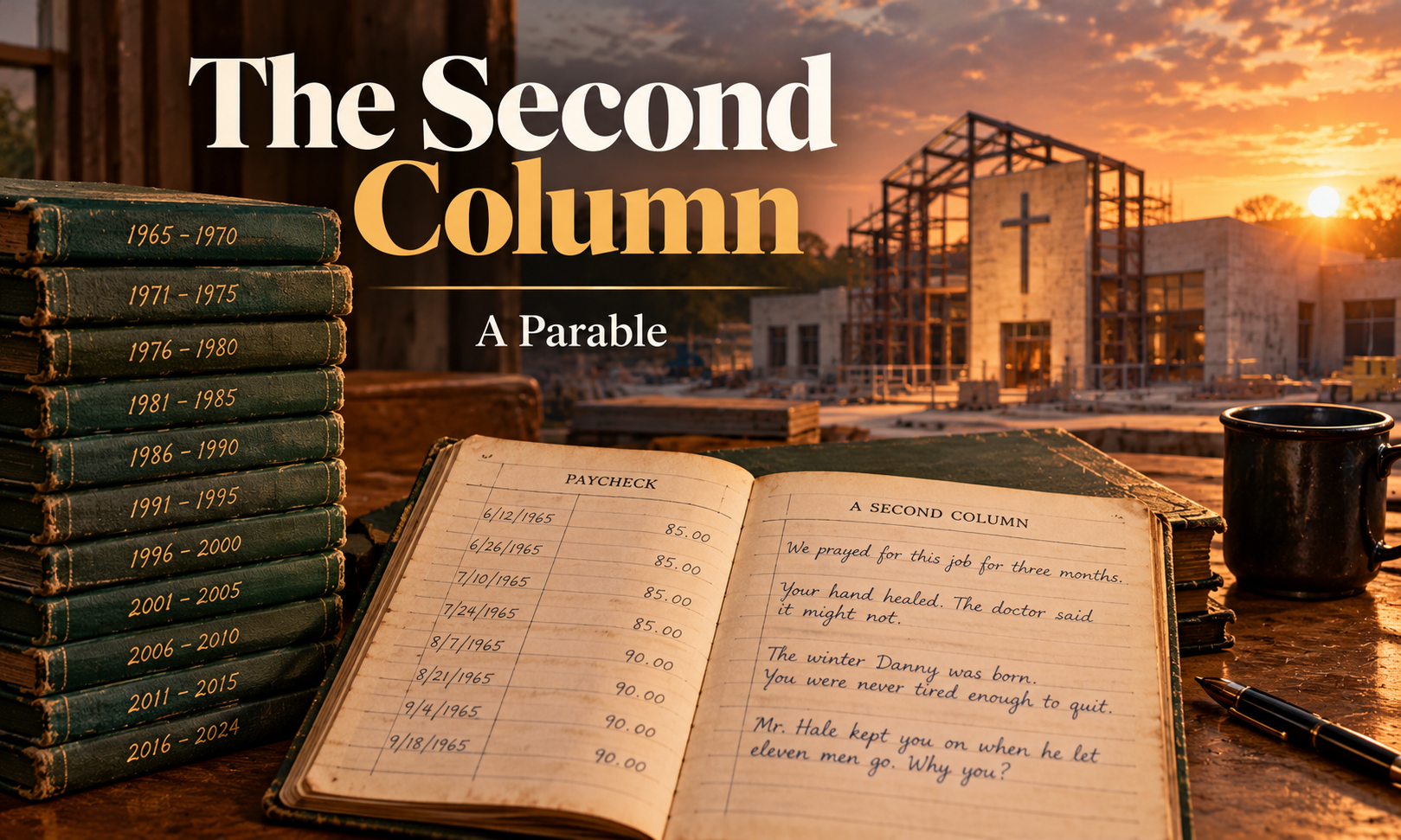
Ray Ellison started keeping the ledger when he was nineteen, the summer he got on at the machine shop on Calloway Street. A green clothbound book, one line for every paycheck. He kept it up for fifty-nine years. By the end there were eleven of them on a shelf in his garage.
His granddaughter Maya found them the week after the doctor's appointment. She had come over to help him clear out the garage, because the doctor had used the word months, and Ray did not want to leave a mess.
"Grandpa, you wrote down every check you ever got?"
"Every one," he said. "Never missed a week."
She held up the first book. "Somebody else wrote in this one."
Ray took it from her and sat down on an overturned bucket.
He knew the handwriting before he read a word. Beside his tidy column of numbers, in soft pencil, his wife Ruth had started a second column. She had been gone nine years.
Next to his first paycheck at Calloway she had written: We prayed for this job for three months.
Next to a gap of six weeks in 1971: Your hand healed. The doctor said it might not.
Next to a fat stretch of overtime: The winter Danny was born. You were never tired enough to quit.
Next to the year the shop almost closed: Mr. Hale kept you on when he let eleven men go. Why you?
Page after page. Every time Ray had written what he earned, Ruth had quietly written where it came from.
He had never once noticed.
The church was raising money for a youth center on the empty lot behind the fellowship hall. The drawings had stood on an easel in the lobby for a year. The building would take four years to finish.
Ray had planned to give something sensible. He had done the math, and the number was fine. It was the kind of number nobody would question.
That night he took all eleven ledgers into the kitchen and read Ruth's column from start to finish. When he closed the last book, he could not find a single line in fifty-nine years that had started with him. The job, the healing, the overtime, the shop that stayed open, the strength in his hands. Every number had a second column.
He got out his checkbook and wrote a different number.
He asked Pastor Owens and Maya to come to the house together. He handed the pastor the check, and the pastor read it twice and then sat down without being asked.
"Ray, you won't see this building finished."
"I know," Ray said. "I wasn't going to see the money spent either."
Then he turned to Maya. She was twenty-three and had just joined the committee that would run the center when it opened. He slid the first green ledger across the table to her.
"I can give them a building," he said. "I can't give those kids what your grandmother had. Only God gives that. So I'm going to pray for it every day I've got left. And I'd like you to keep praying when I'm done."
Ray lived long enough to see the groundbreaking. He sat at the edge of the lot with a blanket over his knees, and when they turned the first shovel of dirt, he cried and laughed at the same time.
The center opened three and a half years later. In the lobby, behind glass, there is a green clothbound book lying open. Most visitors walk right past it.
But Maya stops every morning when she unlocks the doors. She reads one line from the second column, and then she prays for the kids by name.
Go Deeper
Ready to put this teaching into practice? Two Very Small Coins is a guided workbook drawn from Mark 12, 2 Corinthians 8 and 9, 1 Kings 17, Exodus 36 and 1 Chronicles 29. Work through four movements at your own pace and finish with one page you build for yourself: Your Giving Plan.
David gave his personal treasure for a temple he would never see, and then he prayed the most honest sentence a giver can pray: everything comes from you, and we have given you only what comes from your hand. Here is what 1 Chronicles 29 teaches about owning nothing and giving freely.
A Temple He Would Never See
David wanted to build God a house more than he wanted almost anything else. He had the plans. He had the materials. He had the will. And God told him no.
David repeated that answer to the leaders of Israel without hiding it. God had said to him, "You are not to build a house for my Name, because you are a warrior and have shed blood." (1 Chronicles 28:3, NIV). The honor of building would go to his son Solomon, who was still young and untested.
Most of us would have stepped back at that point and let someone else pay for it. David did the opposite. He spent the last season of his life gathering materials for a building he would never see. Then he reached past the royal stores and into his own treasure.
1 Chronicles 29 records that final gift, the response it drew and the prayer David prayed when it was over.
The Prayer After the Offering
What makes this chapter different from other giving stories is what happens after the gold is counted. David does not make a speech about sacrifice. He does not thank the donors or praise his own generosity. He turns to God and gives the whole thing back.
His prayer is a confession of ownership. Everything belongs to God. The people standing before Him are strangers passing through. Even the offering they just gave came out of His hand first.
That prayer changes how we read every number in the chapter. The talents of gold were never really David's. The silver was never really the leaders'. They were stewards handing back what they had been holding for a little while. And the joy that filled Jerusalem that day was the joy of people who finally understood that.
Lesson One: Give Toward What You Will Never See
David knew exactly what he was funding and exactly what he would miss. He told the assembly that Solomon was "young and inexperienced" (1 Chronicles 29:1, NIV) and that "The task is great, because this palatial structure is not for man but for the Lord God." (1 Chronicles 29:1, NIV).
Then he described what he had already set aside from the kingdom's resources. "With all my resources I have provided for the temple of my God—gold for the gold work, silver for the silver, bronze for the bronze, iron for the iron and wood for the wood, as well as onyx for the settings, turquoise, stones of various colors, and all kinds of fine stone and marble—all of these in large quantities." (1 Chronicles 29:2, NIV). And then he went further. "Besides, in my devotion to the temple of my God I now give my personal treasures of gold and silver for the temple of my God, over and above everything I have provided for this holy temple" (1 Chronicles 29:3, NIV).
Notice the phrase over and above. David had already done his duty as king. This gift came from his own treasure and his own devotion. It was not required. It was love.
And it was love aimed at a future he would not share. David would be in the grave before the first stone was laid. He gave anyway, because the temple was not for David. It was for God, and for worshipers he would never meet.
That is a rare kind of stewardship. Most of our giving has a return built into it: results we can see, a name remembered, a benefit we enjoy. But some of the most important gifts God asks of us are for harvests we will never gather.
Parents, mentors and founders who build something to outlast them do this. So does every believer who gives to a ministry that will flourish after they are gone.
The question this lesson asks is simple. Is any of your giving aimed beyond your own lifetime? If every gift you make has to come back to you in some visible way, David's last offering invites you to give toward something you will never see.
Lesson Two: Leaders Go First, and Joy Follows
David did not ask anyone to give until he had given. Only after he named his own gift did he turn to the assembly with a question. "Now, who is willing to consecrate themselves to the Lord today?" (1 Chronicles 29:5, NIV).
He did not ask who would give money. He asked who would consecrate themselves to the Lord. The gold was the outward sign of an inward decision.
The leaders answered first. "Then the leaders of families, the officers of the tribes of Israel, the commanders of thousands and commanders of hundreds, and the officials in charge of the king's work gave willingly." (1 Chronicles 29:6, NIV).
Then something happened in the crowd. "The people rejoiced at the willing response of their leaders, for they had given freely and wholeheartedly to the Lord. David the king also rejoiced greatly." (1 Chronicles 29:9, NIV).
The people rejoiced at the willing response of their leaders. Generosity at the top did not create pressure. It created joy. When the people watched the most powerful men in the nation give freely, they did not feel squeezed. They felt glad.
Generosity flows downhill. Parents who give cheerfully raise children who think giving is normal. A church whose leaders give first, without grumbling or display, frees the people to give from joy instead of guilt.
When leaders ask others to give what they will not give themselves, people may comply, but they will not rejoice.
If you lead anything, your giving is never only private. Someone is watching how willingly you open your hand. The most effective appeal you will ever make is the one you make with your own example first.
Lesson Three: Everything Comes From You
When the giving was done, David stood before the whole assembly and prayed. He began with praise. "Yours, Lord, is the greatness and the power and the glory and the majesty and the splendor, for everything in heaven and earth is yours. Yours, Lord, is the kingdom; you are exalted as head over all." (1 Chronicles 29:11, NIV).
He went on. "Wealth and honor come from you; you are the ruler of all things. In your hands are strength and power to exalt and give strength to all." (1 Chronicles 29:12, NIV).
Then came the line at the heart of the chapter. "But who am I, and who are my people, that we should be able to give as generously as this? Everything comes from you, and we have given you only what comes from your hand." (1 Chronicles 29:14, NIV).
That sentence turns giving inside out. We usually think of giving as moving something from our account to God's. David saw that nothing started in his account. The gold, the ability to earn it, the years of life and the very desire to give all came from God. When David handed it back, he was not making God richer. He was returning what had always been His.
That truth humbles the giver, because he has only passed along what he was given. It also frees him. If everything already belongs to God, we lose nothing when we give. We are moving God's resources from one place in His kingdom to another.
Notice also David's question: who am I? He had just given more gold than most people would see in a lifetime, and his response was wonder that God would let him take part at all.
The steward who prays this prayer stops calling money mine and starts calling it His, in my care for now. It is hard to cling to something you have finally admitted you do not own.
Lesson Four: Strangers With a Short Lease
David's prayer took a surprising turn. In the middle of a celebration, with gold piled high and the people rejoicing, he spoke about how temporary everything was. "We are foreigners and strangers in your sight, as were all our ancestors. Our days on earth are like a shadow, without hope." (1 Chronicles 29:15, NIV).
David was the king of Israel, living in his own palace. Yet before God he saw himself as a resident alien, passing through land that belonged to another. Abraham had wandered. Jacob had sojourned. Even in the land of promise, Israel lived as tenants.
And their days were like a shadow, real but brief, gone when the light moves. David was old when he prayed this. He knew his shadow was growing long.
He followed that with a reminder of where the offering came from. "Lord our God, all this abundance that we have provided for building you a temple for your Holy Name comes from your hand, and all of it belongs to you." (1 Chronicles 29:16, NIV).
Put those two thoughts together and you have the stewardship mindset. We are here briefly. What we hold is not ours. Both truths point the same direction. If my days are short and my possessions are borrowed, then the wisest thing I can do with them is put them to work for what lasts.
This is not a gloomy thought. It is a clarifying one. People who believe they own everything, forever, hoard. A stranger with a short lease holds things lightly. He enjoys them, cares for them, and lets them go when the time comes.
David's honesty about his own mortality did not dampen his generosity. It fueled it. He gave like a man who knew his time was short and his treasure was borrowed. That is the freedom of knowing who you are and whose you are.
Lesson Five: God Tests the Heart, and David Prayed for Theirs
David's prayer ends with the heart. "I know, my God, that you test the heart and are pleased with integrity. All these things I have given willingly and with honest intent." (1 Chronicles 29:17, NIV).
God was not impressed by the size of the offering. He was looking at what was behind it. Integrity means wholeness, a life where the inside matches the outside. David's gift carried no hidden motive and no performance for the crowd.
God sees whether we give to be seen, to ease guilt or to earn influence. He also sees when we give simply because we love Him. The amount matters far less than the honesty.
Then David turned his prayer toward others. He asked God to "keep these desires and thoughts in the hearts of your people forever, and keep their hearts loyal to you." (1 Chronicles 29:18, NIV). He knew that a single day of joyful giving would not be enough. Hearts drift. Generosity fades. What the people felt that day needed God's keeping to last.
And he prayed for his son. "And give my son Solomon the wholehearted devotion to keep your commands, statutes and decrees" (1 Chronicles 29:19, NIV). David had already charged Solomon to serve God "with wholehearted devotion and with a willing mind" (1 Chronicles 28:9, NIV). Now he asked God to give him that devotion.
Every parent and leader must learn this. You can provide the materials, draw the plans and set the example, but you cannot give someone else a devoted heart. Only God can. So the last thing David did with his treasure was give it away, and the last thing he did for his son was pray.
The best inheritance is not the gold. It is a heart that stays loyal to God after the gold is gone.
For Business Leaders: Your Margin Came From His Hand
Every business owner is tempted to see profit as a personal achievement. You took the risks and worked the hours. David's prayer does not deny the work, but it names the source: strength, wisdom and opportunity came from God's hand.
When a leader sees profit that way, generosity stops feeling like a loss. Giving from the margin becomes a way of returning God's resources to His purposes, and the team learns what really matters by watching where the money goes.
"What do you have that you did not receive? And if you did receive it, why do you boast as though you did not?" (1 Corinthians 4:7, NIV).
Your Obedience Step
Before your next budget or year-end review, list three things in your business you did not create: a gift, a door that opened, a person who came at the right time. Then set a fixed share of this year's profit to give away, and tell your leadership team why.
For Community Leaders: Give First, Then Ask
David named his own gift before he asked anyone else for theirs. The leaders of Israel gave next, and the people rejoiced. That order matters in every church, nonprofit and civic group. People follow what leaders do far more than what leaders say.
If you are asking others to give time, money or energy to a cause, let them see you go first. Do it quietly and gladly. Your willingness will do more to lift the room than any presentation.
"A generous person will prosper; whoever refreshes others will be refreshed." (Proverbs 11:25, NIV).
Your Obedience Step
Before your group's next appeal for volunteers or funds, make your own commitment first and share it plainly, without fanfare. Then ask the other leaders on your team to settle theirs before anyone else is asked.
For Home Leaders: Pray for the Heart You Cannot Give
David could leave Solomon gold, plans and a kingdom. He could not leave him a devoted heart. So he prayed for one. Parents face the same limit. We can provide, protect, teach and model, but we cannot make our children love God.
That means our work must be soaked in prayer. Let your children hear you thank God, see you give, and overhear you asking Him for a heart in them that stays loyal to Him.
"Every good and perfect gift is from above, coming down from the Father of the heavenly lights, who does not change like shifting shadows." (James 1:17, NIV).
Your Obedience Step
This week, pray out loud with your family for each child by name, asking God for a heart fully devoted to Him. Then choose one family gift together and let the children help decide where it goes.
For the Everyday Believer: Hold It Like a Stranger
You may never give talents of gold. But you hold something: a paycheck, a home, time, skills, a few good years. David's prayer invites you to see that all of it came from God's hand, belongs to Him, and is yours only for a shadow's length of days.
That is not a reason for fear. It is a reason for freedom. When you stop treating your possessions as permanent and personal, you can enjoy them without clinging and share them without anxiety.
"Command those who are rich in this present world not to be arrogant nor to put their hope in wealth, which is so uncertain, but to put their hope in God, who richly provides us with everything for our enjoyment." (1 Timothy 6:17, NIV).
Your Obedience Step
Walk through your home or your bank statement and pray David's words over what you see: everything comes from you. Then pick one thing you have been holding tightly and give it, or a portion of it, to someone who needs it this week.
They Ate and Drank With Great Joy
The chapter does not end with a balance sheet. It ends with a feast. "They ate and drank with great joy in the presence of the Lord that day." (1 Chronicles 29:22, NIV). The giving was over, the prayer was prayed, and Jerusalem celebrated.
Then the people acknowledged Solomon as king, and the young man David had worried about took the throne with the temple materials already gathered. David had stewarded his last years so that his son could begin well.
The chapter closes on David's own life. "He ruled over Israel forty years—seven in Hebron and thirty-three in Jerusalem." (1 Chronicles 29:27, NIV). "He died at a good old age, having enjoyed long life, wealth and honor." (1 Chronicles 29:28, NIV). Long life, wealth and honor: the very things David had confessed came from God's hand. He received them, enjoyed them, and gave them back.
That is stewardship at the end of a life: not a tight fist around what we gathered, but an open hand, a prayer of thanks and a table full of joy. Everything comes from Him, and those who learn that find that giving it back is cause for celebration.
Questions for Reflection
- Is any of my giving aimed at something I will never see or benefit from?
- If I lead others, have I gone first in the generosity I am asking of them?
- What do I treat as mine that I need to confess as God's?
- How would my spending and giving change if I truly saw my days as a shadow?
- Who am I praying for, by name, to have a heart fully devoted to God?
Closing Prayer
Lord, yours is the greatness and the power and the glory. Everything in heaven and earth is yours, and everything I have came from your hand. Forgive me for the times I have held your gifts as if they were mine. Thank you for every good thing you have placed in my care. Teach me to give willingly and with honest intent, toward what I may never see, and to go first when I ask others to give. Remind me that my days are like a shadow, so that I hold what I have lightly and put it to work for what lasts. Test my heart and find integrity there. Keep my heart loyal to you, and give the people I love a wholehearted devotion that outlives me. In Jesus' name, Amen.
The Second Column
Ray Ellison started keeping the ledger when he was nineteen, the summer he got on at the machine shop on Calloway Street. A green clothbound book, one line for every paycheck. He kept it up for fifty-nine years. By the end there were eleven of them on a shelf in his garage.
His granddaughter Maya found them the week after the doctor's appointment. She had come over to help him clear out the garage, because the doctor had used the word months, and Ray did not want to leave a mess.
"Grandpa, you wrote down every check you ever got?"
"Every one," he said. "Never missed a week."
She held up the first book. "Somebody else wrote in this one."
Ray took it from her and sat down on an overturned bucket.
He knew the handwriting before he read a word. Beside his tidy column of numbers, in soft pencil, his wife Ruth had started a second column. She had been gone nine years.
Next to his first paycheck at Calloway she had written: We prayed for this job for three months.
Next to a gap of six weeks in 1971: Your hand healed. The doctor said it might not.
Next to a fat stretch of overtime: The winter Danny was born. You were never tired enough to quit.
Next to the year the shop almost closed: Mr. Hale kept you on when he let eleven men go. Why you?
Page after page. Every time Ray had written what he earned, Ruth had quietly written where it came from.
He had never once noticed.
The church was raising money for a youth center on the empty lot behind the fellowship hall. The drawings had stood on an easel in the lobby for a year. The building would take four years to finish.
Ray had planned to give something sensible. He had done the math, and the number was fine. It was the kind of number nobody would question.
That night he took all eleven ledgers into the kitchen and read Ruth's column from start to finish. When he closed the last book, he could not find a single line in fifty-nine years that had started with him. The job, the healing, the overtime, the shop that stayed open, the strength in his hands. Every number had a second column.
He got out his checkbook and wrote a different number.
He asked Pastor Owens and Maya to come to the house together. He handed the pastor the check, and the pastor read it twice and then sat down without being asked.
"Ray, you won't see this building finished."
"I know," Ray said. "I wasn't going to see the money spent either."
Then he turned to Maya. She was twenty-three and had just joined the committee that would run the center when it opened. He slid the first green ledger across the table to her.
"I can give them a building," he said. "I can't give those kids what your grandmother had. Only God gives that. So I'm going to pray for it every day I've got left. And I'd like you to keep praying when I'm done."
Ray lived long enough to see the groundbreaking. He sat at the edge of the lot with a blanket over his knees, and when they turned the first shovel of dirt, he cried and laughed at the same time.
The center opened three and a half years later. In the lobby, behind glass, there is a green clothbound book lying open. Most visitors walk right past it.
But Maya stops every morning when she unlocks the doors. She reads one line from the second column, and then she prays for the kids by name.
Go Deeper
Ready to put this teaching into practice? Two Very Small Coins is a guided workbook drawn from Mark 12, 2 Corinthians 8 and 9, 1 Kings 17, Exodus 36 and 1 Chronicles 29. Work through four movements at your own pace and finish with one page you build for yourself: Your Giving Plan.
Comments
Keep it kind and on topic. See something that doesn't belong? Tap Report under it and we'll review it.